Red sails in the sunset
pp. 58-59 · Read in the full issue
The Fellowship
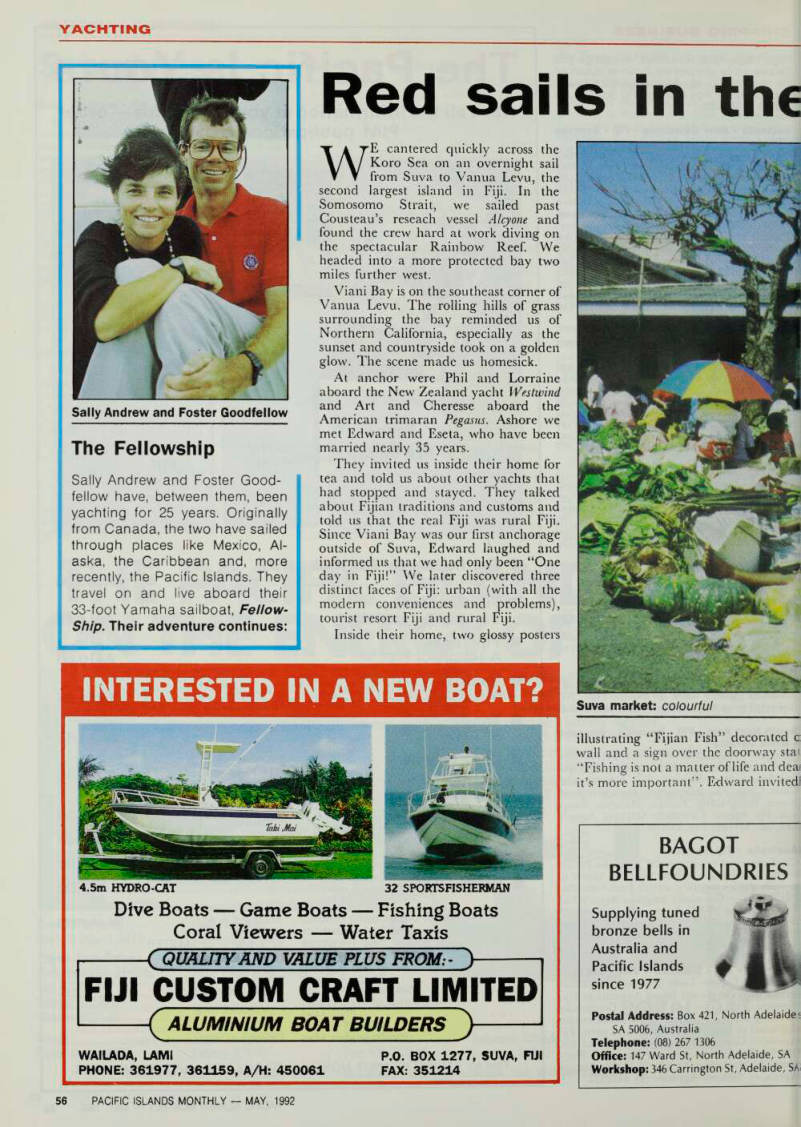
Sally Andrew and Foster Good fellow have, between them, been yachting for 25 years. Originally from Canada, the two have sailed through places like Mexico, Al aska, the Caribbean and, more recently, the Pacific Islands. They travel on and live aboard their 33-foot Yamaha sailboat, Fellow ship. Their adventure continues:
WE cantered quickly across the Koro Sea on an overnight sail from Suva to Vanua Levu, the second largest island in Fiji. In the Somosomo Strait, we sailed past Cousteau’s reseach vessel Alcyone and found the crew hard at work diving on the spectacular Rainbow Reef. We headed into a more protected bay two miles further west.
Viani Bay is on the southeast corner of Vanua Levu. The rolling hills of grass surrounding the bay reminded us of Northern California, especially as the sunset and countryside took on a golden glow. The scene made us homesick.
At anchor were Phil and Lorraine aboard the New Zealand yacht Westwind and Art and Cheresse aboard the American trimaran Pegasus. Ashore we met Edward and Eseta, who have been married nearly 35 years.
They invited us inside their home for tea and told us about other yachts that had stopped and stayed. They talked about Fijian traditions and customs and told us that the real Fiji was rural Fiji.
Since Viani Bay was our first anchorage outside of Suva, Edward laughed and informed us that we had only been “One day in Fiji!” We later discovered three distinct faces of Fiji: urban (with all the modern conveniences and problems), tourist resort Fiji and rural Fiji.
Inside their home, two glossy posters
illustrating “Fijian Fish” decorated c wall and a sign over the doorway stai “Fishing is not a matter of life and deal it’s more important”. Fxlward invitedl
Sally Andrew and Foster Goodfellow
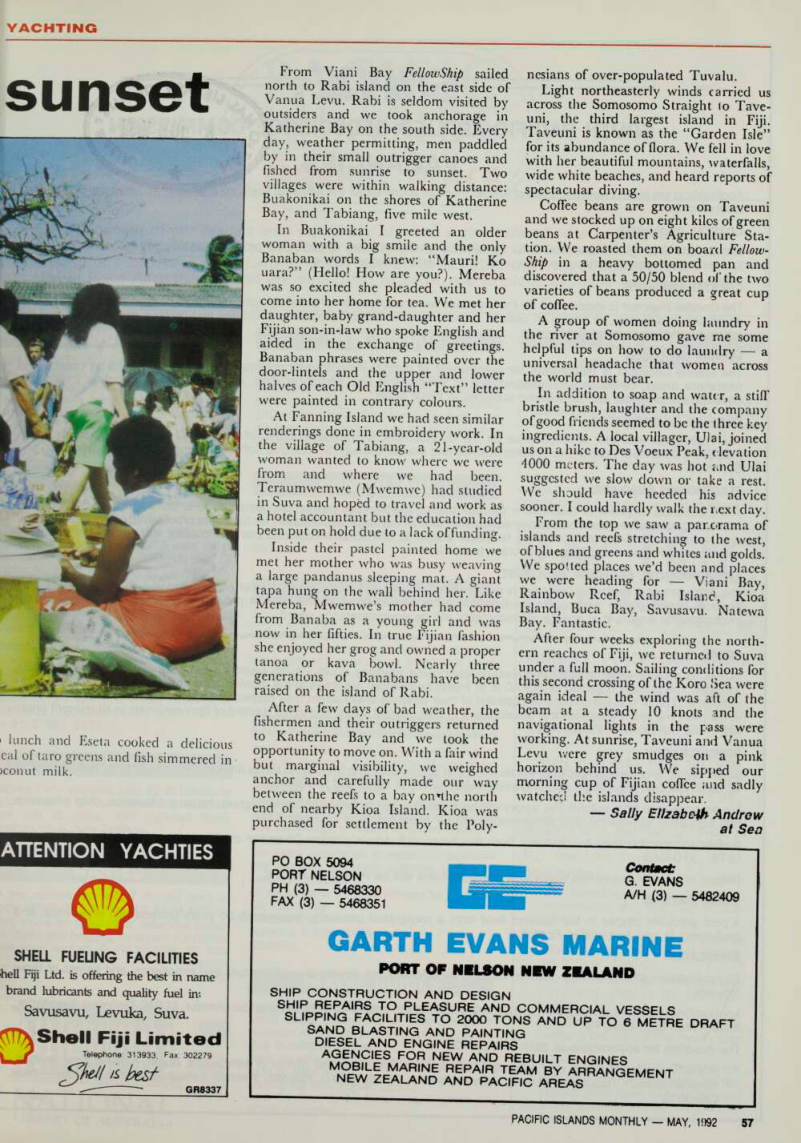
Suva market: colourful
* lunch and Eseta cooked a delicious cal of taro greens and fish simmered in >conut milk.
From Viani Bay Fellowship sailed north to Rabi island on the east side of Vanua Levu. Rabi is seldom visited by outsiders and we took anchorage in Katherine Bay on the south side. Every day, weather permitting, men paddled by in their small outrigger canoes and fished from sunrise to sunset. Two villages were within walking distance: Buakonikai on the shores of Katherine Bay, and Tabiang, five mile west.
In Buakonikai I greeted an older woman with a big smile and the only Banaban words I knew: “Mauri! Ko uara?” (Hello! How are you?). Mereba was so excited she pleaded with us to come into her home for tea. We met her daughter, baby grand-daughter and her Fijian son-in-law who spoke English and aided in the exchange of greetings.
Banaban phrases were painted over the door-lintels and the upper and lower halves of each Old English “Text” letter were painted in contrary colours.
At Fanning Island we had seen similar renderings done in embroidery work. In the village of Tabiang, a 21-year-old woman wanted to know where we were from and where we had been.
Teraumwemwe (Mwemwc) had studied in Suva and hoped to travel and work as a hotel accountant but the education had been put on hold due to a lack offending.
Inside their pastel painted home we met her mother who was busy weaving a large pandanus sleeping mat. A giant tapa hung on the wall behind her. Like Mereba, Mwemwe’s mother had come from Banaba as a young girl and was now in her fifties. In true Fijian fashion she enjoyed her grog and owned a proper tanoa or kava bowl. Nearly three generations of Banabans have been raised on the island of Rabi.
After a few days of bad weather, the fishermen and their outriggers returned to Katherine Bay and we took the opportunity to move on. With a fair wind but marginal visibility, we weighed anchor and carefully made our way between the reefs to a bay on*the north end of nearby Kioa Island. Kioa was purchased for settlement by the Poly
nesians of over-populated Tuvalu.
Light northeasterly winds carried us across the Somosomo Straight lo Tave uni, the third largest island in Fiji.
Taveuni is known as the “Garden Isle” for its abundance of flora. We fell in love with her beautiful mountains, waterfalls, wide white beaches, and heard reports of
spectacular diving.
Coffee beans are grown on Taveuni and we stocked up on eight kilos of green beans at Carpenter’s Agriculture Sta tion. We roasted them on board Fellow ship in a heavy bottomed pan and discovered that a 50/50 blend of the two varieties of beans produced a great cup of coffee.
A group of women doing laundry in the river at Somosomo gave me some helpful lips on how to do laundry a universal headache that women across the world must bear.
In addition to soap and water, a stiff' bristle brush, laughter and the company of good friends seemed to be the three key ingredients. A local villager, U)ai, joined us on a hike to Des Voeux Peak, elevation 4000 meters. The day was hot and Ulai suggested we slow down or take a rest.
We should have heeded his advice sooner. I could hardly walk the next clay.
From the top we saw a panorama of islands and reefs stretching to the west, of blues and greens and whites and golds.
We spotted places we’d been and places we were heading for Viani Bay, Rainbow Reef, Rabi Island, Kioa Island, Buca Bay, Savusavu. Natewa
Bay. Fantastic.
After four weeks exploring the north ern reaches of Fiji, we returned to Suva under a full moon. Sailing conditions for this second crossing of the Koro Sea were again ideal the wind was aft of the beam at a steady 10 knots and the navigational lights in the pass were working. At sunrise, Taveuni and Vanua Levu were grey smudges on a pink horizon behind us. We sipped our morning cup of Fijian coffee and sadly watched the islands disappear.
Sally Elizabeth Andrew at Sea