The return of
pp. 52-54 · Read in the full issue
Shipping Business
The return of the cargo cult
A MODE of travel, commonly sought after in years past and suffering from a contemporary decline in public awareness, is making a spirited comeback in interest and popu
larity.
The passenger carrying freighter or cargo boat continues to ply the worlds’ oceans offering travellers a sense of
unhurried tranquility, nostalgia, ro
mance and a very special travel experi ence.
The passenger freighter provides care
free days in a restful environment, where passengers make time their servant rather than their master.
The delightful setting of sea and sky is interrupted only by occasional fascinat ing port calls (at times to out-of-the-way exotic locations) for considerably longer durations than those offered by commer cial passenger liners.
One service growing in popularity with Australians is cruising on the Arnui 11, a copra freighter, which sails from Tahiti each three weeks around the
Marquesas Islands. The Aranui ll service, which enables an irresistible “discovery” of Tahiti, the Tuamotu and Marquesas Islands some of the most remote and beautiful spots in the world (where life has scarcely changed since Captain in Cook sailed by in 1769) is reminiscent of the Somerset Maugham era, when travel was to be savoured and enjoyed moment by moment and destination were often incidental to or an unintended part of the journey.
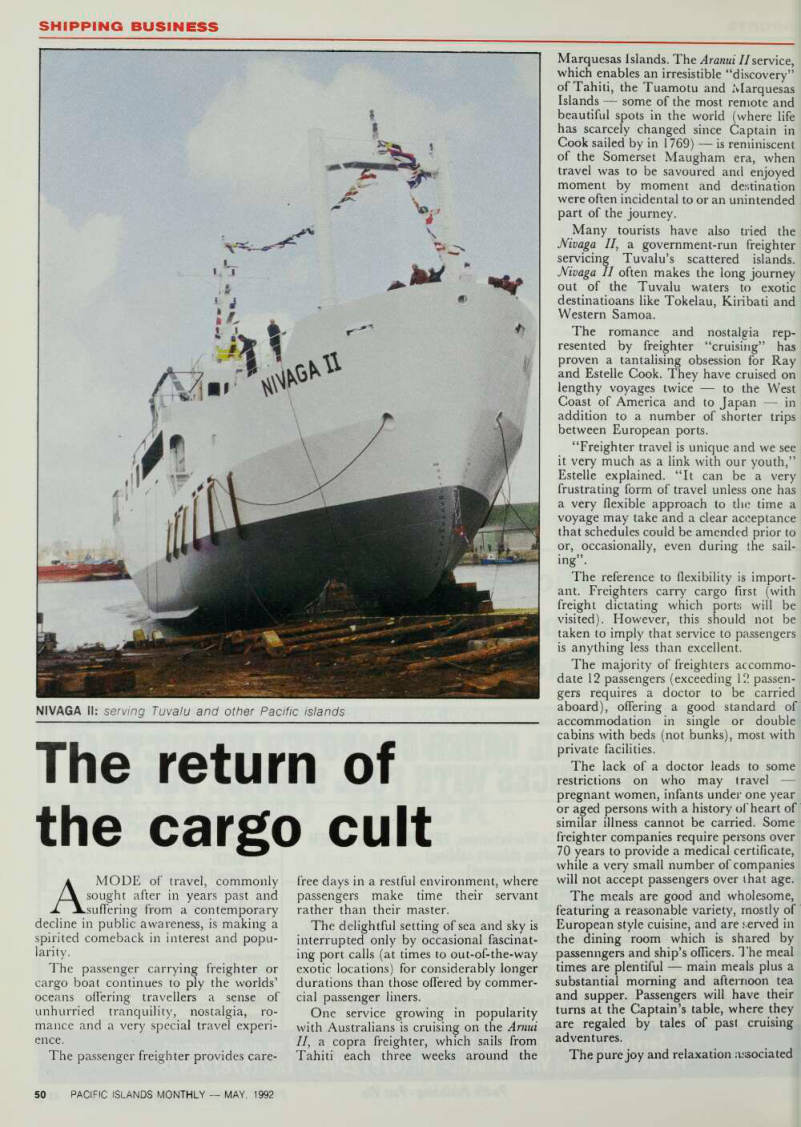
Many tourists have also tried the Nivaga 11, a government-run freighter servicing Tuvalu’s scattered islands.
Nivaga II often makes the long journey out of the Tuvalu waters to exotic destinatioans like Tokelau, Kiribati and Western Samoa.
The romance and nostalgia rep resented by freighter “cruising” has proven a tantalising obsession for Ray and Estelle Cook. They have cruised on lengthy voyages twice to the West Coast of America and to Japan in addition to a number of shorter trips between European ports.
“Freighter travel is unique and we see it very much as a link with our youth,”
Estelle explained. “It can be a very frustrating form of travel unless one has a very flexible approach to the time a voyage may take and a clear acceptance that schedules could be amended prior to or, occasionally, even during the sail ing”.
The reference to flexibility is import ant. Freighters carry cargo first (with freight dictating which ports will be visited). However, this should not be taken to imply that service to passengers is anything less than excellent.
The majority of freighters accommo date 12 passengers (exceeding 12 passen gers requires a doctor to be carried aboard), offering a good standard of accommodation in single or double cabins with beds (not bunks), most with
private facilities.
The lack of a doctor leads to some restrictions on who may (ravel pregnant women, infants under one year or aged persons with a history of heart of similar illness cannot be carried. Some freighter companies require persons over 70 years to provide a medical certificate, while a very small number of companies will not accept passengers over (hat age.
The meals are good and wholesome, featuring a reasonable variety, mostly of European style cuisine, and are served in the dining room which is shared by passenngers and ship’s officers. T he meal times are plentiful main meals plus a substantial morning and afternoon tea and supper. Passengers will have their turns at the Captain’s table, where they are regaled by tales of past cruising adventures.
The pure joy and relaxation a.-sociated
NIVAGA II: serving Tuvalu and other Pacific islands
with cargo boats, shared with only a handful of fellow passengers, is the most common reason this form of travel is actively sought after resulting in most services being booked out many months ahead.
Freighters must not be confused with commercial cruise liners nor with smaller, ill-equipped tramp steamers (where passengers are neither planned for nor legally permitted to board in some cases).
The most asked question is where freighters operate. The answer is virtu ally everywhere to major ports in the northern hemisphere and some Eur opean major cities have daily or thrice weekly sailings.
The freighter offers a number of activities to those passengers not wishing to snooze on a deckchair all day. On most freighters you will find a swimming pool and a games room the latter likely to feature darts and table tennis and, for :he more physical (or those wishing to ceep the effects of the meals schedule at aay) a painted line around the deck narks a course which can be walked or ogged, depending upon the arrange nents negotiated with crew and other >assengers.
A few freighters offer a sauna and a nodest gymnasium, while all possess an xtensively stocked library, a video
facility with a good choice of titles and several board games. Some of the crew are as adept at chess as they are at pretending to be more novices and will eagerly seek the chance to master unsuspecting passengers.
Cabin service is available only on a limited number of lines (Columbus Line to USA for example), but most do not service cabins and passengers are ex pected to keep their own cabins tidy.
Towels and linen are provided and changed weekly passengers have their own laundry (or may be shared with
ships’ officers) equipped with washing
machines, dryers and a drying room.
The ships are air-conditioned and the
cabins have adequate bedding.
There is an onboard “canteen” open during certain hours of the day where passengers may purchase items such as toiletries, beverages, liquor and ciga rettes and sundry items. The choice of brands is mostly quite limited, however.
A list of port call addresses will be provided and mail can be directed ahead to await your arrival. Urgent messages can be sent and received on the ship radio or telex.
Another freighter “convert” is Marj Perkins who began travelling by freighter following the death of her husband in 1977.
“I read that Australian actor Leo
McKern preferred travelling by cargo boats whenever possible and began to seek out information”, Marj recalls.
“Very few travel agents have the facts on freighter travel, largely because modern travellers want fixed schedules and are pedantic about departing and arriving to a planned schedule.” Marj says the level of accommodation and meals “is mostly as good as large cruise ships” and notes that fares are usually similar to or less than the cruise vessels.
“I am grateful for the chance to stay in port for two or three days as this enables passengers to get ashore and meet the people. Also, I have the choice of being accommodated aboard ship or, if I prefer, may stay with a family or in a hotel onshore,” Marj explains.
Marj has had occasional access to the bridge and radio room on some voyages.
Like many other dedicated freighter travellers, Marj decries large cruise ships.
“I understand many people enjoy cruise liners, but to me the liner is like a floating city and I may as well stay in Sydney,” she says, pointing out that she has formed quality relationships with passengers on freighters. “I believe the freighter reintroduces the ‘lost art’ of conversation ... I have sat for hours on deck just talking and laughing with other Dassengers. Freighters offer the chance to dc as active or as luxuriously lazy as one
likes.” Although some freighters
amend their schedules from time to time, many services operate to a published schedule and have little or no alterations which might inconvenience passengers. Marj Perkins says the rules are simple: “Never attempt an itinerary which demands you reach a certain port by a particular date. If prospective passengers accept the next travel leg may have to be by air, they are less likely to be disappointed,” she advises.
The heavy incidence of freighter services in the northern hemisphere in Europe, Canada and the United States and limited services from Australia can mean Australian passengers may have to fly to another country to commence their sea journey.
A few services from Australia sail from Melbourrne, Sydney or Brisbane, mostly to USA (east and west coasts)
Europe (Spain, Germany, Poland or
UK) and Japan, while Fremantle is a departure point for a service to Europe.
Passage is usually sold on the basis of a through journey and shorter sectors will only be available where cabin space is not booked for the entire sailing a most unusual event.
In order to protect coastal shipping
in most countries (not that Australia has much coastal passenger shipping),
international shipping regulations de
mand passengers to board ship at the last Australian port of call prior to departure and get off at the first port of call in the destination country.
A useful example in a service to US which may travel Melbourne, Sydney, Brisbane and call in Los Angeles, New Orleans and New York passengers would be required to board in Brisbane and get off at Los Angeles.
Many Australian travellers deter mined to travel by freighter subscribe to the Freighter Cruises newsletter
(stamped addressed envelope to Syd
ney International Travel Centre, 75
King Street, Sydney for details).
Fred Oertli, from Sydney Interna tional Travel Centre, has developed an excellent knowledge of freighters over many years and his travel company is one of the new agents specialising in this form of travel.
“We receive enquiries from all over Australia and can assist with bookings on services departing from Australia and also for many other services in many parts of the world,” Oertli says.
His agency is the booking agent for a number of lines, including the popular
USA registered Columbus Line.
Two areas difficult to reach from Australia are southern Africa and South America, although both are easily reached from Europe or North America.
All passengers must carry passports with necessary visas. A number of regular freighter passengers opt to carry their own first aid kit (although the freighter will have a well stocked First Aid supply) to meet non-serious illness needs.
Travel insurance is important and each passenger should seek reliable advice in selecting a policy which will meet the costs of serious illness and hospitalisation in diverse locations from Lagos to Los Angeles.
The majority of freighter lines offer 160 kilos of baggage per person with excess baggage carried at normal cargo rates. Passengers can take their own converters for electric current, but most freighters will have universal plugs for shavers, hair dryers and similar appliances. Money matters will usually vary depending on the nationality of the ship concerned, although US dollars in addition to the currency of the freighter line can be
negotiated successfully. Personal
cheques and credit cards are of no use on board.
American travel agent Fred Tyarcs is a freighter fanatic and reported in a freighter newsletter ...
“The cruise is the reward. I stand on deck and watch millions of fish dart past the ship, stand fascinated by the rail as a school of porpoises leap out of the water and watch a flying fish skimming across the surface of the water. When the ocean isn’t providing wonder and entertainment one can turn to the immense birdlife, watching
and identifying occasional passing
ships or resting up for the next port of call”.
The range of people interested in this form of travel is extremely diverse.
Professionals, factory workers and re tirees feature among passenger lists.
Tony Wheeler, noted traveller and publisher of the successful Lonely Planet travel guides has travelled on freighters out off Singapore and in Indonesia and
Philippine waters.
Days aboard freighters are marked by a timeless relaxation which “draw a special group of travellers together intent on enjoying and savouring the cruise. It is a mild bonus indeed if you should find yourself lazing in a deckchair listening to the mumbling tones of Rumpole of the Bailey.