Racing against Sevens time
pp. 48-49 · Read in the full issue
By Samisoni Kakaivalu
from the present standards; • included within the capacity will be 50 private fully air conditioned boxes each with 24 seats and each with its own catering facilities; • food and beverage sales outlets will be provided at an appropriate scale on each leevel of seating. There will be about 135 outlets altogether of which some can also be used as retail outlets for souvenir and the like; • there will be 81 washrooms provid ing ample toilet facilities; • floodlighting will be provided to an internationally accepted standard; • proper commentary/television facili ties for internal use and for outside broadcasts will be included, as well as electronic scoreboard; • there will be a high grade public address system; • police control rooms and security rooms will be provided together with much improved medical faacilities; • improved changing rooms and ameni ties will be provided for players; • appropriate access and viewing ar rangements will be provided for handi capped persons; • a small lecture theatre and meeting rooms will be included as well as stadium administration offices; • there will be a public restaurant/cafe with a seating capacity of about 300; • there will be provision for 5000 square feet of office for the Hong Kong Sports
Development Board and 30,000 square feet for the National Sports Associations; • stage, sound and lighting facilities fori pop/rock concerts will be included, together with a Diamond Vision screen, Jockey Club property controller Keith Hernon said the race would be on to re develop the stadium in time for the 1992 Sevens next March.
“But it will be unfitted - the sponsors', box will not be pampered or have air conditioning - that will have to wait until the end of the second year,” he said, He said the the aim of would be an increase in both capacity and comfort during each year of the construction period. The Hong Kong Rugby FootballJ Union, organiser of the Sevens, has welcomed the construction of the new stadium.
Said HKRFU chairman Don Watsons “A bigger and more modern stadium wiliJ greatly enhance Hong Kong’s chances ot< hosting the 1997 World Cup of Sevens.; “I would like to thank the Royal; Hongkong Jockey Club for their gener osity and re-assure Sevens spectators that the tournament will go ahead as normal; during the construction period of the newA stadium.”
The Jockey Club is gifting the newA sports facility to the people of Hong Kong to mark 20 years of professional! racing.
“It will be a stadium Hong Kong cam be proud of,” a spokesman added. Q.
WORK on a multi-million dollar stadium to become the new home of the Sevens has begun So Kon Po.
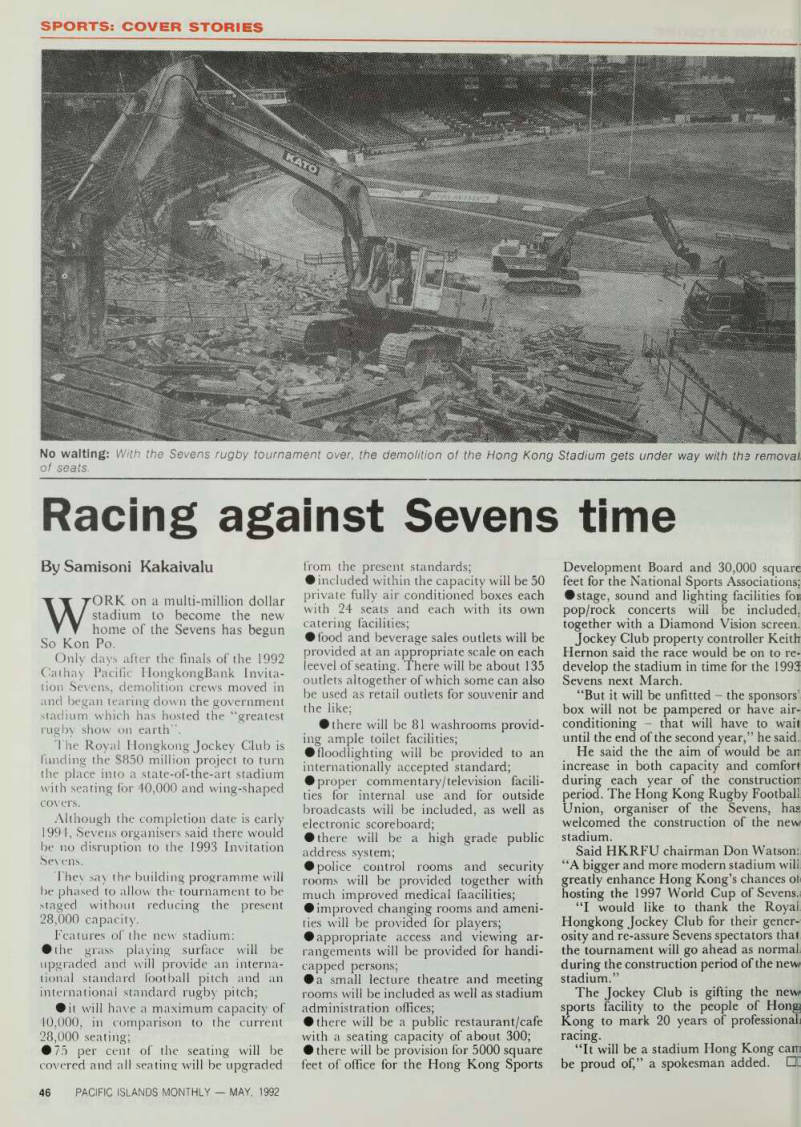
Only days after the finals of the 1992 Cathay Pacific Hongkongßank Invita tion Sevens, demolition crews moved in and began tearing down the government stadium which has hosted the “greatest rugby show on earth ".
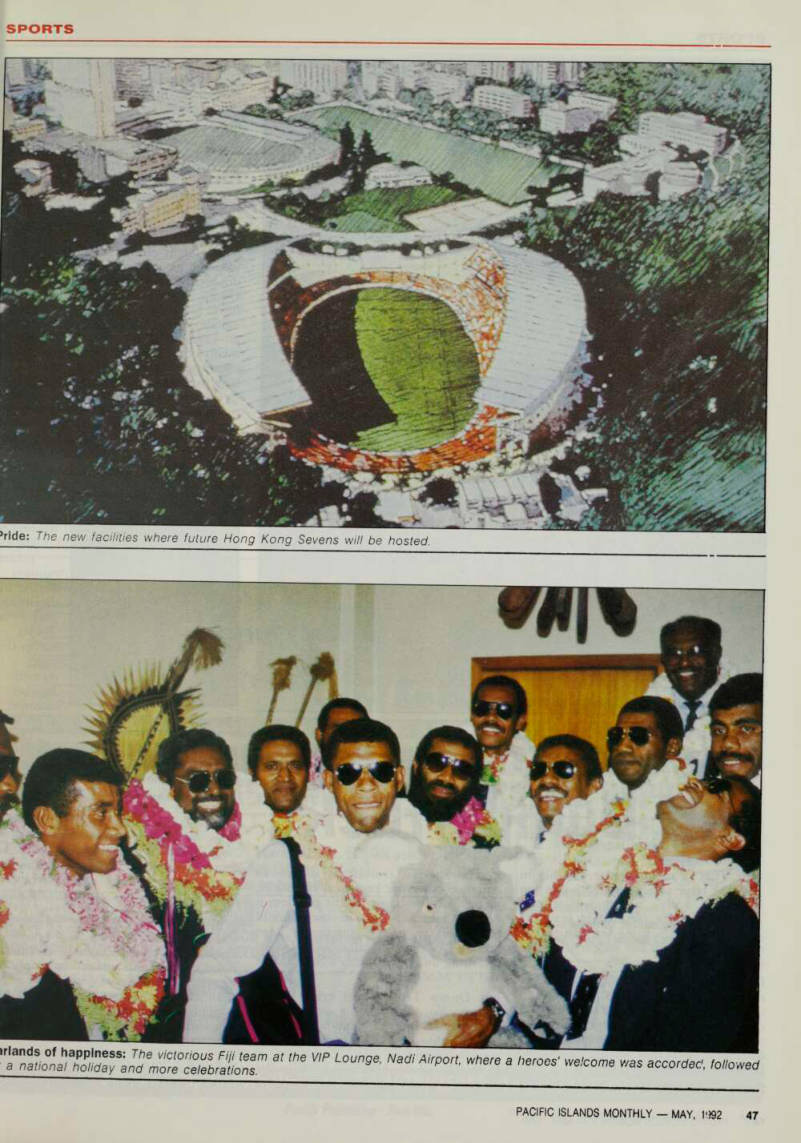
The Royal Hongkong Jockey Club is funding the SB5O million project to turn the place into a state-of-the-art stadium with seating for 40,000 and wing-shaped covers.
Although the completion date is early 1994, Sevens organisers said there would be no disruption to the 1993 Invitation Sevens.
They say the building programme will be phased to allow the tournament to be staged without reducing the present 28,000 capacity.
Features of the new stadium: • the grass playing surface will be upgraded and will provide an interna tional standard football pitch and an international standard rugby pitch; • it will have a maximum capacity of 40,000, in comparison to the current 28,000 seating; • 75 per cent of the seating will be covered and all seating will be upgraded
No waiting: With the Sevens rugby tournament over, the demolition of the Hong Kong Stadium gets under way with the remova of seats.
[?] ride: The new facilities where future Hong Kong Sevens will be hosted.
[?]rlands of happiness: The victorious Fiji team at the VIP Lounge, Nadi Airport, where a heroes' welcome was accorded, followed a national holiday and more celebrations.