hopping
p. 29 · Read in the full issue
Quiet bird suited to island hopping
By Martin Tiffany
IN today’s fast-paced world, fast food is a fact of life, but fast drinks are something new.
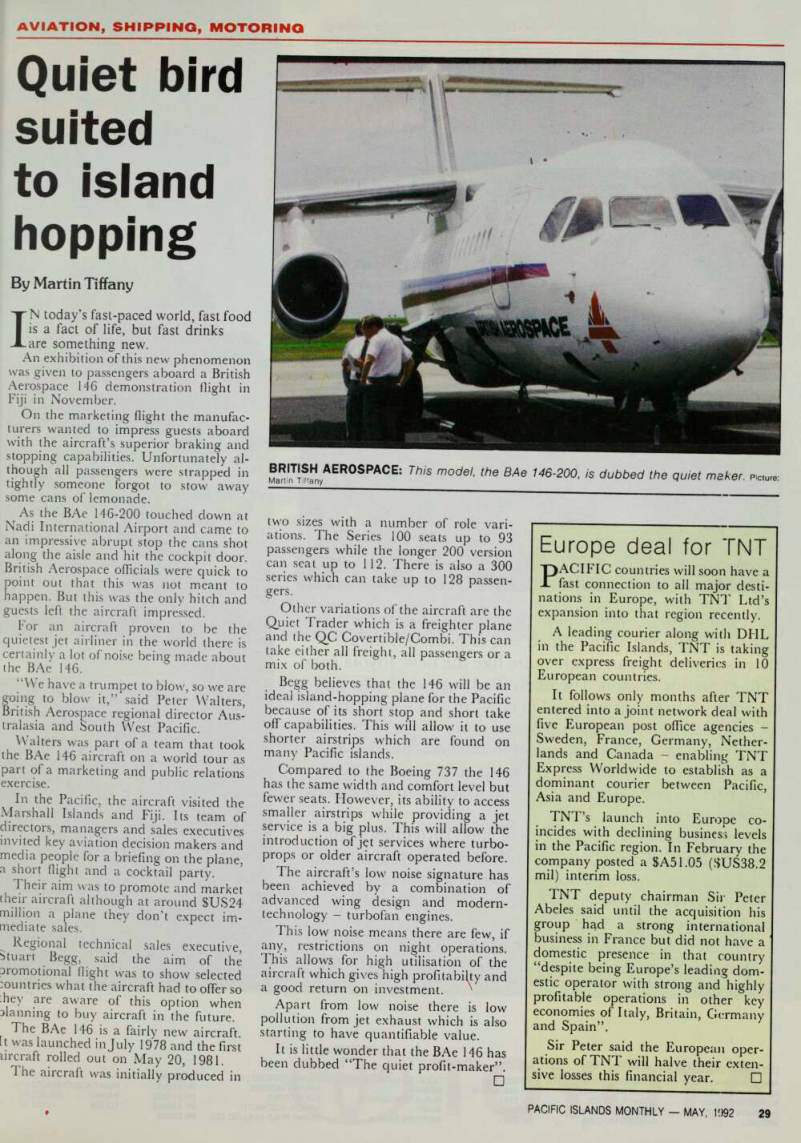
An exhibition of this new phenomenon was given to passengers aboard a British Aerospace 146 demonstration flight in Fiji in November.
On the marketing flight the manufac turers wanted to impress guests aboard with the aircraft’s superior braking and stopping capabilities. Unfortunately al though all passengers were strapped in tightly someone forgot to stow away some cans of lemonade.
As the BAe 146-200 touched down at Nadi International Airport and came to an impressive abrupt stop the cans shot along the aisle and hit the cockpit door.
British Aerospace officials were quick to point out that this was not meant to happen. But this was the only hitch and guests left the aircraft impressed.
For an aircraft proven to be the quietest jet airliner in the world there is certainly a lot of noise being made about the BAe 146.
“We have a trumpet to blow, so we are going to blow it,” said Peter Walters, British Aerospace regional director Aus tralasia and South West Pacific.
Walters was part of a team that took the BAe 146 aircraft on a world tour as part of a marketing and public relations exercise.
In the Pacific, the aircraft visited the Marshall Islands and Fiji. Its team of directors, managers and sales executives invited key aviation decision makers and media people for a briefing on the plane, a short flight and a cocktail party.
Their aim was to promote and market their aircraft although at around SUS 24 million a plane they don’t expect im mediate sales.
Regional technical sales executive, Stuart Begg, said the aim of the promotional flight was to show selected :ountries what the aircraft had to offer so :hey are aware of this option when Manning to buy aircraft in the future.
The BAe 146 is a fairly new aircraft, it was launched in July 1978 and the first urcraft rolled out on May 20, 1981.
The aircraft was initially produced in
two sizes with a number of role vari ations. The Series 100 seats up to 93 passengers while the longer 200 version can seat up to 112. There is also a 300 series which can take up to 128 passen gers.
Other variations of the aircraft are the Quiet Trader which is a freighter plane and the QC Covertible/Combi. This can take either all freight, all passengers or a mix of both.
Begg believes that the 146 will be an ideal island-hopping plane for the Pacific because of its short stop and short take off capabilities. This will allow it to use shorter airstrips which are found on many Pacific islands.
Compared to the Boeing 737 the 146 has the same width and comfort level but fewer seats. However, its ability to access smaller airstrips while providing a jet service is a big plus. This will allow the introduction of jet services where turbo props or older aircraft operated before.
The aircraft’s low noise signature has been achieved by a combination of advanced wing design and modern technology - turbofan engines.
This low noise means there are few, if any, restrictions on night operations.
This allows for high utilisation of the aircraft which gives high profitabilty and a good return on investment. ' Apart from low noise there is low pollution from jet exhaust which is also starting to have quantifiable value.
It is little wonder that the BAe 146 has been dubbed “The quiet profit-maker”. □
BRITISH AEROSPACE: This model. the BAe 146 - 200. is dubbed the quiet maker. Picture: Martin Tiffany