Airlines winging
p. 25 · Read in the full issue
into better times
AS the dark cloud f slowly begin to lift of the Pacific’s key tourism markets, the major tourist carriers to the islands should soon begin to see
the light.
According to a recent independent Asia/ Pacific airline survey, major carriers in Asia and the Pacific can look forward to a prosperous 1992. i.l,* a ■ r c In the latest Asian Investment Strategy eview, a researc report by Singapore soc ro er ern ynch and Company, says regional airlines can expect to improve on last year’s results. The report said worldwide economic problems and the Gulf War had held down passenger traffic but a rebound was expected this year. x It predicted that trans-Padfic traffic ■vould grow at 10-15 per cent in 1992 :ompared with 5-10 per cent last vear. This i nrrre „ as . t, c
nnr?<t Li Tint l l?
jJ C S 7 ° . 01 ", jpenca, str f' la and New Zealand which are slowly ommg out of the gnps of recession.
Recent business surveys in New Zealand, or example, have shown that business :onfidence, investment intentions and ex- >ort markets are all on the way up and the ountry is optimistic about its economy. likewise Australia is showing similar signs •f promise.
Australia’s trade performance over the 'ast 12 months has shown a dramatic urnaround, according to the treasurer, °hn Dawkins.
He said the 26 per cent fall in the current m f, SA67 S r°n a ' ly adjUSted H ,: n t HA677 rnilhon contmued the ownward trend evident in recent months.
The current account deficit was now runnlng at 34 per cent below the levels of a year ago ' According to the report, growth is also expected from Asia and Europe, two markets which are becoming increasingly important for the Pacific.
T f , Japan, lor example, has been the saviour of Fiji s national earner Air Pacific and the country s tounsm sector, making up for the shortfall from traditional markets. p already flies two services to T , .7 a *reaay mes two services to J a P an s anta Airport and the airline’s chairman > Gerald Barrack, recently reiterated that lf they could S et a third slot at Nanta they would not hesitate to take it.
Tu pre l o[ , 1 r . . J- “ , ' l,e( n a stf P s in the ngh s. dlr J ect,on to take advantage of the predlcted nse ln tourlst numbers. a i . , , n . , , M weeldy fll g ht b Y rj CW Zea and > lts Poem § 7b7 > to Honolulu from Auckland via Tonga and Western Samoa has opened up the Eur- PP ean market and allows Europeans to nc^ude Tonga and Samoa on their around tbe wor^d tickets.
Western Samoa’s Polynesian Airlines last month replaced its Boeing 727 aircraft with a Boeing 737-300 to enable the airline to make more frequent flights.
And in January a memorandum of understanding was signed between the Kiribati and Nauru governments allowing Air Nauru to bridge Kiribati with Monolulu a " d Suva ™, e ag ™‘ a >l<™ Air Nauru t 0 USe the landing rights held by Kiribati’s national carrier, Air Tungaru. The Kiri-
bati Goverment, have for years, tried to make Air Tungaru viable on these interna tional routes but it ended up costing them a fortune.
Kiribati’s Minister for Transport, Inatoa Tabania, is confident this new arrangement will make the route viable.
In another move, Air Pacific, Qantas and Air New Zealand are reported to have been discussing operating a mega-carrier in the Southwest Pacific.
Although the three airlines are tight lipped about the proposal, it is understood that it will be similar to a proposal to merge British Airways, Northwest and KLM and formalise seat sharing arrangements.
However, the Fiji Hotel Association is worried that this would be disastrous to tourism viability in the long term. It believes it would result in the elimination of competition between the carriers and a subsequent rise in airfares.
Meanwhile, Air Pacific, in response to the “rapidly evolving competitive environ ment in the South West Pacific” and the “changing marketplace”, will replace its two ATR-42 aircraft with a brand new, high technology, Boeing 737-500 series aircraft in August.
The airline said the 8737-500 was chosen as it is not only capable of operating to all current regional ports and supporting their 8747 and 8767 on the international routes, but was the ideal aircraft to pioneer new services to cities such as Cairns, Wellington and Christchurch. Air Pacific also plans to use the aircraft to re-introduce a Suva- Auckland service later this year.
The airline is also keeping a close eye on Australia and New Zealand and. are looking at the option of leasing another 737-500 aircraft should the two countries recover from recession which should stimu late a demand for services.
So while Royal Tongan Airlines’ cancel lation of their recently-started Nuku’alofa- Nadi service has left a hole in Pacific aviation overall, regional carriers look set for a sunny future if they keep a close eye on global trends and act accordingly. □
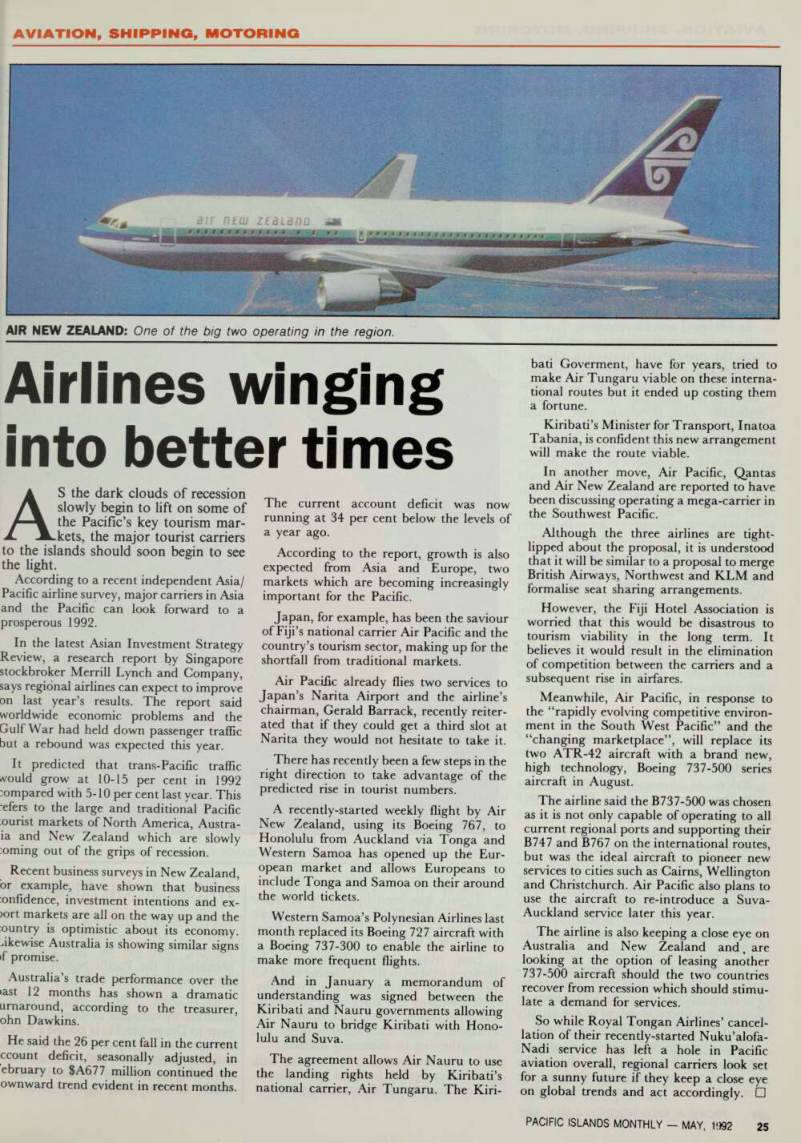
AIR NEW ZEALAND: One of the big two operating in the region.