More trouble looms for Samoa
p. 18 · Read in the full issue
By Ulafala Aiavao
THE good news for Western Samoa is that it recorded its first ever negative inflation rate last year. eipPriccs were down 1.3 per cent over the previous 12 month period.
The Central Bank of Samoa said in its latest quarterly report (October- Dccember 1991) released last month that the negative inflation was due to monet ary policy and improved supplies of local
produce.
In December, however, prices rose as local foodstuffs were devastated by Cyc lone Val.
The bad news is that almost all other economic markers worsened last year, partly because of Cyclone Ofa damage in
February 1990.
Imports last year of WS$232 million (US$95 million) were 25 per cent up on the previous year, and the highest import level so far.
Half the imports by value were for intermediate goods, while there were also substantial import items for road con struction and a major hydro-electric
project underway.
One quarter of total imports were for consumption goods, said the CBS report.
By contrast, the declining level of exports had dropped to just WS$lB million (US$7.3 million) last year. In
short, imports were more than 12 limes the value of exports.
Damage by Cyclone Ofa in February 1990 to cocoa and coconut plantations meant that exports of copra oil and cocoa were negligible last year.
Eighty one per cent of total export came from just three products - taro WS$6.9 million (US$2.B m), coconut cream US$2.l million and automotive harnesses US$l.l million Exports of automotive harnesses began last August from a branch of the Japanese firm Yazaki which, by year’s end, already accounted for 15 per cent of Western Samoa’s exports by value.
That percentage will increase as Yazaki operations are largely unaffected by the more recent devastation from Cyclone Val last December.
Also, Yazaki is expanding into a US$2.2 factory now under construction that will be leased from the Western Samoan government.
However, damage from the latest cyclone is so severe it will be 12 months before the local copra mill or coconut cream processors can count on a recovery in local coconut supplies.
Taro exports were banned soon after Cyclone Val (except to nearby American Samoa). This kept stocks on the local market and prices fairly stable in the wake of temporary food shortages, but
will have a negative effect on taro export earnings.
Private remittances from overseas, which usually equal about half the government budget, dropped 19 per cent last year to US$3O million.
One reason for the high fall was that 1990 remittances were boosted by sym
pathy payments following Cyclone Ofa
earlier that year.
Another reason is continued economic recession in the major tourism source countries of New Zealand, Australia and the United States.
The 1991 remittances figure is one of the lowest in five years, matching only the 1980 inflow. Western Samoa’s bal ance of payments in 1991 had an overall surplus of US$l.2 million, compared with US$l5.5 million a year earlier.
The Central Bank of Samoa said the current account deficit of US$4O.5 mil lion was the highest so far, and only substantial inflows on the capital account of US$4l.B million allowed a small surplus in the balance of payments.
Gross reserves at the end of December were about US$6B million, enough for seven months of imports of goods and services. This coverage was 20 per cent less than the same month a year earlier. □
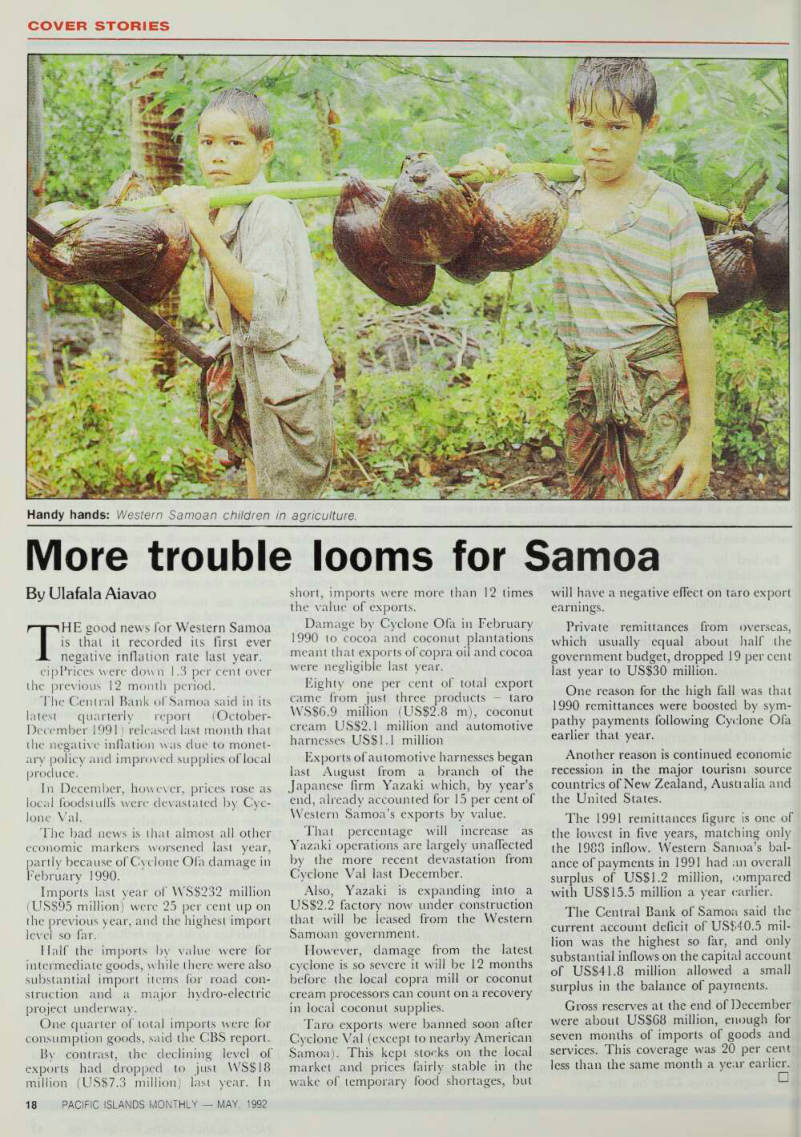
Handy hands: Western Samoan children in agriculture.