Ancient seafaring skills revived
pp. 74-75 · Read in the full issue

Arts
By Angela McCarthy
THE challenge went out from Rarotonga a year ago: show the world Polynesia’s ancient sea faring skills are not forgotten; build a replica of a vaka (traditional sea voyaging canoe) and sail it to Rarotonga for the October 1992 Festival of Arts.
The outer Cook Islanders of Atiu, Mitiaro, Mauke, Mangaia and Aitutaki have taken up the challenge with zeal.
They have finished their double-hulled vaka and have been studying the tra ditional navigation techniques they will need to travel the 260 odd kilometres from their islands to Rarotonga.
Sea-voyaging vaka have been obsolete on these tiny islands for many gener ations so the islanders have had to rely on a hotchpotch of information to create the canoes. They have used oral histories, books and photographs, the recollection of the elderly, and improvisation by
today’s fishing outrigger builders.
The vaka projects all began with tree felling ceremonies. The Gods were asked to bless the trees to give them protection and ensure that they would not crack
when falling or split during construction, and would sail well. The participants say that a lot of the present ceremonies have been improvised because details of old tree-felling ceremonies are no longer fully known. Today, too, the Christian influ ence has meant most blessings had to be asked of the Christian god rather than the pre-missionary deities.
After the prayers and chants, the trees were felled by chainsaws and then stripped of branches, and pulled along log rollers out of the swamp or coral to a roadside where trucks could take them to their carving place. Throughout the whole procedure, chants of encourage ment were sung, usually accompanied by
impromptu dance.
Each felling was followed by a feast prepared by the women. In Atiu and Mitiaro the women were not allowed to watch the felling but, while preparing the food, they danced and chanted their support for the men.
In Mitiaro, some members of a family which owned the biggest mango tree on the island were in disagreement over whether it should be felled because of its age and fruitfulness. The story told is that
the tree refused to fall because permissioi had not been given properly. A member of the family had to say a special praye? over the tree before it would come down The same tree’s timber later gave off sucl bad vibes to the older carvers that the T refused to start carving until the family 5 ' blessing was unanimously given. I eventually was!
The original vaka were enormouj double-hulled craft that carried hum dreds of people, livestock and plants tho width and breadth of the Pacific. Th« islands haven’t attempted to reproduce vaka of that size they no longer have the right-sized timber or the time to do so. However they have put a strong emphasis on making the vaka as tra ditionally as possible. It has not been easy!
The island councils and tuagas (canoe makers) succumbed to chainsaws do nated by the Cultural Development Department for the tree fellings, and tc modern chisels and axes, but the ma terials and method of construction used have been traditional.
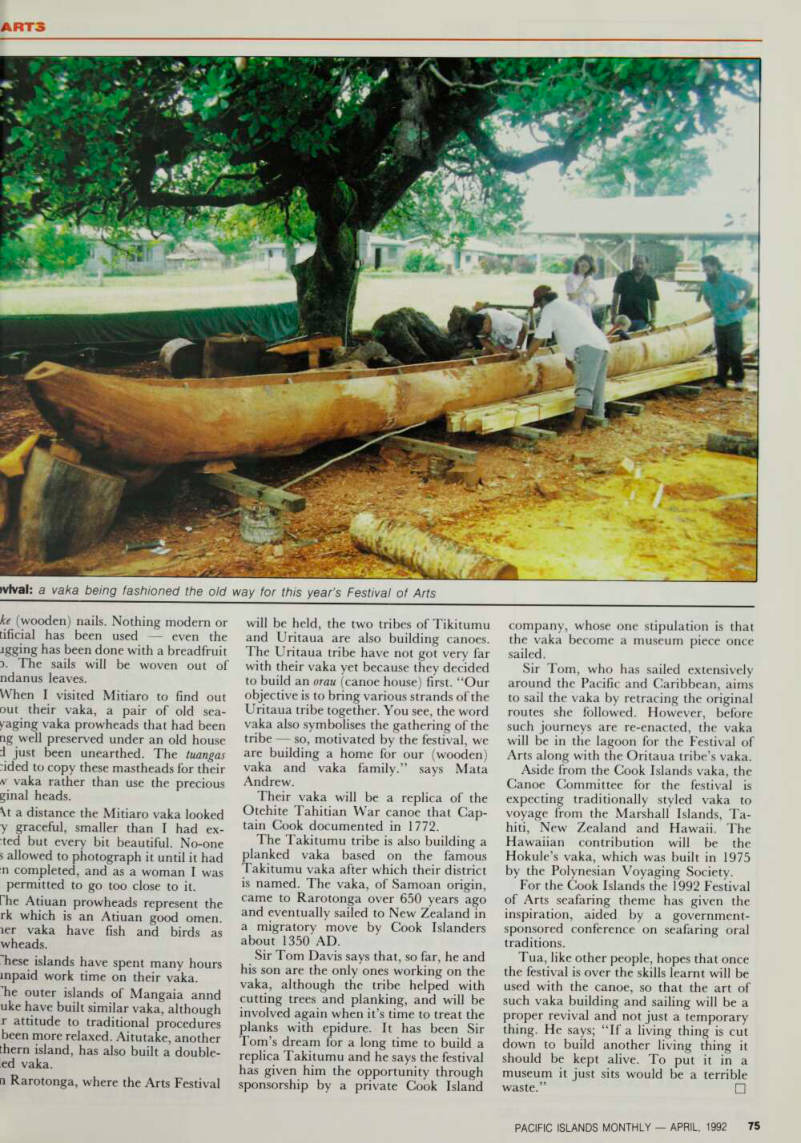
In Mitiaro, four mango trees were used to make the hulls one of which is 27 foot and one slightly less. The vaka, which is waist height and very rounded, is joined by sennit (coconut husk) and
ke (wooden) nails. Nothing modern or
tificial has been used even the igging has been done with a breadfruit d. The sails will be woven out of ndanus leaves.
When I visited Mitiaro to find out out their vaka, a pair of old sea gaging vaka prowheads that had been ng well preserved under an old house d just been unearthed. The tuangas :ided to copy these mastheads for their v vaka rather than use the precious
ginal heads.
\t a distance the Mitiaro vaka looked y graceful, smaller than I had ex :ted but every bit beautiful. No-one s allowed to photograph it until it had n completed, and as a woman I was permitted to go too close to it. fhe Atiuan prowheads represent the rk which is an Atiuan good omen, ler vaka have fish and birds as wheads.
Tese islands have spent many hours mpaid work time on their vaka. lie outer islands of Mangaia annd uke have built similar vaka, although r attitude to traditional procedures been more relaxed. Aitutake, another them island, has also built a doubl ed vaka. n Rarotonga, where the Arts Festival
will be held, the two tribes of Tikitumu and Uritaua are also building canoes.
The Uritaua tribe have not got very far with their vaka yet because they decided to build an orau (canoe house) first, “Our objective is to bring various strands of the Uritaua tribe together. You see, the word vaka also symbolises the gathering of the tribe so, motivated by the festival, we are building a home for our (wooden) vaka and vaka family.” says Mata Andrew.
Their vaka will be a replica of the Otehite Tahitian War canoe that Cap tain Cook documented in 1772.
The Takitumu tribe is also building a planked vaka based on the famous Takitumu vaka after which their district is named. The vaka, of Samoan origin, came to Rarotonga over 650 years ago and eventually sailed to New Zealand in a migratory move by Cook Islanders about 1350 AD.
Sir Tom Davis says that, so far, he and his son are the only ones working on the vaka, although the tribe helped with cutting trees and planking, and will be involved again when it’s time to treat the planks with epidure. It has been Sir Tom’s dream for a long time to build a replica Takitumu and he says the festival has given him the opportunity through sponsorship by a private Cook Island
company, whose one stipulation is that the vaka become a museum piece once sailed.
Sir Tom, who has sailed extensively around the Pacific and Caribbean, aims to sail the vaka by retracing the original routes she followed. However, before such journeys are re-enacted, the vaka will be in the lagoon for the Festival of Arts along with the Oritaua tribe’s vaka.
Aside from the Cook Islands vaka, the Canoe Committee for the festival is expecting traditionally styled vaka to voyage from the Marshall Islands, Ta hiti, New Zealand and Hawaii. The Hawaiian contribution will be the Hokule’s vaka, which was built in 1975 by the Polynesian Voyaging Society.
For the Cook Islands the 1992 Festival of Arts seafaring theme has given the inspiration, aided by a government sponsored conference on seafaring oral traditions.
Tua, like other people, hopes that once the festival is over the skills learnt will be used with the canoe, so that the art of such vaka building and sailing will be a proper revival and not just a temporary thing. He says; “If a living thing is cut down to build another living thing it should be kept alive. To put it in a museum it just sits would be a terrible waste.” □
[?]ival: a vaka being fashioned the old way for this year’s Festival of Arts