Fiji ...
pp. 48-50 · Read in the full issue


SOME authorities on Fiji say there are 320 islands in the Fiji archipelago (18,376 sq. km), but others say this figure does not include the many islets, some of them in rivers.
One list contains almost 1000 names, and a more accurate figure of islands may be 800.
Fiji gained Independence from Britain on October 10,1970, but became a republic on October 7,1987, following a military coup.
The indigenous Fijians are racially classed
as Melanesians but they have a considerable admixture of Polynesian blood. At the time the first Europeans arrived in Fiji, this Polynesian influence was greater in the Lau Islands (nearest to Tonga) and on the windward sides of the largest islands, while people in the interiors of the large islands were more purely Melanesian.
Just less than half the population are Indians, whose ancestors came from India as indentured labourers in 1879. The indenture
system was abandoned in 1916 but by then 40,000 elected to remain as free settlers, and they have long since become part of the community as farmers, business or professional men, public servants, clerical workers, transport workers etc.
Europeans came to Fiji in the early 19th century in search of sandalwood.
Missionaries and settlers who wanted land and trade followed. “Other islanders” now in the census figures are people such as the Banabans, who originally came from Ocean
Natural attractions: waterfall on Taveuni Island
Picture: Beryl Cook
Rich culture: Fiji Indians
Warm smiles: Fijian children
Island and settled on Rabbi Island, or the people from Kioa Island where several hundred Ellice Islands have been resettled.
The people of Rotuma, which became a dependency of Fiji in 1881, are Polynesian.
The Chinese were comparative latecomers to Fiji, the first census to record them being in 1911.
English is the official language, and the Bau dialect is the most widely used of the Fijian ongues. Hindi is spoken by the majority of he Indians.
Che main religious groups are Methodist 36.7 per cent), Hindu (38.1 per cent), toman Catholic (8.8 per cent), and /loslem (7.8 per cent). About 61 per
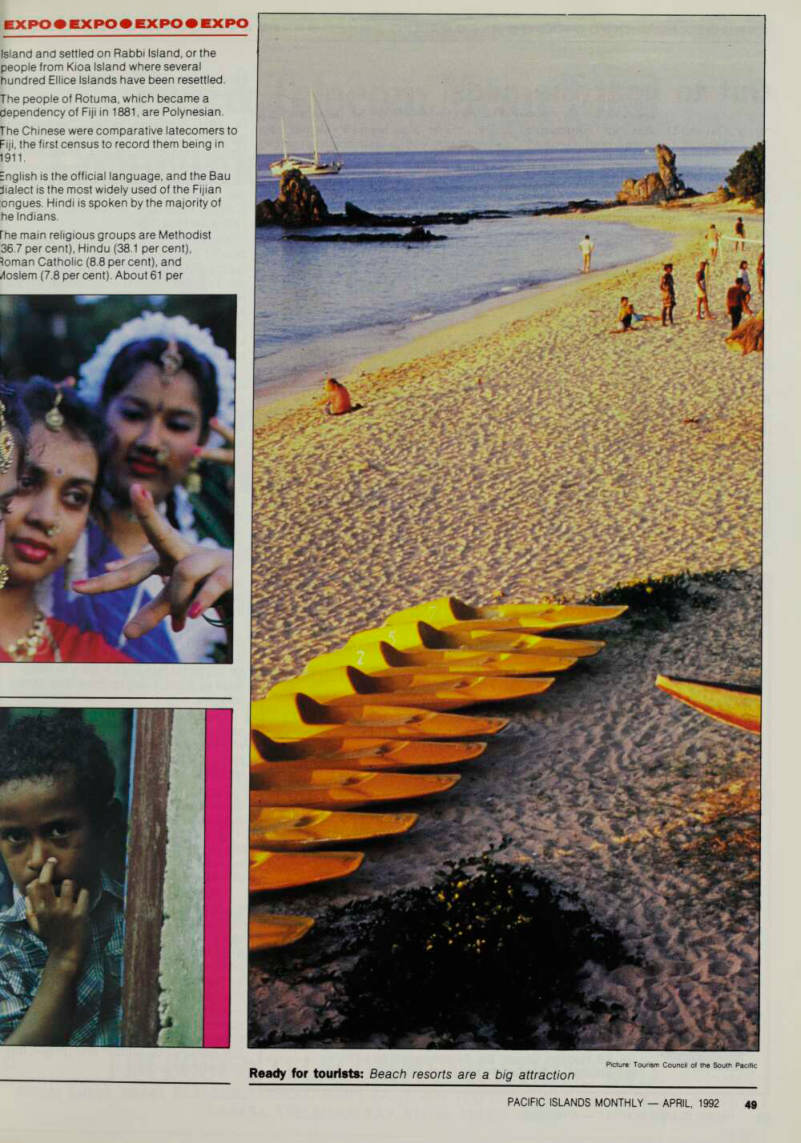
Picture: Tourism Council of the South Pacific
Ready for tourists: Beach resorts are a big attraction
cent of Fijians still live in villages in a largely subsistence economy and with the obligations of communal life.
However, under modern economic pressures life for the people, with increasing numbers of Fijians working for wages or looking for work in cities such as Suva, living far from their family villages.
The growth of urban areas has associated problems lack of housing, employment, education facilities and basic infrastructure has contributed to growth in crime.
Recreation includes sports such as cricket, hockey, basketball, squash, tennis and bowls. The winter sports, Rugby football and soccer, command the biggest followings. Water sports are popular and golf has advanced with private sponsorship of tournaments.
Tourism is the biggest earner, but much of the money goes out of the country to the developers. Sugar has been the economic mainstay, and Fiji produces a range of manufactured products. Processing of raw materials from primary resources has been the most significant form of manufacturing sugar milling, gold extraction, coconut oil extraction and fish canning.
Main exports are sugar, molasses, gold, fish, coconut oil, lumber and ginger, but tourism has grown. □ Compiled from the Pacific Islands Yearbook.