Quality,
pp. 44-45 · Read in the full issue
it grows on trees
By Aniltra Chaudhari
WHEN world copra prices fell. the South Paci fi c s coconut trees seemed to have no other part to play than to sway tneir ironas o a rac e ouns s.
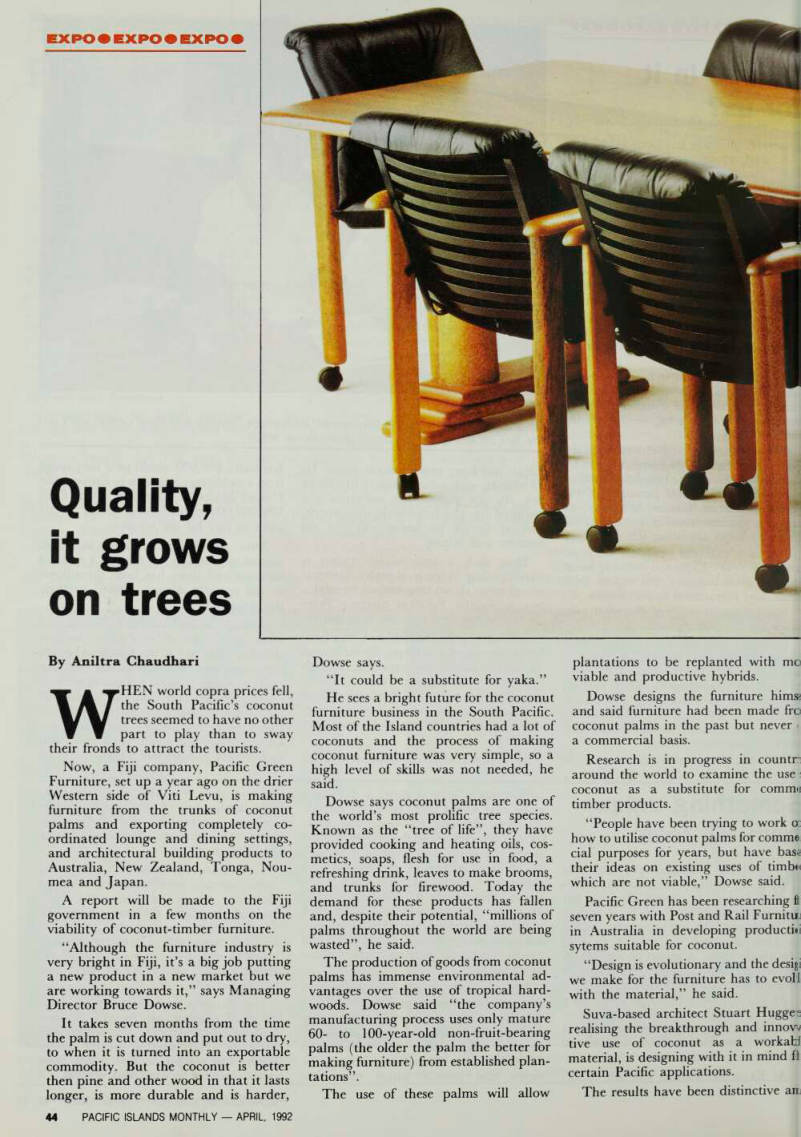
Now, a Fiji company, Pacific Green Furmture. set up a year ago on the drier Western side °f Vtti evu, is making furniture from the trunks of coconut palms and exporting completely co ordinate,d. loun g« and dining settings, and architectural building products to Australia New Zealand, Tonga, Nou mea and Japan.
A report will be made to the Fiji government in a few months on the viability of coconut-timber furniture.
“Although the furniture industry is very bright in Fiji, it’s a big job putting a new product in a new market but we are working towards it,” says Managing Director Bruce Dowse.
It takes seven months from the time it takes seven montns trom tne time the palm is cut down and put out to dry, to when it is turned into an exoortable to when it is turned into an exportable commod.ty. But the coconut is better then pine and other wood in that it lasts longer, is more durable and is harder,
Dowse says.
“It could be a substitute for yaka.”
He sees a bright future for the coconut furniture business in the South Pacific.
Most of the Island countries had a lot of coconuts and the process of making coconut furniture was very simple, so a high level of skills was not needed, he said.
Dowse says coconut palms are one of the world’s most prolific tree species.
Known as the “tree of life”, they have provided cooking and heating oils, cos metics, soaps, flesh for use in food, a refreshing drink, leaves to make brooms, and trunks for firewood. Today the demand for these products has fallen and, despite their potential, “millions of palms throughout the world are being wasted”, he said.
The production of goods from coconut palms has immense environmental ad vantages over the use of tropical hard woods. Dowse said “the company’s manufacturing process uses only mature 60- to 100-year-old non-fruit-bearing palms (the older the palm the better for making furniture) from established plan tations”.
The use of these palms will allow
plantations to be replanted with mo
viable and productive hybrids.
Dowse designs the furniture himsa and said furniture had been made fro coconut palms in the past but never . a commercial basis.
Research is in progress in countn world P e « amine the use coconut a$ a substjtute for comm „ timber products, . , . . . . People have been trying to work oc t 0 utlllse c ° conut palms for comm, c > al . Purposes for years, but have base th , e ! r , ldeas on ex ‘ s j in g “ ses of t ‘ mb " whlch are not vlable - Dowse sald - Pacific Green has been researching fl seven years with Post and Rail Furnituj i n Australia in developing productid sytems suitable for coconut, “Design is evolutionary and the desigi we make f or the furniture has to evoll t h e ma t e rial ”he said.
Suva-based architect Stuar ugge° realising the breakthrough and mnow roronut as a workab tlve V s f . , S 0 0? 1 ? . . °. , A material, is designing with it m mind fl « ,f cations The results have been distinctive arc
ealising the breakthrough and innova ive use of coconut as a workable riaterial, is designing with it in mind for ertain Pacific applications.
The results have been distinctive and efreshing. Coconut can’t compete with xisting timbers in the ease of use.
The wood can be extremely hard and ic high silica content makes traditional
'ood-working machinery inadequate.
Machinery using state-of-the-art
brasives and low-friction sawing systems ere designed to address this particular roblem.
But then its hardness is an advantage ecause the material is strong and arable.
It also has a natural beauty due to the nique grain structure which is unlike ly other timber. The production rocesses which the company has devel 3ed brings out the best of these natural ialities.
But Dowse was not about to release formation on the processing of the •conut trunks.
“That’s a trade secret,” he said.
He did reveal that the sawn trunks mt into an organic solution which evented infection from wood borers
and other bugs, then they were left to dry for two months in a special room for “mellow drying”.
After this the ma terial is ready for mak ing furniture and other goods.
The site of the fac tory on the dry West ern coast of Viti Levu, near Sigatoka, was necessary to obtain ex port quality, low moisture content ma terial.
“Moisture leads to expansion and con traction in any ma terial and could cause cracking in the fin ished product”.
At the Pacific Green
plant, breakthroughs
are occurring all the time, although Dowse
acknowledges that
they still need to ex plore the full potential of coconut timber.
A final report on their research findings
is still to be prepared, however Dowse is confident of the future of the industry and its benefit for the entire region. □
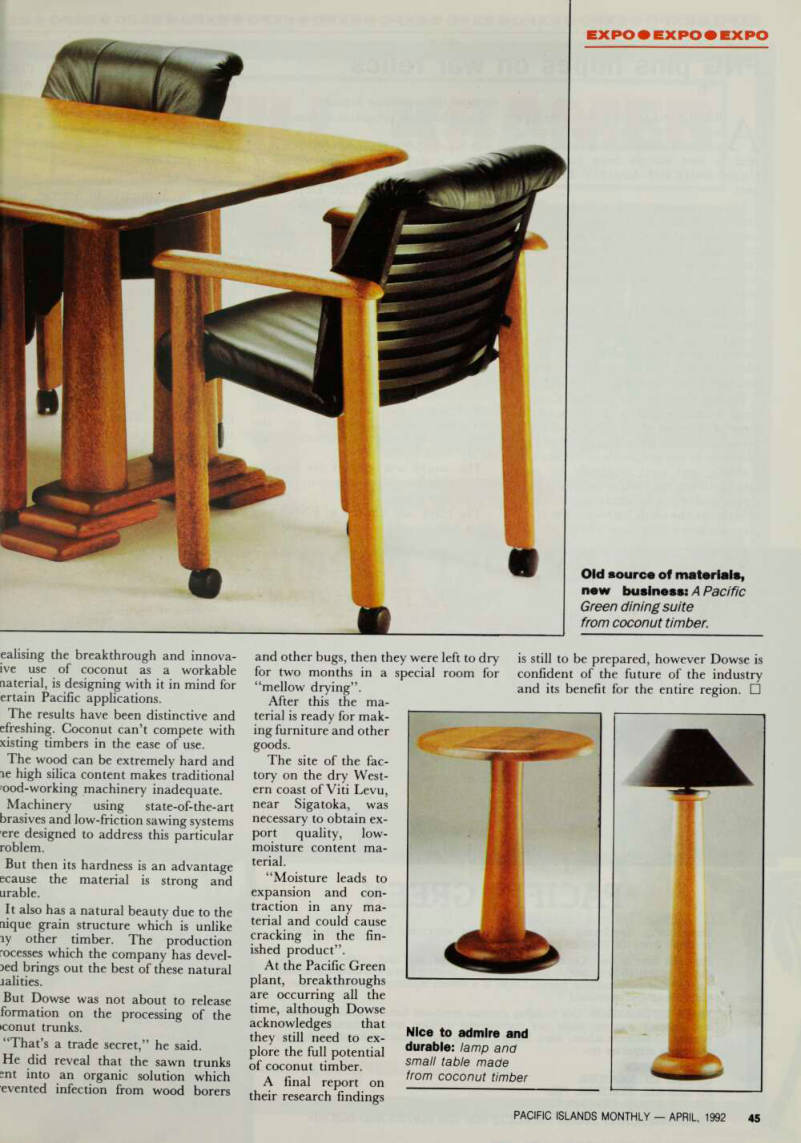
Nice to admire and durable: lamp and small table made from coconut timber
Old source of materials, new business: A Pacific Green dining suite from coconut timber.