Eyes on the Pacific
p. 42 · Read in the full issue
EXPO .EXPO. EXPO .EXPO. EXPO .EXPO. EXPO. EXPO. EXPO. EXPO. EXPO. EX
IT began at the rugby union World Cup in France and Great Britain in October and continued when 30 Fijians landed in Spain in January.
What? Exposure and interest in the South Pacific leading up to Expo 92 in Seville.
Western Samoa took the rugby world by storm when they qualified for the quarter-finals of the World Cup, defeating more-fancied Argentina and Wales.
But the British media, hungry for a new slant to the World Cup, gave them much more. They dubbed them the “sexiest men in the World Cup”, and camped outside the team hotels waiting for interviews. A number of newspapers even ran maps explaining exactly where Western Samoa is m relation to New Zealand and Australia.
It generated so much interest in
Europe that Expo organisers are looking
at having a rugby union team from Western Samoa and Fiji play during
E X P°.
Now what about these 30 Fijians in Spain? These men came to Seville on January 13 to re-erect prefabricated traditional South Pacific buildings which will make up the Pacific Pavilion.
Being the only dark-skinned people on the Expo site obviously helped to get them noticed. But when they lifted the
huge poles for the Papua New Guinean haus tambaran out of the container and onto their shoulders the Spanish workers on the site really took an interest.
Used to such jobs being done by machine, they all stopped work and rushed to the Pacific Pavilion site.
Spanish Ambassador to Australia Senor Jose Luis Pardos said he is convinced that the Pacific Pavilion will be “attraction number one in Spain”. He said this is because the word pacifico is a Spanish word meaning “peace”, and the Spanish are very interested in the culture and civilisation of the Pacific.
“They are more interested (in the Pacific) than in Germany, Italy, France, Belgium or Holland, because these countries are nearby and we know them.
“We don’t know the Pacific so you are going to show us,” said Senor Pardos.
The Pacific site is also expected to generate interest because it will be a site of traditional buildings which will be in sharp contrast to the multi-million dol lar, high-tech pavilions around it.
The Pacific Pavilion will be made up of three buildings a Fijian bure kalou , a Polynesian fale , and a Papua New Guinean haus tambaram.
You begin your Pacific trip through the bure kalou, in which navigation is the theme and the early ocean voyages in the
Pacific are illustrated. As you queue to enter the hure kalou there is a man carving a traditional canoe.
In t h e middle building, which is the fale, there is a series of light boxes which give very dramatic aspects of the Pacific as it is today each participating country has their own light boxes, The boxes show the unspoilt Pacific environment, major tourist attractions, Pacific faces, the modern Pacific infra structure and other highlights, The haus tambaran is mainly a shop for handicrafts. Business promotion pro grammes to show Pacific trade and investment opportunities also are
planned.
The Pacific Pavilion has a stage for cu l t Ural performances and a spectator area. Around three million visitors are expected through the Pacific Pavilion.
Expo organisers estimate 40 million people will pass through the Expo site.
The Expo site is 215 hectares, more than five times the size of Expo ’BB in Brisbane.
There are 156 participants in Expo 92 111 countries, 17 autonomous regions Q f Spain, 22 international organisations and six companies. The theme is “The Age of Discovery”. The Pacific Pavilion hopes to fit into this theme by letting the world discover the Pacific. □
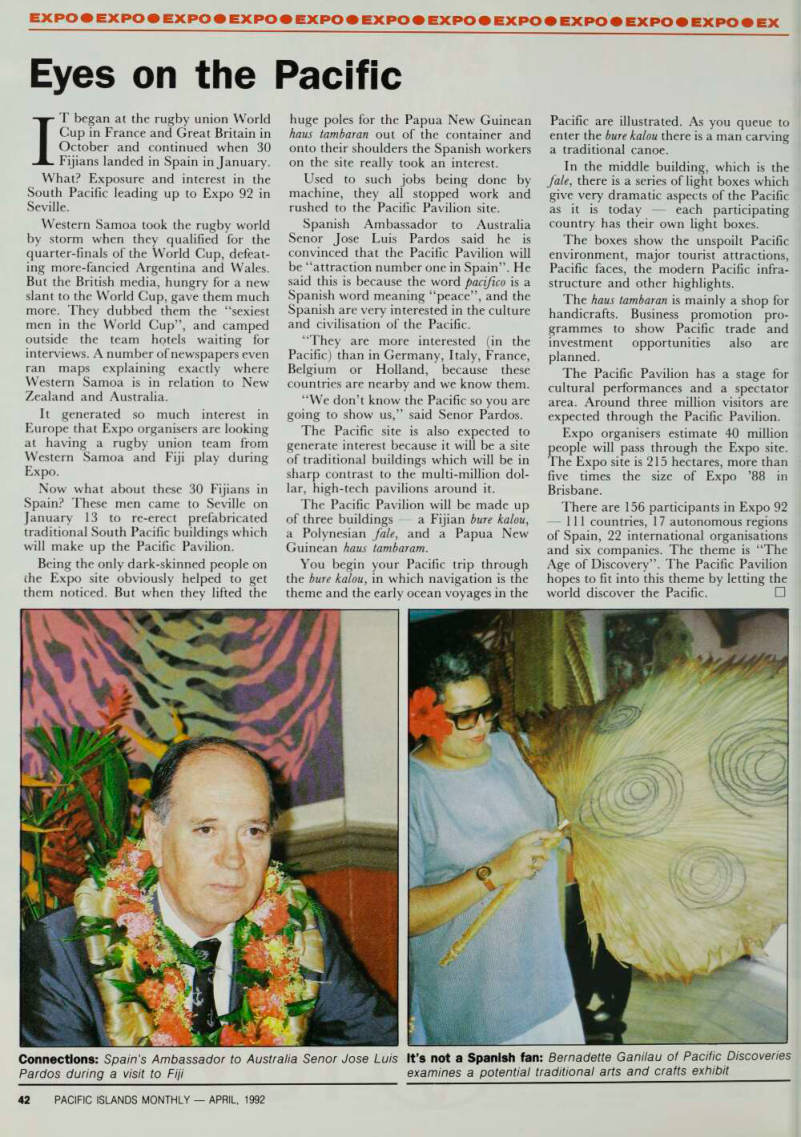
Connections: Spain’s Ambassador to Australia Senor Jose Luis Pardos during a visit to Fiji
It's not a Spanish fan: Bernadette Ganilau of Pacific Discoveries examines a potential traditional arts and crafts exhibit