Solomons’ sweet success
p. 34 · Read in the full issue
By Martin Tiffany
OH How Sweet It Is,” declares the sign on the front of the little white wooden building in Honiara. It is describing the honey sold within, but could well be describing what this honey is ac complishing.
It is doubtful whether many visitors to Honiara will notice this wooden building on the hand side of the road as they whizz to town from Henderson Airport.
Situated about halfway between Honi ara and the airport, it will most likely pass as a blurr and the sign “Honey For Sale” will not be read.
But, what this little building is achiev ing is certainly making people in the Solomon Islands sit up and take notice.
It is the headquarters of the Solomons Islands honey industry, which in three years has made the country self-sufficient in honey. It has also enabled the Solomons to establish an export market and made honey the fastest-growing industry in the Solomons.
In 1988, the Solomons imported about 51535,000 worth of honey. This figure was expected to expand by about 10 per cent per annum.
But then Welshman Bryan Evans appeared and changed all that.
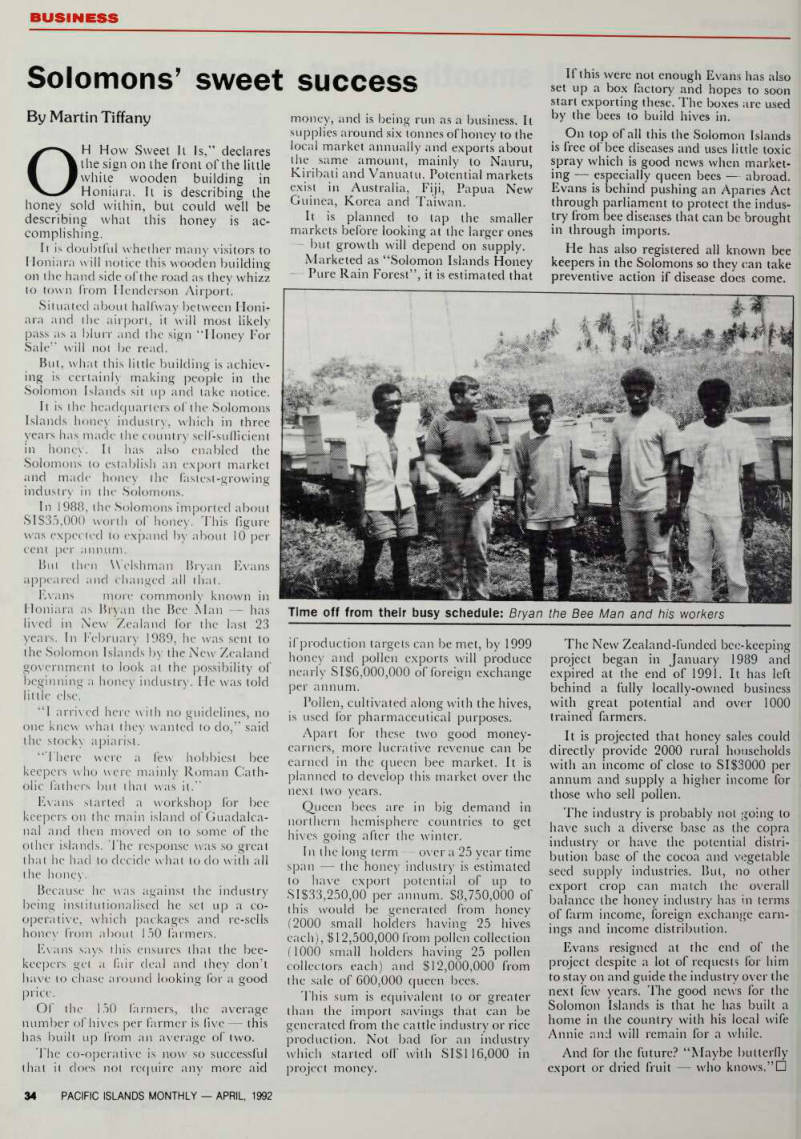
Evans more commonly known in Honiara as Bryan the Bee Man has lived in New Zealand for the last 23 years. In February 1989, he was sent to the Solomon Islands by the New Zealand government to look at the possibility of beginning a honey industry. He was told little else.
“1 arrived here with no guidelines, no one knew what they wanted to do,” said the stock) apiarist.
“There were a few hobbicst bee keepers who were mainly Roman Cath olic fathers but that was it.”
Evans started a workshop for bee keepers on the main island of Guadalca nal and then moved on to some of the other islands. The response was so great that he had to decide what to do with all the honey.
Because he was against the industry being institutionalised he set up a co operative, which packages and re-sells honey from about 150 farmers.
Evans says this ensures that the bee keepers get a fair deal and they don’t have to chase around looking for a good
price.
Of the 150 farmers, the average number of hives per farmer is five this has built up from an average of two.
The co-operative is now so successful that it does not require any more aid
money, and is being run as a business. It supplies around six tonnes ofhoney to the local market annually and exports about the same amount, mainly to Nauru, Kiribati and Vanuatu. Potential markets exist in Australia, Fiji, Papua New Guinea, Korea and Taiwan.
It is planned to tap the smaller markets before looking at the larger ones - but growth will depend on supply.
Marketed as “Solomon Islands Honey — Pure Rain Forest”, it is estimated that
if production targets can be met, by 1999 honey and pollen exports will produce nearly 5156,000,000 of foreign exchange per annum.
Pollen, cultivated along with the hives, is used for pharmaceutical purposes.
Apart for these two good money earners, more lucrative revenue can be earned in the queen bee market. It is planned to develop this market over the next two years.
Queen bees are in big demand in northern hemisphere countries to get hives going after the winter.
In the long term over a 25 year time span the honey industry is estimated to have export potential of up to 51533,250,00 per annum. $8, 750,000 of this would be generated from honey (2000 small holders having 25 hives each), 512,500,000 from pollen collection (1000 small holders having 25 pollen collectors each) and 512,000,000 from the sale of 600,000 queen bees.
This sum is equivalent to or greater than the import savings that can be generated from the cattle industry or rice production. Not bad for an industry which started off with 515116,000 in
project money.
If this were not enough Evans has also set up a box factory and hopes to soon start exporting these. The boxes are used by the bees to build hives in.
On top of all this the Solomon Islands is free of bee diseases and uses little toxic spray which is good news when market ing especially queen bees abroad.
Evans is behind pushing an Apanes Act through parliament to protect the indus try from bee diseases that can be brought
in through imports.
He has also registered all known bee keepers in the Solomons so they can take preventive action if disease does come.
The New Zealand-funded bee-keeping
project began in January 1989 and
expired at the end of 1991. It has left behind a fully locally-owned business with great potential and over 1000 trained farmers.
It is projected that honey sales could directly provide 2000 rural households with an income of close to SIS3OOO per annum and supply a higher income for those who sell pollen.
The industry is probably not going to have such a diverse base as the copra industry or have the potential distri bution base of the cocoa and vegetable seed supply industries. But, no other export crop can match the overall balance the honey industry has in terms of farm income, foreign exchange earn ings and income distribution.
Evans resigned at the end of the project despite a lot of requests for him to stay on and guide the industry over the next few years. The good news for the Solomon Islands is that he has built a home in the country with his local wife Annie and will remain for a while.
And for the future? “Maybe butterfly export or dried fruit who knows.” □
Time off from their busy schedule: Bryan the Bee Man and his workers