ports unfolding
p. 20 · Read in the full issue
Tale of two ports unfolding with the future
THE Singapore of the South Pacific. Where? Those with some knowledge of this region should have no problem picking the front-runner to fit the description.
With its diverse and growing industries - especially under its tax-free zone scheme strong export base and status as a tourist haven, Fiji is the obvious choice. But something else sets it apart.
Unlike other regional countries, Fiji has two major ports. Suva, the main port, which handles the bulk of the country’s containerised cargo, and Lau toka, from where major foreign
exchange-earners, sugar and woodchips,
are exported.
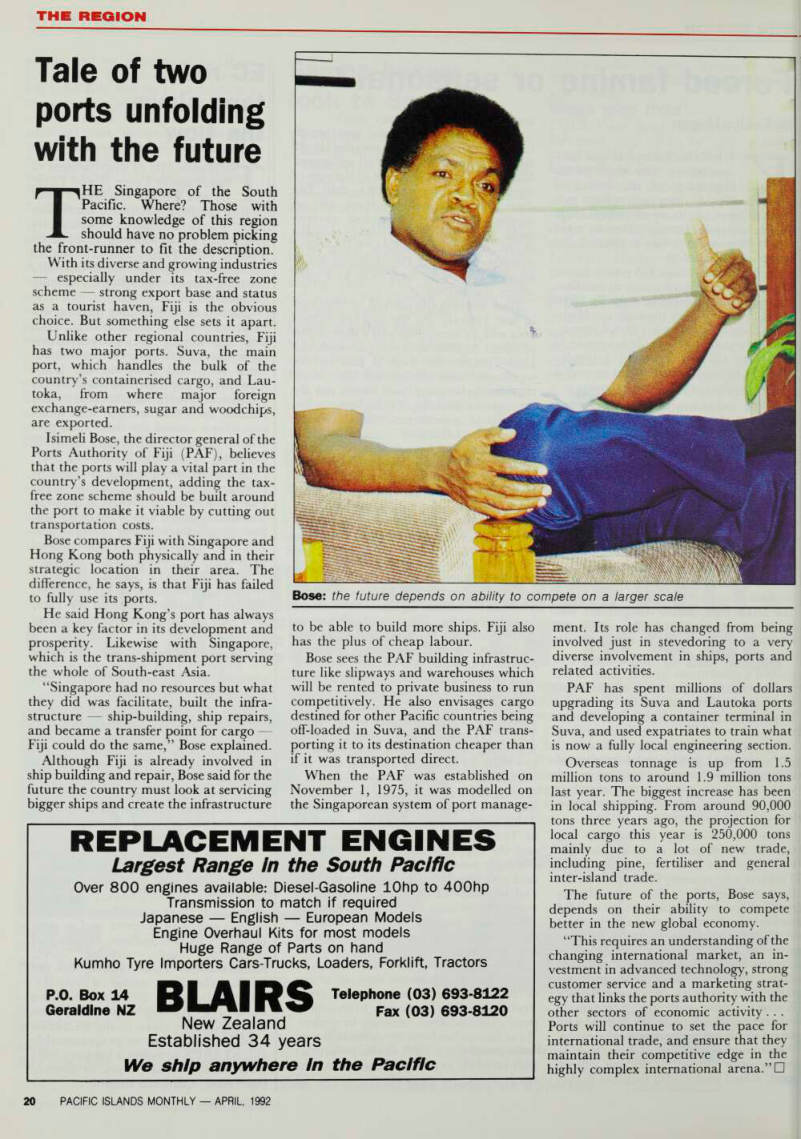
Isimeli Bose, the director general of the Ports Authority of Fiji (PAF), believes that the ports will play a vital part in the country’s development, adding the tax free zone scheme should be built around the port to make it viable by cutting out transportation costs.
Bose compares Fiji with Singapore and Hong Kong both physically and in their strategic location in their area. The difference, he says, is that Fiji has failed to fully use its ports.
He said Hong Kong’s port has always been a key factor in its development and
prosperity. Likewise with Singapore,
which is the trans-shipment port serving the whole of South-east Asia.
“Singapore had no resources but what they did was facilitate, built the infra
structure ship-building, ship repairs,
and became a transfer point for cargo Fiji could do the same,” Bose explained.
Although Fiji is already involved in ship building and repair, Bose said for the future the country must look at servicing bigger ships and create the infrastructure
to be able to build more ships. Fiji also has the plus of cheap labour.
Bose sees the PAF building infrastruc ture like slipways and warehouses which will be rented to private business to run competitively. He also envisages cargo destined for other Pacific countries being off-loaded in Suva, and the PAF trans porting it to its destination cheaper than if it was transported direct.
When the PAF was established on November 1, 1975, it was modelled on the Singaporean system of port manage
merit. Its role has changed from being involved just in stevedoring to a very diverse involvement in ships, ports and related activities.
PAF has spent millions of dollars upgrading its Suva and Lautoka ports and developing a container terminal in Suva, and used expatriates to train what is now a fully local engineering section.
Overseas tonnage is up from 1.5 million tons to around 1.9 million tons last year. The biggest increase has been in local shipping. From around 90,000 tons three years ago, the projection for local cargo this year is 250,000 tons mainly due to a lot of new trade, including pine, fertiliser and general inter-island trade.
The future of the ports, Bose says, depends on their ability to compete better in the new global economy.
“This requires an understanding of the changing international market, an in vestment in advanced technology, strong customer service and a marketing strat egy that links the ports authority with the other sectors of economic activity . . .
Ports will continue to set the pace for international trade, and ensure that they maintain their competitive edge in the highly complex international arena.” □
Bose: the future depends on ability to compete on a larger scale