Merry-maker’s UPNG plans
pp. 15-18 · Read in the full issue
Headlines
By Martin Tiffany
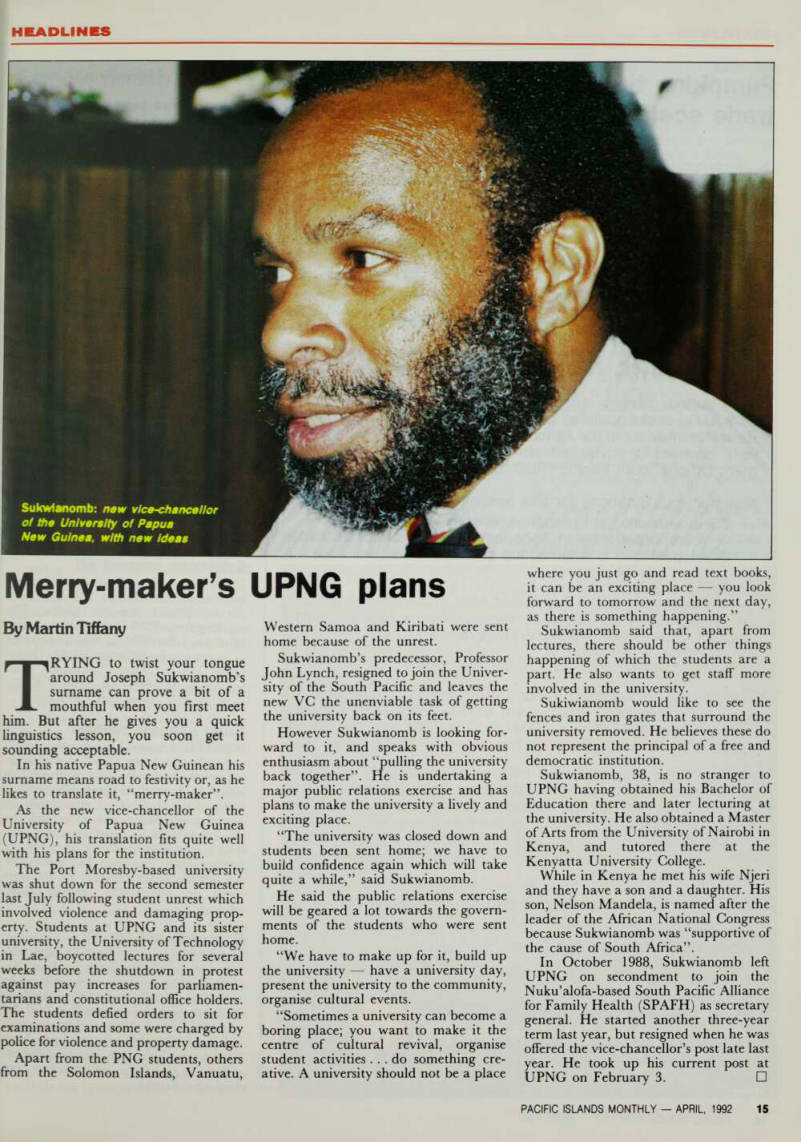
TRYING to twist your tongue around Joseph Sukwianomb’s surname can prove a bit of a mouthful when you first meet him. But after he gives you a quick linguistics lesson, you soon get it sounding acceptable.
In his native Papua New Guinean his surname means road to festivity or, as he likes to translate it, “merry-maker”.
As the new vice-chancellor of the University of Papua New Guinea (UPNG), his translation fits quite well with his plans for the institution.
The Port Moresby-based university was shut down for the second semester last July following student unrest which involved violence and damaging prop erty. Students at UPNG and its sister university, the University of Technology in Lae, boycotted lectures for several weeks before the shutdown in protest against pay increases for parliamen tarians and constitutional office holders.
The students defied orders to sit for examinations and some were charged by police for violence and property damage.
Apart from the PNG students, others from the Solomon Islands, Vanuatu,
Western Samoa and Kiribati were sent home because of the unrest.
Sukwianomb’s predecessor, Professor John Lynch, resigned to join the Univer sity of the South Pacific and leaves the new VC the unenviable task of getting the university back on its feet.
However Sukwianomb is looking for ward to it, and speaks with obvious enthusiasm about “pulling the university back together”. He is undertaking a major public relations exercise and has plans to make the university a lively and
exciting place.
“The university was closed down and students been sent home; we have to build confidence again which will take quite a while,” said Sukwianomb.
He said the public relations exercise will be geared a lot towards the govern ments of the students who were sent home.
“We have to make up for it, build up the university have a university day, present the university to the community, organise cultural events.
“Sometimes a university can become a boring place; you want to make it the centre of cultural revival, organise student activities ... do something cre ative. A university should not be a place
where you just go and read text books, it can be an exciting place you look forward to tomorrow and the next day, as there is something happening.”
Sukwianomb said that, apart from lectures, there should be other things happening of which the students are a part. He also wants to get staff more involved in the university.
Sukiwianomb would like to see the fences and iron gates that surround the university removed. He believes these do not represent the principal of a free and democratic institution.
Sukwianomb, 38, is no stranger to UPNG having obtained his Bachelor of Education there and later lecturing at the university. He also obtained a Master of Arts from the University of Nairobi in Kenya, and tutored there at the
Kenyatta University College.
While in Kenya he met his wife Njeri and they have a son and a daughter. His son, Nelson Mandela, is named after the leader of the African National Congress because Sukwianomb was “supportive of the cause of South Africa”.
In October 1988, Sukwianomb left UPNG on secondment to join the Nuku’alofa-based South Pacific Alliance for Family Health (SPAFH) as secretary general. He started another three-year term last year, but resigned when he was offered the vice-chancellor’s post late last year. He took up his current post at UPNG on February 3. □
Sukwlanomb: new vice-chancellor of the University of Papua New Guinea, with new ideas
Pumpkins tip
trade scales
IN November 1991, Tonga recorded what is said to be its first visible trade surplus US$7O,OOO. The surplus is said to be from squash pumpkin exports to Japan of about US$3.3 million.
French aid to Cooks THE Cook Islands has signed an aid
agreement with France worth almost US$l million, signalling an end to a 25-year struggle for better water and
electricity supplies.
Anti-snake grant
HAWAII has received a US$lOO,OOO grant from Washington’s Office of Ter ritorial and international affairs to de velop fool-proof ways of preventing Guam’s destructive brown tree snake from becoming established in Hawaii.
Some snakes have been found dead at Honolulu International Airport, in the
landing gear of planes from Guam.
US confirms presence THE United States has affirmed its commitment to a military presence in the Asia-Pacific region, saying any talk of its decline in the region is wrong and dangerous. Assistant American Defence Secretary, James Lilley, told an Asia- Pacific defence conference in Singapore the need for a United States role in the region’s security affairs would continue.
Special youth Jail?
WESTERN Samoa’s Police Com missioner, Galuvao Tanielu, has called for the establishment of a special jail for young people. He says offenders as young as 12 have been jailed with adults in the past because there were no alternatives, and as a result teenage inmates had picked up bad habits.
Rules for death PAPUA New Guinea’s attorney general, Bernard Narakobi, is working on a set of rules for the enforcement of capital punishment in the country. The PNG
parliament passed the death penalty bill
last year but it has still not been implemented due to lack of enforcement regulations.
Solomons warned off THE Papua New Guinea government has warned the Solomon Islands to keep out of PNG’s internal affairs. The warning from PNG Trade and Industry Minister, John Giheno, was in response to statements by Solomon Islands Oppo sition leader, Joses Tuhanuku, and
former parliamentarian, Sethuel Kelly,
in support of Bougainville secession.
Bond scheme revived WESTERN Samoa has revived a schol arship bond scheme aimed at encourag ing graduates funded by government to return and work in the public service.
Most of the bonds were guaranteed by parents, who are liable to refund the thousands of tala spent on their chil dren’s sponsored studies if they do not honour signed contracts. The bond is for the same number of years the students spent on scholarship (usually three
years).
Samoans set for TV SAMOANS waiting for their own tele vision station might get it by June, if a new timetable by the government can be met. The plan is to use Television New Zealand expertise to install a NZ Pal system covering Apia during the 30th independence celebration in June. Most TV owners have US standard NTSC systems to pick (free) transmissions from American Samoa.
Shock death
of lekawe
JACQUES lekawe, the first Kanak elected to head a regional organis ation died unexpectedly in Welling ton last month from cancer. He was admitted to hospital after complaining of a sore throat, but died soon after. lekawe, 45, was to take over as secretary-general of the Noumea-based South Pacific Commission in June.
Married with five children, he ob tained a law degree in France before returning the New Caledonia to take up a career in the administration of the territory. Before being appointed to head the SPC, he was New Caledonia’s deputy high commissioner responsible for devel opment, and the president of the Cale donian Investment Bank.
AIDS a big export
FRENCH Polynesia and New Caledonia have the highest incidence of AIDS in the region, says a Australian HIV surveil lance report. Papua New Guinea has the largest number of carriers 37 though its relative percentage is lower because of its huge population of four million. The report gives 15 and 9.4 rate per 100,000 population in the French territories. French Polynesia’s figure is alarming with 27 AIDS cases at World Health Organisation’s last count in 1991.
New Caledonia has 16 confirmed cases, Papua New Guinea 37, Guam eight, Fiji seven while Tonga, the Federated States of Micronesia and Marshall Islands two each, and Western Samoa one.
Countries and territories so far of ficially free of the deadly infection are American Samoa, Cook Islands, Kiri bati, Niue, Northern Marianas, Palau, Solomon Islands, Tokelau, Tuvalu, Vanuatu and Wallis and Futuna. Last month a medical research centre in Melbourne disclosed that Australian male tourists could be “exporting AIDS” to Asian and Pacific holiday countries because of the increasing number of tourists travelling specifically on sex holidays. Australia has 2882 AIDS cases up from the last count of 2474 casees, and 396 known HIV virus carriers
New party
TWELVE Fiji trade unionists and for
mer Fiji Labour Party (FLP) officials
launched a new political party on February 25 because of FLP’s insistence on boycotting this year’s general elec tions. The New Labour party will be headed by Michale Columbus, president of the Fiji Trade Union Congress and a former vice-president of the FLP.
Deaths due to blockade THERE have been more claims that the Papua New Guinea blockade of Bou gainville has contributed to the deaths of
many people. Sam Voron, the Australian amateur radio enthusiast who set up the seccessionist Bougainville government’s radio services, says it is stopping medical supplies and causing great misery.
Mine determined BOUGAINVILLE Copper Limited, the company that operated the giant copper mine on the secessionist island, says it is determined to re-open the mine once the crisis on the island is over, but the company has been unable to assess the mine’s future viability because they have been unable to visit it since 1990.
Niue aid cut SHARP cuts in New Zealand’s aid to Niue have forced the country to seek development assistance in Australia.
Niue Premier Sir Robert Rex and the head of the island’s public service Terry Chapman returned from Canberra in February after meeting with Prime Minister Paul Keating and Foreign Affairs Minister Senator Gareth Evans.
Who’s a Fijian?
THE question of who qualifies to be a Fijian was brought to the front in Fiji in February. This followed the disqualifi cation of prominent Fiji businessman and former member of parliament Jim Ah Koy from contesting a parliamentary seat reserved for indigenous Fijians.
Ah Koy’s mother is an indigenous
Fijian and last year his name was included in the Vola ni Kawa Bula, which is the register of indigenous Fijians.
However, his name was struck from the roll of Fijian voters in late February because his father is not a Fijian.
According to the registration officer for the Suva City Fijian Urban Constitu ency, Taniela Tabu, since Ah Key’s father is not a Fijian he cannot be registered on the roll of Fijian voters.
Ah Koy said the move was premedi tated and said he would appeal to the courts.
Earlier when Ah Koy’s “Fijianness” was challenged, he filed objections to the registration of Fijian high chief, Ratu Viliame Dreunimisimisi, as a Fijian on the grounds that his grandfather was a Tongan.
Ah Koy said the decision to drop him from the roll of Fijian voters would lead to questions about the duality of laws in Fiji. It would also create two classes of Fijians. Ah Koy supporter, Major Gen eral Sitiveni Rabuka, said the moves to question the Fijianness of Ah Koy and Dreunimisimisi were deeply “embarrass ing”.
University of the South Pacific aca demic Dr Tupeni Baba said the Fijian race was headed towards extinction if “we continue to define Fijianness so
rigidly and on grounds of racial pu rity.” Prior to the military coups of 1987, Ah Koy had sat in parliament as representative of the General Electors, a party which encompassed all races who are not indigenous Fijians or ethnic Indians. Fiji’s post-coup consti tution guarantees a majority of parlia mentary seats for indigenous Fijians.
PNG’s first freeway
PAPUA New Guinea is to get its first freeway following Cabinet approval of a K 65 million tender for the construc tion of the Spring Garden Road/
Airport link, providing 3000 jobs in
skilled, semi-skilled and manual labour areas. The project involves construction of a tunnel through Burns Peak to provide a more direct link from the city area, including the port, and the provision of a freeway linking the city, via the tunnel, to Jacksons Airport. The contract has been awarded to Kinhill Kramer Consortium. Work is sched uled to start by June and finish within three years.
Difficult decade ahead A RECENT economic report predicts a difficult decade for Pacific Island economies. The Pacific Economic Bull etin, published by the Australian Na tional University, says Island countries will fall further behind the competitive nations of the Pacific rim. □