Rebuilding and
pp. 12-13 · Read in the full issue
Vanuatu Rebuilding and moving on
Good sign for the future Ephraim Kalsakau, president National Union Blong Laba (2750 members) and co ordinator of the National Committee of Unions UNIONS in Vanuatu are going
through a rebuilding process.
Three of four major unions are involved in the new Vanuatu National Committee of Unions [VNCU] and we plan to set up a union centre.
The new government is surprisingly open to our aspirations, and perhaps it is a good sign for future labour relations.
After talks with Serge Vohor [Foreign Affairs Minister and UMP party presi dent] we have been promised a building or a centre, and arbitration and concili ation procedures are being introduced.
The big test will come with the new Parliament site.
One of the reasons the union move ment didn’t progress during the Lini era was because of the public servants’ strike in 1981 a year after Independence. As leader of the strike I was branded from
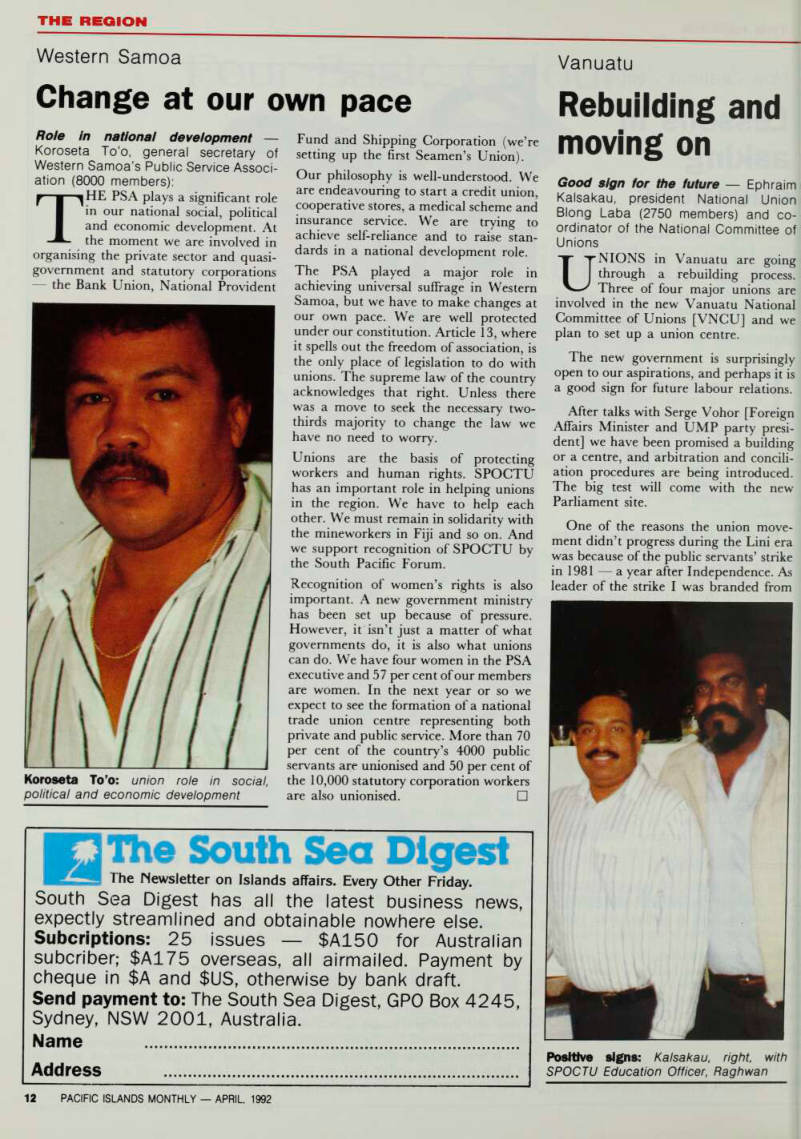
Positive signs: Kalsakau, right, with SPOCTU Education Officer, Raghwan
then on as “sabotaging” the govern ment efforts. I was forced to resign at the time, becoming Port Vila’s senior health inspector and later, in 1984, town clerk.
Later I was involved in setting up the Municipal Workers Union and we supported the Labour Party in the 1987
general election.
In 1983 we had as many as 22 unions registered in a country of merely 150,000 people. They were mainly craft unions and you’d have a situation where a mechanics union, for example, would only have 20 members.
The Lini government was being advised by expatriate officials to keep the unions in check. By 1987 there was a Vanuatu Trades Union Congress but it was formed top down rather than from grassroots up and it didn’t survive.
Now we have about 4500 workers unionised. Under the VNCU umbrella, the National Union Blong Leba has about 2750 members, the Public Ser vice Association 700 and the Teachers Union 630; the Health Workers Union which is not so far within thhe VNCU has about 200 members.
The low point for labour relations came during the dock-workers’ strike on Santo between October 1990 and August 1991.
We were seeking better pay and conditions the government would raise the minimum wage paid just one month before the elections. Police were Drought in to harass the workers who
vere seeking legitimate demands.
Hopefully labour relations will be Detter now with the change of govern nent.
We appreciate the help from other mions in the region, like Australia and 'Jew Zealand, but instead of deciding iclp from afar, the unionists should ome to Vanuatu and see for themselves •ur difficulties and what we need. □