asking
p. 11 · Read in the full issue
New Zealand - Niue
Lessons in asking questions
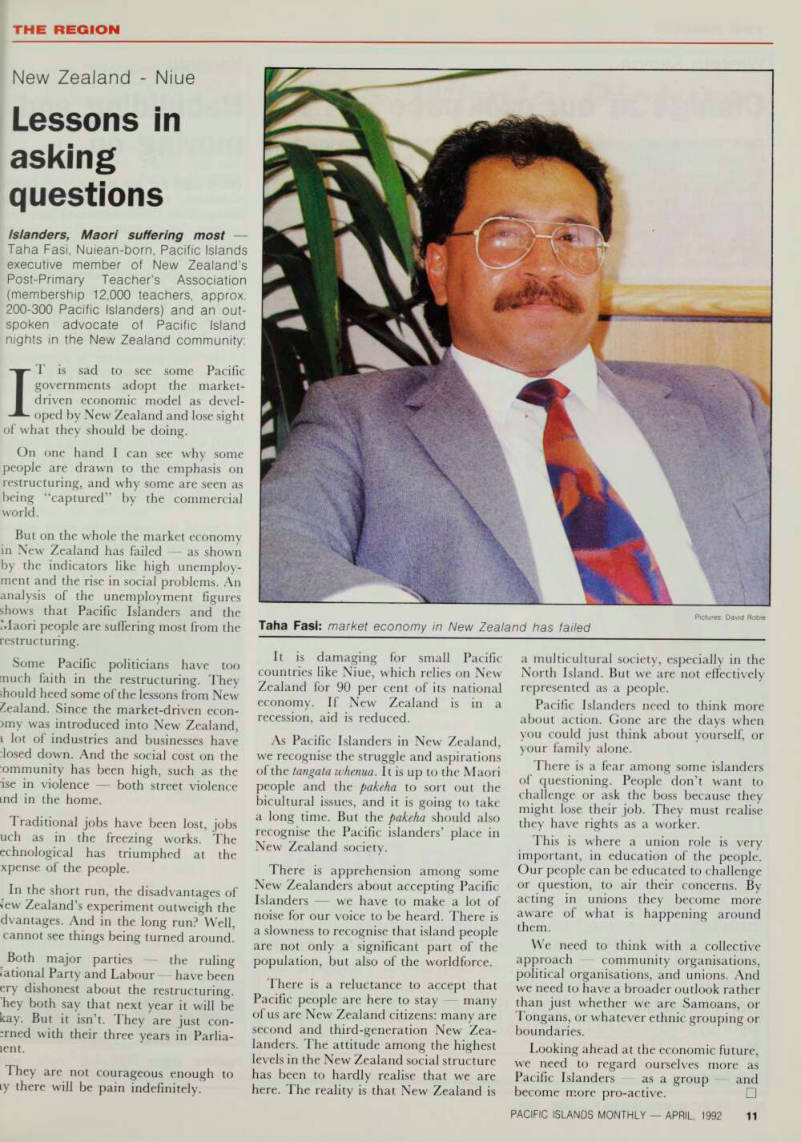
Islanders, Maori suffering most Taha Fasi, Nuiean-born, Pacific Islands executive member of New Zealand’s Post-Primary Teacher’s Association (membership 12,000 teachers, approx. 200-300 Pacific Islanders) and an out spoken advocate of Pacific Island nights in the New Zealand community: IT is sad to see some Pacific governments adopt the market driven economic model as devel oped by New Zealand and lose sight of what they should be doing.
On one hand I can see why some people are drawn to the emphasis on restructuring, and why some are seen as being “captured” by the commercial world.
But on the whole the market economy in New Zealand has failed as shown by the indicators like high unemploy ment and the rise in social problems. An analysis of the unemployment figures shows that Pacific Islanders and the Maori people are suffering most from the restructuring.
Some Pacific politicians have too much faith in the restructuring. They should heed some of the lessons from New Zealand. Since the market-driven econ omy was introduced into New Zealand, i lot of industries and businesses have dosed down. And the social cost on the immunity has been high, such as the ise in violence both street violence md in the home.
Traditional jobs have been lost, jobs uch as in the freezing works. The echnological has triumphed at the xpense of the people.
In the short run, the disadvantages of Jew Zealand’s experiment outweigh the dvantages. And in the long run? Well, cannot see things being turned around.
Both major parties the ruling fational Party and Labour have been ery dishonest about the restructuring, 'hey both say that next year it will be kay. But it isn’t. They are just con !rned with their three years in Parlia lent.
They are not courageous enough to iy there will be pain indefinitely.
It is damaging for small Pacific countries like Niue, which relies on New Zealand for 90 per cent of its national economy. If New Zealand is in a recession, aid is reduced.
As Pacific Islanders in New Zealand, we recognise the struggle and aspirations of the tangata whenua. It is up to the Maori people and the pakeha to sort out the bicultural issues, and it is going to take a long time. But the pakeha should also recognise the Pacific islanders’ place in New Zealand society.
There is apprehension among some New Zealanders about accepting Pacific Islanders we have to make a lot of noise for our voice to be heard. There is a slowness to recognise that island people are not only a significant part of the population, but also of the worldforce.
There is a reluctance to accept that Pacific people are here to stay many of us are New Zealand citizens: many are second and third-generation New Zea landers. The attitude among the highest levels in the New Zealand social structure has been to hardly realise that we are here. The reality is that New Zealand is
a multicultural society, especially in the North Island. But we are not effectively represented as a people.
Pacific Islanders need to think more about action. Gone are the days when you could just think about yourself, or your family alone.
There is a fear among some islanders of questioning. People don’t want to challenge or ask the boss because they might lose their job. They must realise they have rights as a worker.
This is where a union role is very important, in education of the people.
Our people can be educated to challenge or question, to air their concerns. By acting in unions they become more aware of what is happening around them.
We need to think with a collective approach community organisations, political organisations, and unions. And we need to have a broader outlook rather than just whether we are Samoans, or Tongans, or whatever ethnic grouping or boundaries.
Looking ahead at the economic future, we need to regard ourselves more as Pacific Islanders as a group and become more pro-active. □
Taha Fasi: market economy in New Zealand has failed
Pictures: David Robie