From colonialism to unionism
pp. 6-8 · Read in the full issue
The Region
With the first Fiji election since the 1987 military coups scheduled for May and a national strike planned against new labour laws, journalist Craig Skehan attempts to unravel some historical threads of organised unionism
FIJI’S 1879 colonial policy of importing indentured labour from India to work sugarcane plantations, often in dehumanis ing conditions, established a pattern
whereby Fiji Indians fought for economic
and political security. Fijians, on the other hand, tended to align themselves with the colonisers in return for guaran tees of supremacy.
Even during the indenture period there were instances of Indian challenges to authority. The history books record strikes on individual plantations oper ated by Australia’s Colonial Sugar Re fining Company (GSR) in 1886, 1887 and 1888. Some leaders were jailed.
Another strike by Indian labourers in 1907 resulted in three men being wounded by police bullets. Frustrations exploded in January, 1920, just after the indenture system ended. Striking Indian Public Works Department and munici pal employees were joined by sugar workers. In the second week, defence force machinegunners intimidated a thousand protesting strikers into dispers ing. The colonial administration saw the stoppage as politically motivated.
New Zealand dispatched soldiers and the Australian Government sent the warship
Marguerite. Indian women allegedly
severely beat a Fijian special constable and three European special constables.
An indian striker died from his wounds
after being shot by police.
Significantly, an Indian lawyer from Mauritius, Manilal Doctor, was seen as fomenting the strike and deported from Fiji. Indian lawyers continue to play a prominent role in politics, and some people wish that it was still possible to deport “troublemakers”. The colonial administration of 1920 helped instil a view among prominent Fijians that disloyal, anti-Empire Indian radicals were out to undermine the colony and seize power for themselves. Whereas indigenous Fijians today control the military, the power of the gun was then firmly in European hands. One group became known as “The Loyal Indians” because they opposed the strike.
An association of canegrowers was formed in 1920, and in February 1921 GSR labourers began striking over pay, access to land and living conditions, and to pressure for the release of men still in
prison from the 1920 strike. The stoppage went until August and, although it fizzled, again attitudes had been hardened. Many of the Indians involved became more anti-European and op posed to the colonial system.
The Fiji Times newspaper editorialised that while industrious Indians were welcome, “the agitating parasite is as great a curse to Fiji as he is to any other land and we want him blotted out.”
In 1920 and 1921, minority Muslims joined with striking Hindus. However, this co-operation broke down with in creasing free immigration from India and rising Hindu/Muslim rivalry. Hindu fundamentalist Arya Samaj carried a pan-Indian political message, while the Fiji Muslim League founded in 1926 sought better understanding between “the Government and its subjects”.
Many representative organisations de veloped along racial lines. In 1939, a new industrial issue caused further polaris ation. Indians refused to serve in World War II because they were not to be given the same pay and conditions as Eur opeans. Fijians, however, found common cause with Empire and went to war.
The agitating parasite Is as great a curse to FIJI as he Is to any other land The FIJI Times, 1920
The schism, and its historical ramifi cations, was reinforced through a strike during 1943 by Indian cane farmers over cane prices. Critics saw this as tanta mount to sabotage during a crisis. By the 1946 census, Fiji Indians outnumbered Native Fijians, fuelling paranoia.
A boom in the sugar industry during the 1950 s led to a push for greater Indian access to Fijian land, and rekindled tensions over only short-term leases being available. Rural Fijians were drifting to the cities, especially Suva where there were not enough jobs. Many urban refugees became disillusioned and alien ated. Food prices were rising faster than pay rates.
Common problems to some extent broke down barriers between Indians and Fijians, manifest by the involvement of both races in a bitter and violent strike and rioting in 1959. James Anthony, of mixed Indian, Irish and Polynesian: background, was among the leaders, ag was Apisai Mohammed Tora, a Fijiarr who had flirted with communism andf made an extraordinary conversion to the Muslim faith. Their union was the Wholesale and Retail Workers Generali Union, which had coverage including* 300 oil industry workers, mostly em ployed by the multi-nationals Shell and!
Vacuum Oil.
Pay demands led to a strike on Monday,, December 7, By December 9, Europeans* were being used to drive petrol tankers* with police guards. While the uniom guaranteed supplies for essential services,, the colonial administration used police to< break pickets at retail outlets. Bus and! taxi drivers, if they failed to join the; strike, were physically intimidated.
Europeans were particularly singled out: as targets for abuse and rocks by angry 1 crowds. When unionists were refused J permission to hold an outdoor meeting in j Suva, violence escalated into rioting,, Despite police baton charges and use of] teargas, there was extensive damage to< major stores and some looting.
Gangs of youths rampaged though the night and Burns Philp manager Bruce Brownlee was critically injured. A roll call of Fiji’s most senior Chiefs inter vened, calling on Fijians to end the violence. Among them was the current President, Ratu Sir Penaia Ganilau, and now incumbent Interim Prime Minister Ratu Sir Kamisese Mara.
Some Chiefs suggested that the good name of Fijians was being blackened by Indian ringleaders. Union secretary James Anthony reportedly slept for 12 hours after being prescribed a sleeping draft, only to awake to find that the union’s President, Ratu Meli Gonewai, had negotiated an end to the dispute. For years to come, Fijian unions went back to greater organisation on racial lines, with some official encouragement.
In 1960 there was another prolonged strike in the cane fields. Harvest boycotts were to become an almost annual event.
The fact that today Fiji has a National Farmers’ ‘Union’ (NFU), even though most farmers are self-employed, is no accident. It is a product of history where the miller, once GSR but now the Government’s Sugar Corporation, has often been seen as an establishment foe.
Fiji’s politics from the early 1960 s to the mid 1980 s were dominated by the National Federation Party (NFP),
funded by the leaders of the 1960 strike, nd the Fijian Association, formed in esponse to industrial militancy. The issociation’s combination with the Gen
ral Voters (Europeans, part-Europeans
nd Chinese), as well as an Indian rump, r as known as the Alliance Party.
While political leaders stepped back om confrontation in 1969 to allow mtative agreement on a 1970 indepen ence Constitution, subject to later “view, the friendliness did not last, lections in 1972, 1977 and 1982 were laracterised by disputes over Consti itional provisions. Some politicians :ploited sensitivities over land, access to lucation and availability of govern ent jobs. But Ratu Mara held on to the ime Ministership until April 1987, hen he faced a new force.
The Fiji Labour Party had been rmed in 1985, following a wages freeze 1984. It preached multi-racial class ditics and was headed by a former esident of the Fiji Public Service isociation, Dr Timoci Bavadra.
Another leading light in the formation the Labour Party was an old adversary Ratu Mara, Mahendra Chaudhry,
who held positions in the Fiji Trades Union Congress (FTUC), the Public Service Association and the National Farmers’ Union. Ratu Mara resented what he saw as Chaudhry’s confrontationist approach and accused him of attempting to politicise the public service. Some Alliance members con sidered the FTUC and Labour to be anti-American communist fronts.
There was another side to the union movement. For example Taniela “Big Dan” Veitata of the Dockworkers’ and Seamen’s Union was involved in agi tation following election in April 1987 of a Labour/NFP coalition headed by Bavadra as Prime Minister. One of the strangest decisions of the interim Govern ment was to make Veitata minister responsible for implementing industrial relation policies. Another of the militants involved in destabilising Bavadra was Tora.
There were orchestrated demonstra tions, roadblocks and firebombings. Siti veni Rabuka’s May coup ousting Bavadra, avowedly to avoid civil viol ence and restore Fijian political domi nance, followed. Chaudhry, as a
shortlived Finance Minister in the Bavadra Government, was bitter. Critics say he has since used his union positions to extract revenge with a political agenda not necessarily beneficial to the worker.
One associate of the 44-year-old Chaudhry says his experience as a Government auditor gave him an indepth understanding of the decision making system. He has well-placed friends and has been known to receive confidential Government documents vir tually hot off the press. However, a sometimes self-righteous attitude, and a tendency to be dismissive of contrary views, have made enemies of some union
colleagues.
Among those purportedly working to
undermine him have been the President of the FTUC, Michael Columbus, who has been involved in unionism since the 19505. There are reportedly moves to use an FTUC delegates’ conference in May to force Chaudhry to give up his FTUC position to allow employment of a fulltime national secretary, who would be subject to greater control. Chaudhry has something of a reputation for stack ing meetings to get his own way. Those seeking to bring him down a peg or two are generally regarded as wishing to take the trade union movement in a more
conciliatory direction.
The Government has taken a different path in trying to reduce Chaudhry’s power. New Labor laws have resulted in him being charged before the courts with breaching a provision banning an indi vidual from holding more than one industrial position Chaudhry still has three such organisational hats. The Australian Government and the Interna tional Confederation of Free Trade Unions have been among those outside
Fiji opposing the action.
Other provisions of the new laws include secret ballots for union elections and strikes, ending of automatic em ployer deductions of union members’ dues, and provision for unions to pay monetary damages for illegal strikes.
Chaudhry has said there will be a national strike and protest over the laws, which include jail terms for breaches, but has not said when. With the first post coup elections scheduled for May, there remains a danger of such a protest resulting in a major confrontation. In the past, however, national union leaders have not been able to maintain momen tum for such actions. Any bans applied by the Australian Council Trade Unions (ACTU) and New Zealand unions, with which the FTUC has close contacts, could bring the situation to a head
quickly.
In January this year, the Interim Government was irate over Australian Transport Workers’ Union (TWU) bans applied against some of Fiji’s Air Pacific flights, at the request of Fiji trade unions.
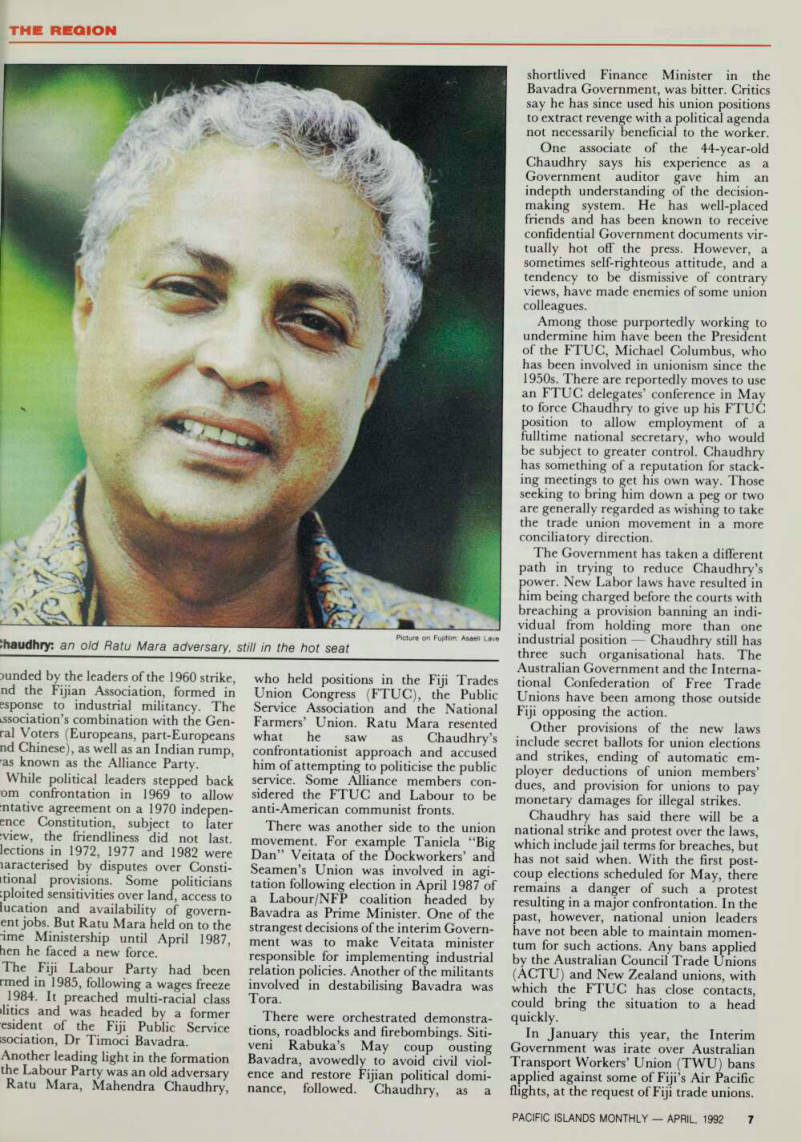
Chaudhry: an old Ratu Mara adversary, still in the hot seat
Picture on Fujifilm: Asaeli Lave
Some Fiji ministers reportedly wanted
Chaudhry jailed.
Deputy Prime Minister Josevata Kami kamica, seen as backing the labour laws in an attempt to paint himself as a man with the personal toughness to be a Prime Minister, this time counselled restraint. Nonetheless, bitterness in Gov ernment circles over the Air Pacific bans ran deep because it threatened attempts to overcome a tourism slump.
The labour laws are part of what Kamikamica and other economic minis ters see as a need to develop an export
oriented economy propelled by market forces. For people like Chaudhry, the Government has no mandate for such changes because of the way it came to power.
Chaudhry has continued to cling to the need to boycott the forthcoming elections under what he sees as a racist and undemocratic Constitution guaranteeing an ethnic Fijian House of Representa tives majority. That stance has brought him increasingly into conflict with more pragmatic colleagues involved with the Labour Party. Even Adi Kuini Bavadra,
whose former husband, the late Timoci: Bavadra, was involved with Labour’s birth, recently said publicly she believed; there was no practical option other thair Labour going along with the National Federation Party in fielding election; candidates and encouraging supporters to vote.
Only time will reveal a clearer picture on the wisdom or folly of the boycott stance.: As things stand, the Labour Party is badly wounded, possibly fatally. Promin ent defectors Columbus among them have already formed a ‘New Laboun Party’ which will try and put MPs into: Parliament to fight against the Consti tution from within. Chaudhry has been involved in vitriolic exchanges on the 3 issue with former allies.
While Chaudhry has had a massive set back on the Labour boycott, he can takes heart from a morale-boosting landslides win for the National Farmers’ Union in hotly contested, and much delayed, elections for the industry’s Cane Grow ers’ Council. His more conservatives opponents in this arena argued that the country’s 23,000 mainly Indian cane farmers had lost out badly from regulan protests interrupting cane harvesting and!
milling. Evidently a majority decided!
that Chaudhry’s militant tactics had put) more money in their pockets than had! been lost.
In the middle of last year, there was the deep irony of coup leader Rabuka* intervening with Chaudhry and Colum bus as a peacemaker to successfully end! a long harvest boycott over Sugan Corporation payments for raw cane, and! avert a threatened national strike against) industrial decrees. The decrees, whichi included 14-year jail terms for disruption! of vital industries, were subsequentlys scrapped. Ironically, despite the coupsg Chaudhry believed that at least it wasa possible to sit down and exchange views with the former army\ strongman who is now bidding, along* with Kamikamica and others, to becomes Prime Minister.
The current degree of polarisation oft Fiji’s politics and industrial relations? partly goes back to the bitter days oft indenture, colonial polices of separates development, and the legacy of political! opportunism. The establishment tendedl to identify with development interests? and fear challenges to their authority.
On the other hand, concepts of maximis ing industrial muscle to force gains? perpetuated a cycle of conflict which is? still playing itself out. Arguably, what) Fiji needs, if it is to transform into stability and mistrust into trust, is a£ circuit-breaker.
The big question is whether the forces? within the trade union movement, andf the national elections, will provide such a opportunity. The costs off the alternative are high indeed. □ C