All's fine for a Fiji stopover
pp. 57-58 · Read in the full issue
Yachting
p ales from the Fellowship by Sally •lizabeth Andrew CRUISING boats from around the world congregate in Fiji waters during the austral win ter, especially during the lonths of September and October. This uilti-national blend ofyachties includes rst-year South Pacific cruisers coming om North America, European circum
avigators arriving via the anama Canal and Cape forn, New Zealanders and ustralians sailing direct to Fiji r via Tonga, and a big mtingent of South Pacific veterans” who have returned r another season.
Fiji is a great place to relax, ive fun and reprovision, iva, the capital, is on the indward side of Viti Levu id the entrance and range arkers to the harbour are ten obscured by low clouds id rain. A rusty wreck on the ef marks one side of the trance a reminder to dinners to be careful. Entry
-malities are straight
■ward and, after clearing stoms, anchorage can be ten in front of the Royal va Yacht Club. Fellowship chored in Suva Harbour th nearly 100 other boats m around the world.
Suva is full of ethnic variety foods, goods, people and vices. The native Fijian pulation greeted us with ula! Bula!” as we walked ng the street. Like most of i, Suva (population 70,000) a cultural crossroads of
“lanesian, Polynesian,
cronesian, Indian, Chinese i European cultures. It is a
fascinating place to visit with an over whelming diversity of cultures and arti facts.
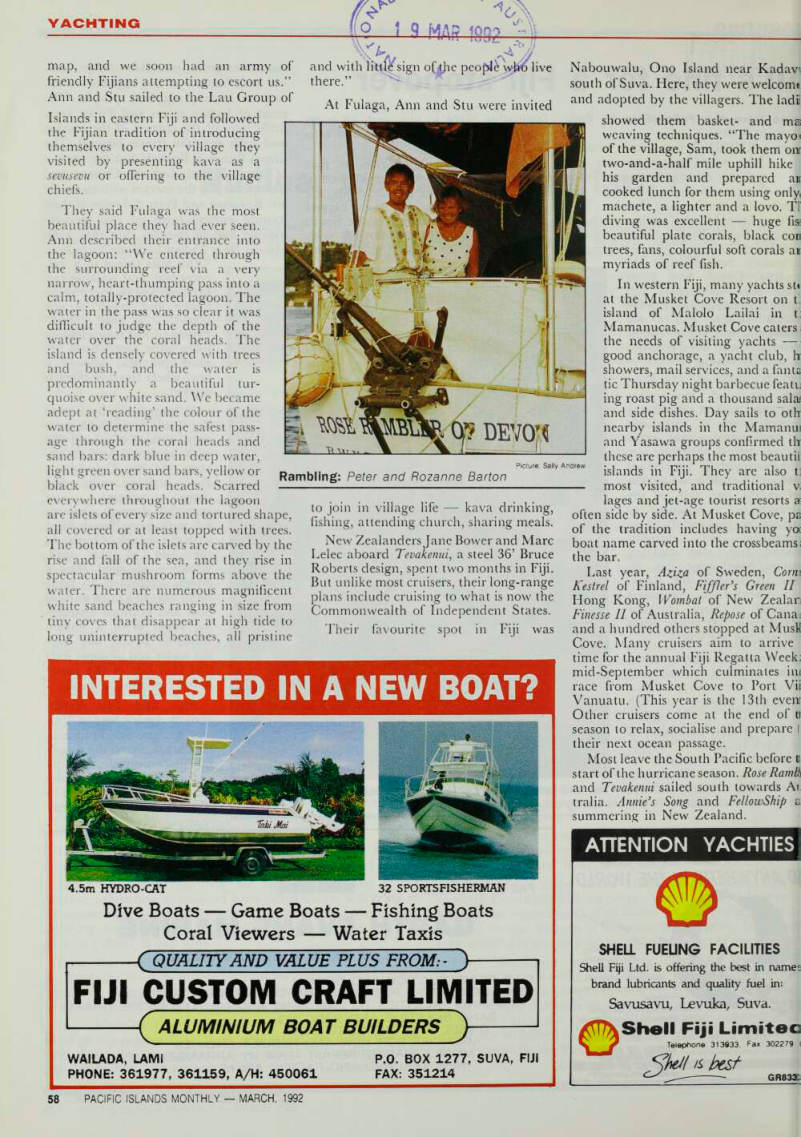
Peter and Rozanne Barton on Rose Rambler of Devon (homeport Plymouth, England) loved Suva the people, the restaurants, and shopping at the biggest and best open-air market in the South Pacific. It literally overflowed with produce and colours: pawpaw gold,
cucumber green, pumpkin orange, tom ato red, lemon yellow, eggshell white, cassava brown, eggplant purple. The scent of Indian spices and Fijian kava drifts into all the corners of the market and spills into the streets beyond. The lingua franca is English, but the chatter of ethnic Fijians, Indians, Chinese and Europeans fills the market with an exotic air. Rozanne and Peter did most of their touring around town on two strange looking folding bicycles that they keep aboard their 35-foot Camper/Nicholson.
“You miss things in a car, cocooned, and walking can be slow. Locals everywhere notice and laugh at our bikes a good intro!”
Peter and Rozanne’s folding bikes with tiny wheels are quite practical aboard a boat where stowage space is limited.
A longer trip by bus to the outskirts of Suva gave them a taste of inland Fiji with its forests and moun tains. At the Colo-i-Suva Park, walking trails wind along streams and waterfalls through a beauti ful mahogany forest filled with the sounds of birds. At the end of the trail, Rozanne changed into a pareo, scrambled up some rocks next to a huge natural pool and grabbed a swing ing rope. With a scream Rozanne swung out over the water and plunged feet first into one of the many natural swimming pools.
Ann and Stu Yellen aboard Annie’s Song , a Val iant 40 from San Fransisco, California, found the people
in Fiji “universally friendly
and helpful. We made the mistake of standing on a street corner reading a city
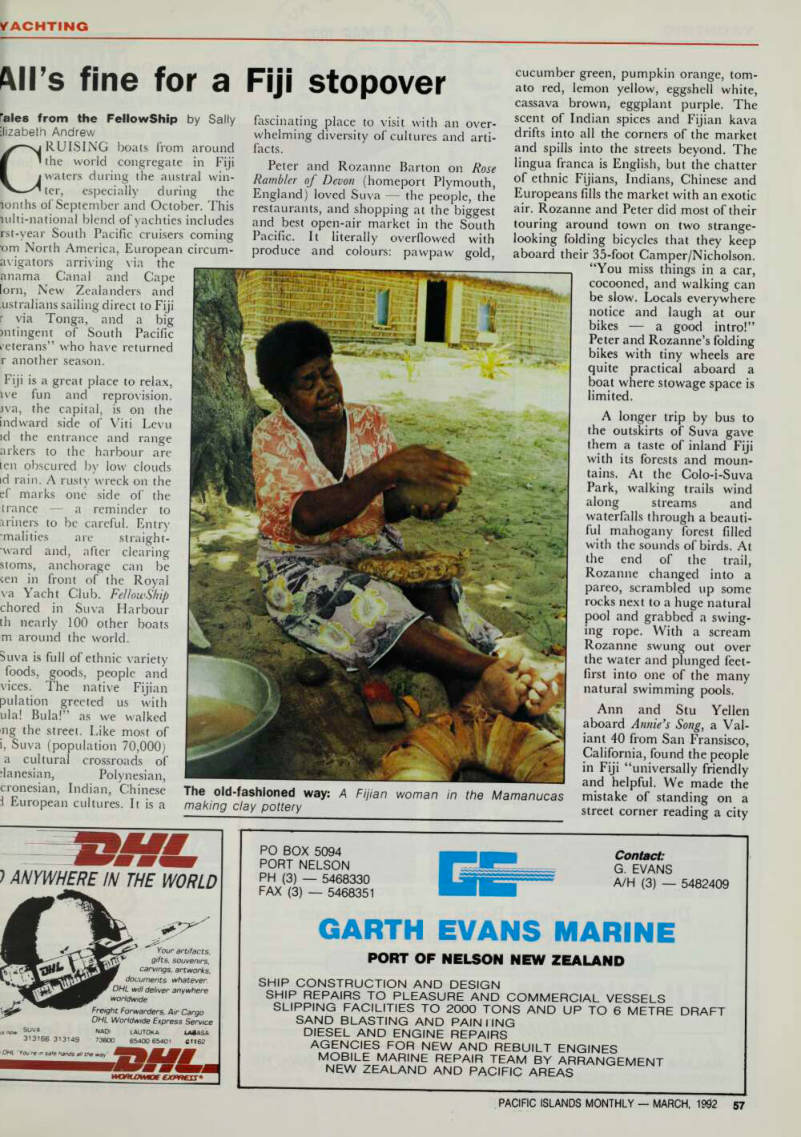
The old-fashioned way: A Fijian woman in the Mamanucas making clay pottery
map, and we soon had an army of friendly Fijians attempting to escort us.”
Ann and Stu sailed to the Lau Group of
Islands in eastern Fiji and followed the Fijian tradition of introducing themselves to ever)' village they visited by presenting kava as a sevusevu or offering to the village chiefs.
They said Fulaga was the most beautiful place they had ever seen.
Ann described their entrance into the lagoon: “We entered through the surrounding reef via a very narrow, heart-thumping pass into a calm, totally-protected lagoon. The water in the pass was so clear it was difficult to judge the depth of the water over the coral heads. The island is densely covered with trees and bush, and the water is predominantly a beautiful tur quoise over white sand. We became adept at ‘reading’ the colour of the water to determine the safest pass age through the coral heads and sand bars: dark blue in deep water, light green over sand bars, yellow or black over coral heads. Scarred
everywhere throughout the lagoon
are islets of every size and tortured shape, all covered or at least topped with trees.
The bottom of the islets are carved by the rise and fall of the sea, and they rise in spectacular mushroom forms above the water. There are numerous magnificent white sand beaches ranging in size from tiny coves that disappear at high tide to long uninterrupted beaches, all pristine
and with little sign o(jtJie people wj *6 live there.”
At Fulaga, Ann and Stu were invited
to join in village life kava drinking, fishing, attending church, sharing meals.
New Zealanders Jane Bower and Marc Lelec aboard Tevakenui , a steel 36’ Bruce Roberts design, spent two months in Fiji.
But unlike most cruisers, their long-range plans include cruising to what is now the Commonwealth of Independent States.
Their favourite spot in Fiji was
Nabouwalu, Ono Island near Kadavv south of Suva. Here, they were welcome and adopted by the villagers. The ladil
showed them basket- and ma weaving techniques. “The mayo* of the village, Sam, took them onr two-and-a-half mile uphill hike his garden and prepared an cooked lunch for them using machete, a lighter and a lovo. Tl' diving was excellent huge fis beautiful plate corals, black con trees, fans, colourful soft corals an myriads of reef fish.
In western Fiji, many yachts sU at the Musket Cove Resort on t; island of Malolo Lailai in f: Mamanucas. Musket Cove caters. the needs of visiting yachts good anchorage, a yacht club, hr showers, mail services, and a fanta tic Thursday night barbecue featu ing roast pig and a thousand salat and side dishes. Day sails to othr nearby islands in the Mamanui and Yasawa groups confirmed thr these are perhaps the most beautii islands in Fiji. They are also tJ most visited, and traditional v, lages and jet-age tourist resorts a
often side by side. At Musket Cove, ps of the tradition includes having ya boat name carved into the crossbeams the bar.
Last year, Aziza of Sweden, Conn Kestrel of Finland, Fifjler’s Green II Hong Kong, Wombat of New Zealar Finesse II of Australia, Repose of Cana, and a hundred others stopped at MusW Cove. Many cruisers aim to arrive time for the annual Fiji Regatta Week mid-September which culminates ini race from Musket Cove to Port Vii Vanuatu. (This year is the 13th even Other cruisers come at the end of t) season to relax, socialise and prepare I their next ocean passage.
Most leave the South Pacific before tl start of the hurricane season. Rose Ram& and Tevakenui sailed south towards At tralia. Annie's Song and Fellowship a summering in New Zealand.
Rambling: Peter and Rozanne Barton
Picture: Sally Andrew