Nuclear weapon of the law
p. 56 · Read in the full issue
FOR centuries, debt-dodgers have contrived various debt-evasion schemes to deprive a creditor of its entitlement to the fruits of judgment.
Involving the dissipation or disposal of assets within the country or their removal overseas, such schemes are usually invoked between the time of initiation of proceedings and the date of judgment to remove assets away from the reach of the successful
plaintiff.
With the advent of Electronic Funds Transfer facilities, unscrupulous defendants are able to whisk their assets out of the country in the “twinkling of a telex” literally, a matter of seconds.
Until recently, English common law preferred to lend its aid to the evasive tactics of crafty defendants. It refused to intervene on the precept that pending final judgment,
individuals enjoyed the freedom to deal with assets as they wished. Then, in a series of landmark decisions, the English Court of Appeal swept aside earlier authority to found its jurisdiction to grant an injunction restraining the defendant from removing, disposing, or otherwise dealing with assets so as to defeat the plaintiffs entitlement to have its judgment satisfied.
Acquiring its name from the landmark case in which the English Court of Appeal considered and approved the remedy, the Mareva injunction is essentially an order which “freezes” or “preserves” the assets of the defendant until the claim is
judicially determined.
Unlike the saisie conservatoire which is available in European continental jurisdictions and the American writ of pre-trial attachment, the Mareva injunction does not enable the plaintiff to seize the defendant’s assets as security for its claim.
It does not create any proprietary interest in the assets in favour of the applicant. Neither does it prohibit debtors from absconding. It merely ensures that the defendant’s assets (which include all forms of property) will be available for satisfaction of the plaintiff’s judgment.
If the defendant fails to comply with the terms of the Mareva injunction, it risks punishment for contempt of court.
Initial scepticism regarding the juristic foundation of the Mareva injunction appears to have faded away. Referring to his procreative role in inventing the Mareva injunction, Lord Denning has described its advent as “the greatest piece of judicial reform in my time”.
From the cradle of its territorial application being limited to “freezure” of assets situated within the country, the Mareva injunction has developed to extend its tentacles worldwide wherever the defendant’s assets may be located.
Its availability is not confined to the commercial sphere.
Mareva injunctions have been granted in tax cases, divorce cases, and in the context of criminal proceedings. The popularity and effectiveness of the remedy is confirmed by
Pacific Law
reports estimating that the number of applicai tions for Mareva injunctions in Englano currently exceeds 20 per month.
Mareva injunctions have been granted ii many common law jurisdictions (including Australia, New Zealand, Canada and a numbe of Pacific countries). Perhaps much to the env' of their English brethren, the judges of somi Pacific courts had enjoyed the power to orde the more extensive remedy of pre-trial attach ment long before the Mareva injunction wa devised.
These courts’ jurisdiction to order pre-tris attachment in the event of some risk o dissipation or removal of assets derives from thr Rules of Court made under the Western PacifT (Courts) Order in Council. There are isolate: instances in which this power has bee: exercised.
Applications for Mareva injunctions an
invariably brought without notice to the defendant to preserve the element of surprise. Various requirements must be salislie: before the Court will grant the injunction. Once the injunctioc is granted, the defendant may approach the Court to discharge it or vary its terms. The defendant may offer security or provic: an undertaking to satisfy the plaintiffs claim.
Obviously, third parties (especially the defendant’s banker;who have notice of the Mareva injunction are in a precariou position. They must be extra vigilant in their efforts to ensui that they do not breach its terms. Their duty to comply will the order of the Court takes precedence over their obligation to the defendant.
The Mareva injunction is widely perceived as an oppressiv remedy. Its potential abuses are well known. Armed with Mareva injunction, a merciless plaintiff can virtually crippi the defendant’s business operations.
Every monetary transaction is subjected to scrutiny am approval by the plaintiff. Businessmen arc no! usuall accustomed to such degrees of accountability and interfere in. in their daily affairs.
However, courts are sensitive to the practical problems face by defendants and generally allow funds to be drawn fil ordinary living and business expenses.
The strategic value of the Mareva injunction cannot If ignored. Combined with an order compelling the defendant disclose the whereabouts of its assets, the Mareva injunction] a useful tactical weapon in the plaintiff’s armoury. It has beo; instrumental in securing the prompt settlement of many claim] Lord Donaldson has correctly described the Marev; injunction as “one of the law’s ‘nuclear’ weapons” a prodm. of judicial creativity demonstrating the law’s capacity to adai to the modern demands of the nuclear age. Both the Mare*; injunction and the plea-trial attachment order can I effectively mobilised in combating the increasing incidence debt evasion in the Pacific.
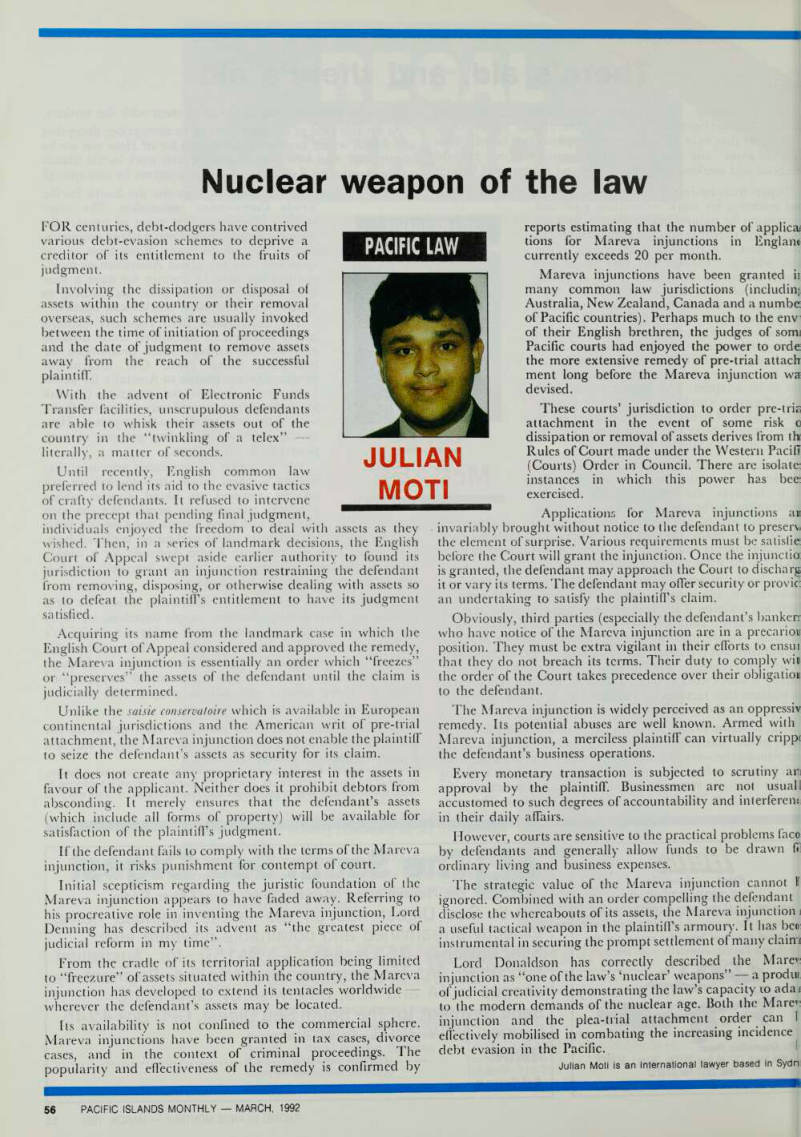
Julian Moll is an International lawyer based in Sydm