BOUGAINVILLE’S rebellion
p. 20 · Read in the full issue
Guide for mining guerillas
Plunder! by Roger Moody, PARTIZANS/Campaign Against Foreign Control of Aotearoa in London and Christchurch, NZ$25.
and secession have become pointers to the future for Pacific indigenous land rights guerillas.
The term “to Bougainville” is already a new lexicon among activists confronting
mining companies.
Roger Moody, author of the contro versial new book, Plunder! , argues that opposition is growing among indigenous groups over the ravages caused by mining companies, particularly the British-based giant Rio Tin to Zinc. He believes two critical focus points for opposition to RTZ are in Papua New Guinea and the United Stales.
On Bougainville, the Bougainville Revolutionary Army is still precariously clinging to power alter succeeding in closing the Panguna copper mine in 1989 and turning the island into a de facto republic. And, at the Flambeau copper mine in Wisconsin, a coalition of farmers, environmentalists, political groups and indigenous activists defeated a proposal by RTZ to develop a mine.
“By working together and putting the spotlight on RTZ’s high-handed disre gard for the land, people and laws of the world,” says Moody, “opponents have been able to create some semblance of accountability and to protect themselves against some of RTZ’s worst misdeeds.”
According to Professor A 1 Gedicks, of the US-based Centre for Alternative
Mining Development Policy, Plunder!
gives a “rare glimpse into the neo colonial mindset of RTZ’s top execu tives” and gives a valuable account of community-based organising methods to defend indigenous land rights, work er’s health and the environment. He describes the book as a guerilla’s handbook “with this knowledge in hand, communities directly affected by mining activities can go about planning effective corporate counter-strategies.”
Described as the “driving force” behind the People Against Rio Tinto Zinc and its Subsidiaries (PARTIZANS) movement, set up in 1978 to fight for indigenous land owner groups, Moody is also coordinator of the London-based Mincwatch, which moni tors the international activities of min
ing conglomerates.
Plunder! chronicles RTZ , which has mineral interests in every continent except the Antarctic.
With 52 mines in 40 countries, RTZ is the world’s largest mining corpor ation. Conzinc Riotinto of Australia (CRA Ltd) is a subsidiary of RTZ and in turn is principal owner of Bougain
ville Copper Ltd. CRA five years ago discovered the Mt Kare gold mine in the PNG Highlands, which has been the target of a protest raid by a provincial MP and seven armed landowners.
The 198-page book includes more than 80 illustrations, including maps, charts and photographs. The longest chapter deals with CRA, Aboriginal and Maori land, and Bougainville.
Measured by market capitalisation, CRA ranks sixth among the world’s top 10 mining corporations. RTZ may be the world’s most criticised miner, but CRA is more responsible than any other of its units for the desecration of indigenous land and culture. Comalco (67 per cent CRA-owned) has, for more than a decade, successfully cajoled, deceived and browbeaten legislators over a whole continent. CRA could be producing yellowcake long after Rio Algom’s mines have closed. CRA’s operations are bigger and more import ant than RTZ’s smelting plants. The parent company may be the most diversified mining company in the world, but CRA runs a close second.
In the context of RTZ’s worldwide operations, Moody says CRA was the first mining company in Australia against which the major land councils called a boycott for its violation of ancestral land at Lake Argyle and at Noonkanbah.
The author warns that there is a paradox in that, successful as land protesters might be in squeezing com panies like RTZ and CRA, the more likely they would move into other Pacific countries and territories such as elsewhere in PNG, Fiji and New Caledonia. He claims it is Bougainville Copper Ltd which, of all CRA’S main enterprises, has best illustrated the degree to which the company is “pre
pared to exploit indigenous people” and
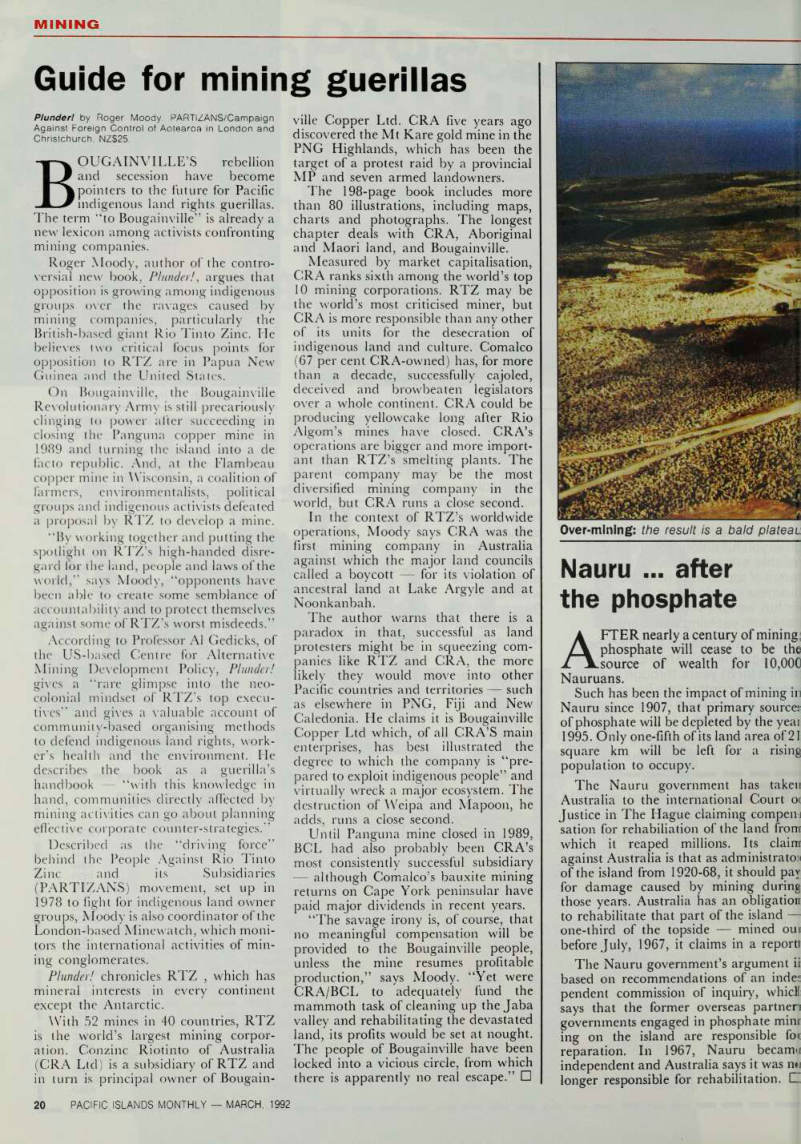
virtually wreck a major ecosystem. The destruction of VVeipa and Mapoon, he adds, runs a close second.
Until Panguna mine closed in 1989, BCL had also probably been CRA’s most consistently successful subsidiary although Comalco’s bauxite mining returns on Cape York peninsular have paid major dividends in recent years.
“The savage irony is, of course, that no meaningful compensation will be
provided to the Bougainville people,
unless the mine resumes profitable production,” says Moody. “Yet were CRA/BCL to adequately fund the mammoth task of cleaning up the Jaba valley and rehabilitating the devastated land, its profits would be set at nought.
The people of Bougainville have been locked into a vicious circle, from which there is apparently no real escape.” □