Waiting for oil taps to turn
p. 17 · Read in the full issue
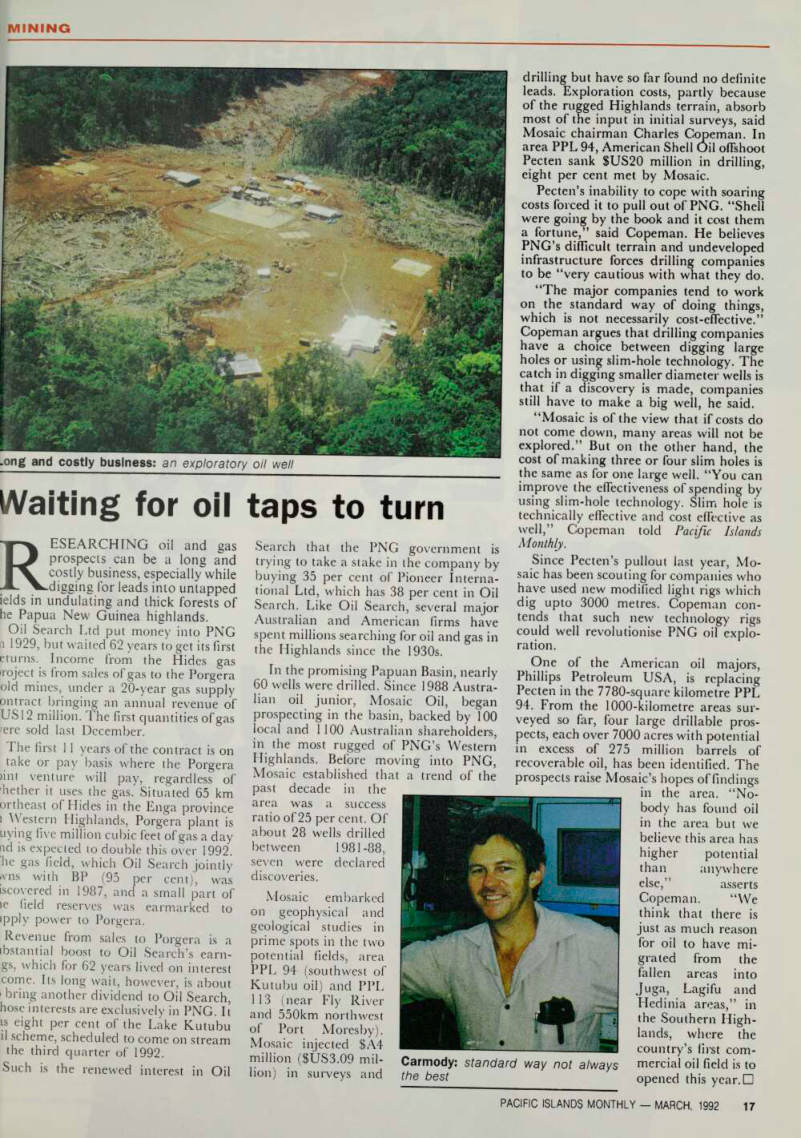
RESEARCHING oil and gas prospects can be a long and costly business, especially while digging for leads into untapped ields in undulating and thick forests of he Papua New Guinea highlands.
Oil Search Ltd put money into PNG n 1929, but waited 62 years to get its first bturns. Income from the Hides gas Toject is from sales of gas to the Porgera old mines, under a 20-year gas supply ontract bringing an annual revenue of US 1 2 million. The first quantities of gas 'ere sold last December.
The first 11 years of the contract is on take or pay basis where the Porgera )int venture will pay, regardless of r hether it uses the gas. Situated 65 km ortheast of Hides in the Enga province
i Western Highlands, Porgera plant is
uying five million cubic feet of gas a day ad is expected to double this over 1992. he gas Held, which Oil Search jointly >vns with BP (95 per cent), was iscovered in 1987, and a small part of ie field reserves was earmarked to
ipply power to Porgera.
Revenue from sales to Porgera is a ibstantial boost to Oil Search’s earn gs, which for 62 years lived on interest come. Its long wait, however, is about 1 bring another dividend to Oil Search, hose interests are exclusively in PNG. It is eight per cent of the Lake Kutubu il scheme, scheduled to come on stream the third quarter of 1992.
Such is the renewed interest in Oil
Search that the PNG government is trying to take a stake in the company by buying 35 per cent of Pioneer Interna tional Ltd, which has 38 per cent in Oil Search. Like Oil Search, several major Australian and American firms have spent millions searching for oil and gas in the Highlands since the 19305.
In the promising Papuan Basin, nearly 60 wells were drilled. Since 1988 Austra lian oil junior, Mosaic Oil, began prospecting in the basin, backed by 100 local and 1100 Australian shareholders, in the most rugged of PNG’s Western Highlands. Before moving into PNG, Mosaic established that a trend of the
P ast decade m the a *^ a was a success ratio of 25 per cent. Of ab out 28 wells drilled between 1981-88, seven were declared discoveries, Mosaic embarked on geophysical and i • 1 1 a geological studies in prime spots in the two potential fields, area PPL 94 (southwest of Kutubu oil) and PPL 113 (near Fly River and 550 km northwest of Port Moresby),
Mosaic injected »A 4
million (SUS3.O9 mil lion) in surveys and
drilling but have so far found no definite leads. Exploration costs, partly because of the rugged Highlands terrain, absorb most of the input in initial surveys, said Mosaic chairman Charles Copeman. In area PPL 94, American Shell Oil offshoot Pecten sank SUS2O million in drilling, eight per cent met by Mosaic.
Pecten’s inability to cope with soaring costs forced it to pull out of PNG. “Shell were going by the book and it cost them a fortune,” said Copeman. He believes PNG’s difficult terrain and undeveloped infrastructure forces drilling companies to be “very cautious with what they do.
“The major companies tend to work on the standard way of doing things, which is not necessarily cost-effective.”
Copeman argues that drilling companies have a choice between digging large holes or using slim-hole technology. The catch in digging smaller diameter wells is that if a discovery is made, companies still have to make a big well, he said.
“Mosaic is of the view that if costs do not come down, many areas will not be explored.” But on the other hand, the cost of making three or four slim holes is the same as for one large well. “You can improve the effectiveness of spending by using slim-hole technology. Slim hole is technically effective and cost effective as well,” Copeman told Pacific Islands Monthly.
Since Pecten’s pullout last year, Mo saic has been scouting for companies who have used new modified light rigs which dig upto 3000 metres. Copeman con tends that such new technology rigs could well revolutionise PNG oil explo ration.
One of the American oil majors, Phillips Petroleum USA, is replacing Pecten in the 7780-square kilometre PPL 94. From the 1000-kilometre areas sur veyed so far, four large drillable pros pects, each over 7000 acres with potential in excess of 275 million barrels of recoverable oil, has been identified. The prospects raise Mosaic’s hopes of findings
in the area. “No body has found oil in the area but we believe this area has higher potential than anywhere else,” asserts
Copeman. “We
think that there is just as much reason for oil to have mi grated from the fallen areas into
Juga, Lagifu and
Hedinia areas,” in the Southern High lands, where the country’s first com mercial oil field is to opened this ycar.D
Long and costly business: an exploratory oil well
Carmody: standard way not always the best