UN Security
pp. 7-8 · Read in the full issue
Force for small states
By lan Williams
A RESOLUTION to form a United Nations Security Force for small states was passed unanimously by the General Assembly in December last year.
The resolution, jointly sponsored by the Maldives and the Solomons and supported by 64 other states, calls on the Secretary General to continue monitoring the security situation of small states while exploring further ways to ensure their safety.
Small developing states are con stantly exhorted by the international aid agencies not to dissipate their resources on military hardware or manpower. Most are very happy not to do so. However, the invasion of Kuwait reminded the world of the vulnerability of small states to aggressive neighbours.
It is not just larger countries which pose a threat. Many groups ranging from guerillas to drug smugglers would like to wrap themselves in the legal protection of a sovereign state, no matter how minute.
The fission of seemingly stable na tions in Europe indicates that soon
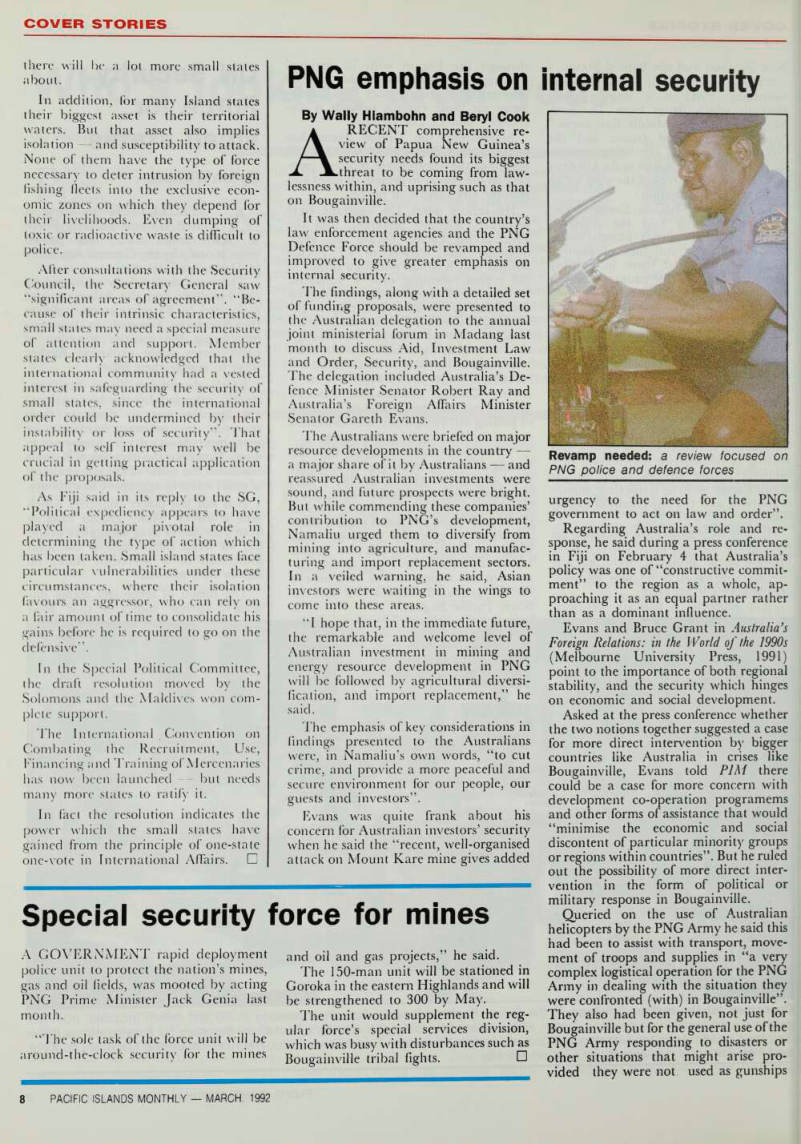
Concerned for the reglon: Delegates to the Forum Regional Seucurity Committee meeting in Fiji last month included. from left, Australia's Ambassador to Fiji John trotter, FSM Ambassador to Fiji Alik Alik, Fiji's Pernanent Secretary for Foreign Affairs Robin Yarrow, Kiribatis Assistan Secretary Miniistry of Foregin Affairs and Trade Taam Biribo, Nauru's Presidential Counsel Leo Keke, and New Zealand's ambassador to Fiji Don Mackay.
there will be a lot more small stales about.
In addition, for many Island states their biggest asset is their territorial waters. But that asset also implies isolation - and susceptibility to attack.
None of them have the type of force necessary to deter intrusion by foreign fishing fleets into the exclusive econ omic zones on which they depend for their livelihoods. Even dumping of toxic or radioactive w'aste is difficult to police.
After consultations with the Security Council, the Secretary General saw “significant areas of agreement”. “Be cause of their intrinsic characteristics, small states may need a special measure of attention and support. Member states clearly acknowledged that the international community had a vested interest in safeguarding the security of small states, since the international order could be undermined by their instability or loss of security”. That appeal to self interest may well be crucial in getting practical application of the proposals.
As Fiji said in its reply to the SG, "Political expediency appears to have played a major pivotal role in determining the type of action which has been taken. Small island states face particular vulnerabilities under these circumstances, where their isolation favours an aggressor, w ho can rely on a fair amount of time to consolidate his gains before he is required to go on the defensive”.
In the Special Political Committee, the draft resolution moved by the Solomons and the Maldives won com plete support.
The International Convention on Combating the Recruitment, Use, Financing and Training of Mercenaries has now been launched but needs many more stales to ratify it.
In fact (he resolution indicates the power which the small states have gained from the principle of one-stale one-vote in International Affairs. □