Who’s looking after you?
pp. 6-7 · Read in the full issue
Cover Stories
By Martin Tiffany
THE United States’ scaling down of its military presence in the Asia-Pacific region has left the Islands to ponder whether they are vulnerable to expansionary moves or the conflicts of other countries. And the long-running Bougainville crisis in Papua New Guinea has raised the touchy subject of if and to what extent larger countries in the nation should interfere in crises which may be internal, or which may be a threat to regional peace and stability. Meetings in New Zealand and Fiji last month, and an earlier resolution in the United Nations at the end of last year, raised the question of whether we need a regional security or surveillance force, what form and role it would take, and how it would be funded. There has even been talk of an Islands Interpol. The basic questions, however, are just who is looking after the Island nations, and whether what we have is enough to guarantee regional peace, stability and well-being.
PAPUA New Guinea’s
deputy Opposition
Leader, Sir Julius Chan, first made reference to a regional security force in 1980 when, as PNG Prime Minister, he sent troops to the Vanuatu island of Espiritu Santo to help quell a secessionist attempt after independence.
At the lime, Sir Julius talked aboui “the need for a South Pacific peace-keeping force to handle any similar situations in the future’’.
“The force I envisage would contain personnel from all its democratic mem
her countries, w ith at least half coming from Island State members, and be funded predominantly by Australia, New Zealand and, maybe, even the United States," said Sir Julius.
"It would be a small but highly mobile body and, in times of peace, carry out a continuous programme of engineering projects and immediate disaster relief.”
Its use as a military peace-keeping force, he said, would be only at the
request of legitimate, democratically
elected governments “as was the case in Vanuatu”. He said the peace-keeping force would be a watchdog for small Island states “a potent deterrent to individuals seeking to overthrow the will of the majority". However, he pointed out that this was not a proposal for Australia to play “regional policemen”.
The idea could bear relevance to recent events. In January this year, PNG considered setting up its own anti terrorist squad to counter attacks like the one on January 23 which has crippled the Australian-owned Mount Kare al luvial gold mine. Police Minister Mathias Ijape wanted urgent cabinet approval to set up the crack unit of 300 specially trained policemen. Later that month, PNG announced it was going to establish a rapid response police unit to protect its mining industry (story page 8 But how realistic is a regional security or defence force? The New Zealand army chief of staff, Major General Bruce Meldrum, said his country is cautious about the political, financial, and admin istrative implications of a military force.
He said the idea of full-time armies for small Island nations and a regional force arc matters for individual nations and regional governments but, in his opinion,
the Islands did not need full-time armies.
The new defence attache at the Australian Embassy in Suva, Lt Col Mike Dennis, agrees with Maj Gen Meld rum. “This question has been raised several times previously, mainly by Sir Julius Chan, and it generally has received a cool reception in the South Pacific,” Lt Col Dennis told Pacific Islands Monthly.
A major reason for its lukewarm reception, he said, is people have had difficulty explaining how such a force would be used in what many people consider localised or internal problems.
Funding sources and the level of enthusi asm also are questionable.
The New Zealand Ambassador to Fiji, Don Mackay, said he was not aware of any firm stance his country has taken on the issue, and said if it was going to be pursued it would have to be at the very
highest level.
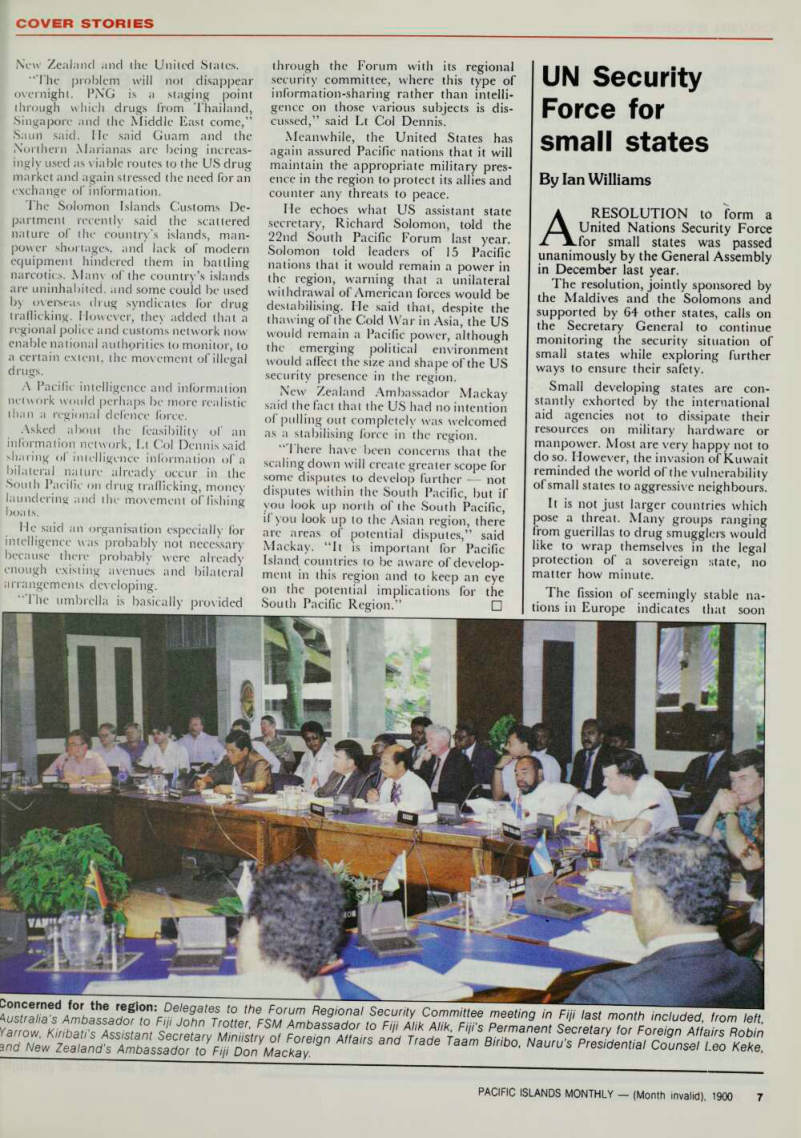
The issue also was expected to be discussed at the Forum Regional Secur ity Committee meeting from February 18 to 21 in Suva. Despite earlier rumours that the meeting could look at setting up an Islands Interpol, the meeting chair man, Nauru’s Leo Keke, told the media during the meeting that the Forum would not be setting up a regional security force and the idea was not even on the meeting agenda. They discussed
drug trafficking, a review of regional
arrangements for extradition and mutual assistance in criminal matters, and assess ment of regional training arrangements.
The idea of a regional force seems attractive given the increase in illegal fishing and drug trafficking in the region, along with regional disturbances.
Already Australia and New Zealand have been flying surveillance flights
around the exclusive maritime zones of some South Pacific countries, and a number of in truders have been caught.
New Zealand has con ducted patrols in the east ern Pacific and Polynesia for a number of years and has recently extended pa trols to PNG, Vanuatu, the Solomon Islands, Nauru, the Marshall Islands and the Feder ated States of Micronesia.
Australia also is fund ing a South Pacific
patrol-boat project to aid
the Islands with maritime surveillance. So far 15 vessels have been com
pleted and distributed as follows: PNG four; Solomons two; Vanuatu one; West ern Samoa one; Cooks one; Federated States of Micronesia two; Marshalls one and Tonga three.
New Zealand also has been supporting this project with navy personnel to the programme as advisers and trainers.
Australia’s total defence cooperation program, in the South Pacific in the 1991-92 period is worth As7s million. Of this, S4O million goes to PNG, 523 million to the rest of the Pacific and the remaining amount goes to the ASEAN
region.
Meanwhile, the discovery of S3o< million worth of hashish in Fiji recently' highlighted the need for an efficient;
regional drug-policing network.
Last month PNG closed all its airports* outside Port Moresby to direct interna tional flights in a bid to halt a thriving; trade in drugs and guns. According toe PNG Police Minister Ijape, Australiani crime syndicates are using PNG’s porous? borders to trade drugs from Australia! and marijuana from PNG.
PNG’s Comptroller of Customs, Pius?
Saun, said they did not have the! necessary capability to patrol thein borders and the exchange of informa tionr especially with Australia was a t vital part of their war against drugs.
Saun said a regional security forces might be hard to develop, and wouldt involve delicate questions such as na
tional sovereignty.
Saun is also the chairman of the Customs Heads of Administration Re gional Meeting (CHARM) which meets annually to discuss regional customs issues. He pointed to the growing regional concern about drugs, and par ticularly the growing use of Pacific Island: countries as transit points into Australia^
New Zealand and the United States.
“'Fhe problem will not disappear overnight. PNG is a staging point through which drugs from Thailand, Singapore and the Middle East come,”
Saun said. Me said Guam and the Northern Marianas are being increas ingly used as viable routes to the US drug market and again stressed the need for an exchange of information.
The Solomon Islands Customs De partment recently said the scattered nature of the country’s islands, man power shortages, and lack of modern equipment hindered them in battling narcotics. Many of the country’s islands are uninhabited, and some could be used by overseas drug syndicates for drug trafficking. However, they added that a regional police and customs network now enable national authorities to monitor, to a certain extent, the movement of illegal drugs.
A Pacific intelligence and information network would perhaps be more realistic than a regional defence force.
Asked about the feasibility of an information network, Lt Col Dennis said sharing ol intelligence information of a bilateral nature already occur in the South Pacific on drug trafficking, money laundering and the movement of fishing boats.
He said an organisation especially for intelligence was probably not necessary because there probably w'ere already enough existing avenues and bilateral
arrangements developing.
“ 1 he umbrella is basically provided
through the Forum with its regional security committee, where this type of information-sharing rather than intelli gence on those various subjects is dis cussed,” said Lt Col Dennis.
Meanwhile, the United States has again assured Pacific nations that it will maintain the appropriate military pres ence in the region to protect its allies and counter any threats to peace.
He echoes what US assistant state secretary, Richard Solomon, told the 22nd South Pacific Forum last year.
Solomon told leaders of 15 Pacific nations that it would remain a power in the region, warning that a unilateral withdrawal of American forces would be destabilising. He said that, despite the thawing of the Cold War in Asia, the US would remain a Pacific power, although the emerging political environment would affect the size and shape of the US security presence in the region.
New Zealand Ambassador Mackay said the fact that the US had no intention of pulling out completely was welcomed as a stabilising force in the region.
“ I here have been concerns that the scaling down will create greater scope for some disputes to develop further not disputes within the South Pacific, but if you look up north of the South Pacific, if you look up to the Asian region, there arc areas of potential disputes,” said Mackay. “It is important for Pacific Island, countries to be aware of develop ment in this region and to keep an eye on the potential implications for the South Pacific Region.” □