The spark in their lives
pp. 57-58 · Read in the full issue
Yachting
les from the Fellowship by Sally Elizabeth Andrew
r JT ATE lit the burner and the stove in the galley burst into flame. She and Ernst were L- from port, and the kerole had leaked out of a feed line on nr 36’ yacht, Koller.
I he Kohnleins were on passage be-
Len Valparaiso, Chile and Mangareva
French Polynesia, and their journey the Koller almost ended at this point. „ n , . . 3m self-sufficiency at sea is a way ol . and is a trait that is held in high ,ard b) most boat-owners, particularly en facing one of their worst nightres a fire at sea. Kate and Ernst, Dcrienccd sailors, had been aware of
the hazards before they left on their big journey, so they ensured Koller was well equipped with safety and navigational gear radar, satnav, sextant, liferaft, auto-pilot, windvane and luckily, fire extinguishers. Having back-up gear like a second stove, extra sails, two auto pilots, two satnavs, two dinghies, and extra bilge pumps is a must, Koller, designed by Asmus and built in Germany, was purchased and equipped specially for a voyage around the world. [t also bears Kate and Ernst’s special influence. They have owned four boats during the past 20 years and Ernst, aged 63, has a twinkle in his eye which might come from always scheming to improve
the quality of life aboard Koller.
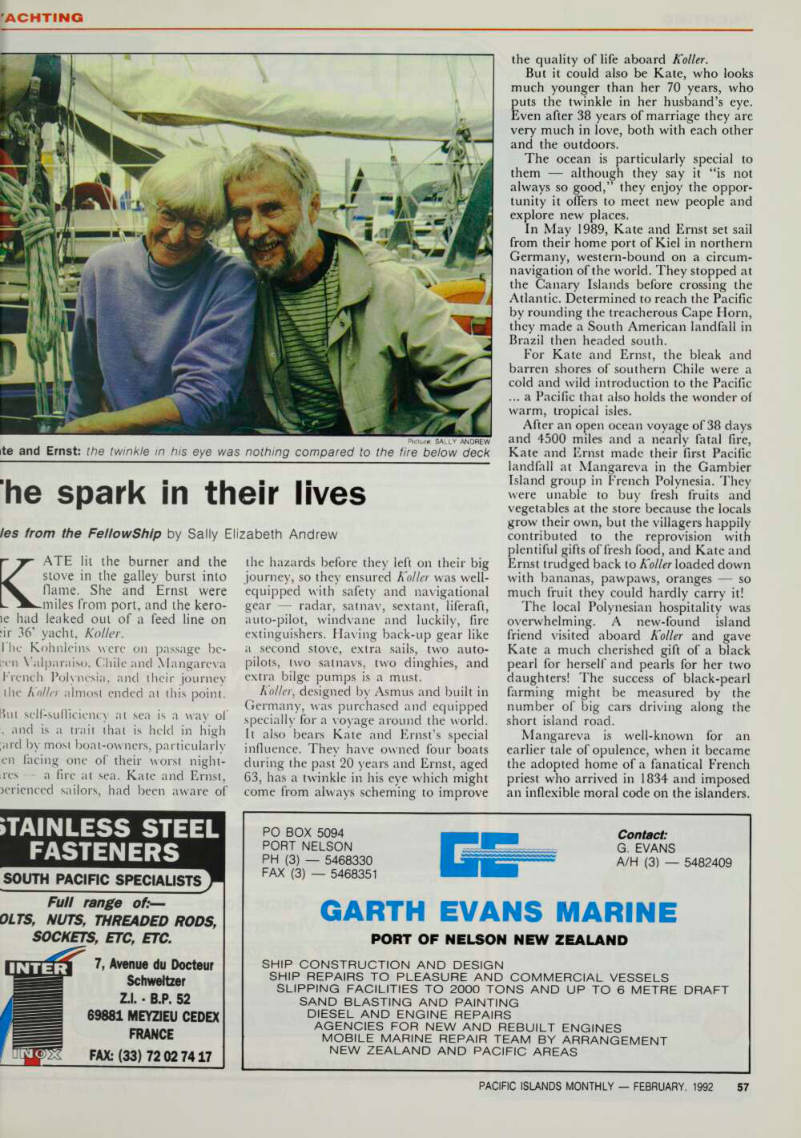
But it could also be Kate, who looks much younger than her 70 years, who puts the twinkle in her husband’s eye.
Even after 38 years of marriage they are very much in love, both with each other and the outdoors.
The ocean is particularly special to them although they say it “is not always so good,” they enjoy the oppor tunity it offers to meet new people and explore new places.
In May 1989, Kate and Ernst set sail from their home port of Kiel in northern Germany, western-bound on a circum navigation of the world. They stopped at the Canary Islands before crossing the Atlantic. Determined to reach the Pacific by rounding the treacherous Cape Horn, they made a South American landfall in Brazil then headed south.
For Kate and Ernst, the bleak and barren shores of southern Chile were a cold and wild introduction to the Pacific ... a Pacific that also holds the wonder of warm, tropical isles.
After an open ocean voyage of 38 days and 4500 miles and a nearly fatal fire, Kate and Ernst made their first Pacific landfall at Mangareva in the Gambier Island group in French Polynesia. They were unable to buy fresh fruits and vegetables at the store because the locals grow their own, but the villagers happily contributed to the reprovision with plentiful gifts of fresh food, and Kate and Ernst trudged back to Koller loaded down with bananas, pawpaws, oranges so much fruit they could hardly carry it!
The local Polynesian hospitality was overwhelming. A new-found island friend visited aboard Koller and gave Kate a much cherished gift of a black pearl for herself and pearls for her two daughters! The success of black-pearl
farming might be measured by the
number of big cars driving along the short island road.
Mangareva is well-known for an earlier tale of opulence, when it became the adopted home of a fanatical French priest who arrived in 1834 and imposed an inflexible moral code on the islanders.
Picture: SALLY ANDREW te and Ernst: the twinkle in his eye was nothing compared to the fire below deck
Father Honorc Laval ruled ruthlessly for about 40 years. He forced the islanders to build a 1200-seat cathedral with twin
towers of white-coral rock, and an altar of polished mother-of pearl. He was eventu ally removed from the island by a French war ship and declared in sane, but the religious influence remains.
While anchored at Mangareva, Kate and Ernst helped with the preparations for an im portant church festival.
The triumphal arches were garlanded in or anges and greenery, and the white towers and blue trim glistened.
Ernst and Kale gath ered leaves for the dancers’ costumes. Big meals of breadfruit, chicken, pork and beef for as many as 100 people were cooked in huge earth ovens.
Kate and Ernst later sailed on to warm welcomes on other islands in French Polynesia. Later, at Palmerston Island, Cook Islanders came out three miles by launch and guided Koller through the dangerous approaches to a tenuous roadstead anchorage. Palmerston is made up of 35 tiny islands which pop up along a barrier reef which completely encloses the lagoon. Entry by boat is impossible, so Kate and Ernst were ferried to the village to meet the chief administrator. There they were greeted with drinking coconuts.
Back in 1774 it is unlikely Captain Cook received the same welcome. Palm erston was uninhabited at the time and it was not until 1862 that William Marsters came to set up a coconut plantation. He must have received a
warm welcome, because he married three sisters and fathered 60 children before dying at the age of 78 and being
buried on the island.
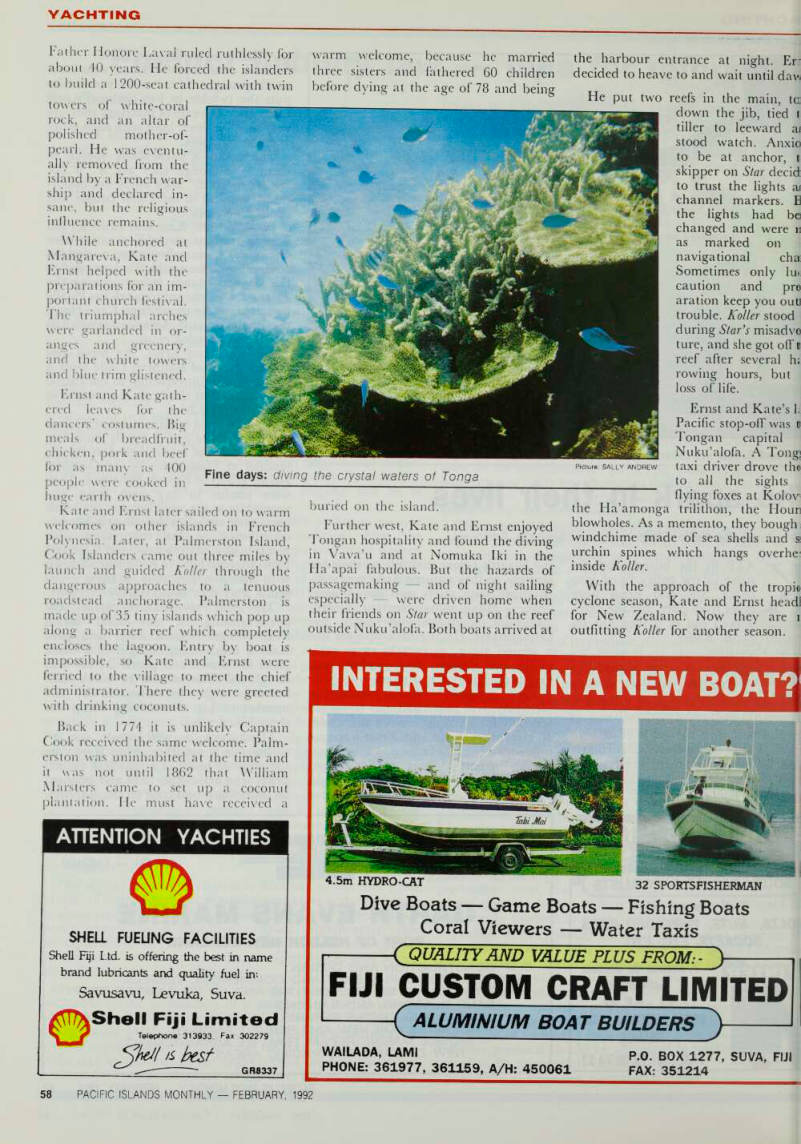
Further west, Kate and Ernst enjoyed Tongan hospitality and found the diving in Vava’u and at Nomuka Iki in the Ha’apai fabulous. But the hazards of
passagemaking and of night sailing
especially were driven home when their friends on Star went up on the reef outside Nuku’alofa. Both boats arrived at
the harbour entrance at night. Er~ decided to heave to and wait until daw He put two reefs in the main, tea
down the jib, tied I tiller to leeward at stood watch. Anxio to be at anchor, t skipper on Star decicfc to trust the lights at channel markers. B the lights had be changed and were n as marked on navigational chae Sometimes only lun caution and pre aration keep you out) trouble. Koller stood during Star’s misadve ture, and she got off tt reef after several h; rowing hours, but loss of life, Ernst and Kate’s I; Pacific stop-off was tl Tongan capital Nukualofa. A Tong; taxi driver drove the to all the sights flying foxes at Kolov'
the Ha’amonga trilithon, the Hour blowholes. As a memento, they bough windchime made of sea shells and s urchin spines which hangs overhe inside Koller.
With the approach of the tropic cyclone season, Kate and Ernst headl for New Zealand. Now they are i outfitting Koller for another season.
Fine days: diving the crystal waters of Tonga
Picture: SALLY ANDREW