Space
pp. 43-45 · Read in the full issue
Technology
Race Is it beyond our vision?
By Beryl Cook
HIGH overhead, beyond the vision of many islanders as they go about their daily work, a battle for a place in space nsues. It’s a mega-million dollar battle ncompassing information networks as as political and corporate >pionage, and as basic as television and ‘lephone services for small island Dun tries.
The big corporations are vying to stablish satellite networks that will span ic vast oceans of the world to link the ig players with big bank accounts. But i the process even the most advanced technology could be lade available to the Islands at the right rice if we plan it right.
First, we have to consider what we 'ant and who can provide it.
Most satellite operators stress business nd educational benefits of satellite ommunications such as improved tele hone and facsimile links and television roadcasts.
There also is a defence case for satellite ommunications. Professor Desmond all of the Strategic and Defence Studies Centre (DSD) in Canberra, for example, Did the media recently that the Austra an government would have known
about the Dili massacre in East Timor even before Jakarta because of the intelligence-gathering agency, the De fence Signals Directorate.
The defence expert said the DSD, which had aN operating budget of $lOO million a year, had a secret “mobile facility” on Cape York Peninsula to spy on Papua New Guinea. It had effectively duplicated ground-receiving facilities for the Indonesia Palapa Satellite Pro gramme so it could tap into satellite communications, and pick up classified military and diplomatic messages from throughout South East Asia, he said.
Papua New Guinea announced in December that it also had begun using Palapa to cover all mining and oil projects in the country under a three year lease between Posts and Telecom munications Corporation and Indonesia.
PTC managing director Ron Elias said this was to safeguard vital telecommuni cations in the mining and oil sector, which was an important foundation of the country’s economy. The move was taken because of potential problems in the lead-up to general elections sched uled for this year. Telecom links at Mount lalibu and Mount Strong already have been disrupted by landowners claiming compensation of more than US$3 million.
For many Islanders, the defence argu
ment might sound more akin to spy novels and movies, or the real-life activities of the wealthier countries. Even drug trafficking still tends to be seen as a problem of the bigger countries, while some of the Islands just happen to be on trafficking routes. Meanwhile, the larger countries already are using satellites to monitor activities such as drug culti vation, at least internally.
Ironically, two developments could thrust the Island countries into the commercial, educational and security spheres of modem satellite technology.
If the price Is right
According to Ed Durand, Executive Engineer in the Telecommunications Division of the Fiji-based Forum Secret ariat, new levels of technology and of competition have put the issue on to most Islands’ agenda for discussion.
“It is only in the last two or three years that the satellites have shown the promise to be able to reach, economically, the extremities of the islands,” he said.
The players
The boom in the satellite business has spawned enough organisations offering satellite services to bewilder novice buyers. Regional players include the United Kingdom’s Inmarsat, the Inter national Maritime Satellite Organis ation, and Intelsat, which is used by the Pacific Area Co-operative Telecommun
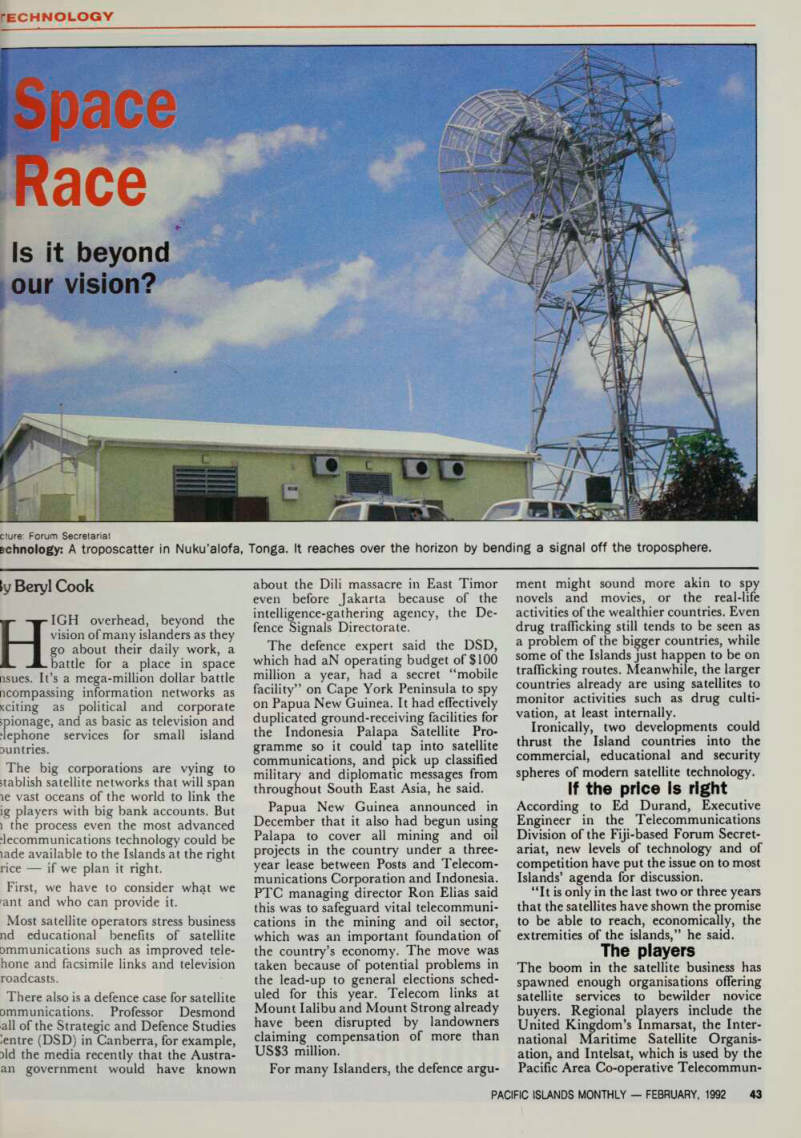
Picture: Forum Secretarial Technology; A troposcatter in Nukualofa, Tonga. It reaches over the horizon by bending a signal off the troposphere.
cations (PACT) network. PACT was Dstered and promoted by the Secretariat s a cheap service for both domestic and cgional communications for Pacific si and countries, and put into place by )TC Australia on December 1, 1990.
Seven nations —' the Cook Islands, ’uvalu, Kiribati, Australia, New Zea ind, Nauru and Niue are running on ic network through Intelsat. A $2.6 lllion grant from the Australian gov mment helped put in place the ground srminal equipment. [“The PACT network is meant for thin lutes where there is not too much affic,” Durand explains. “It uses a cmand assignment multiple-access sys m of circuits, which means you only ask r a circuit when you need it rather than lying for it for 24 hours and only using one hour. Sharing the circuits out like is means the cost to individuals can be wered. That’s the main aim fordable communication for Island mmunities.”
Papua New Guinea did not join the VCT network, because it already was mmitted to Pacstar. Like Tonga, ipua New Guinea is keen to become a ayer in the satellite game itself.
The PNG delegation leader to the nth Pacific Commission (SPC), Mem r of Parliament Arnold Marsipal, told i South Pacific Commission meeting in inga last October that PNG would nour its contract with Intelsat. Pacstar luld simply complement Intelsat and cable systems.
It had been initiated by the Prime inister in 1985 to meet PNG’s domestic needs such as rural
distant jcational TV and emer icy communications. It eady had purchased a inch launch vehicle and nt two years working out ails with International dio Regulations to deter le how its satellite could ;rate in co-ordinated cement with more than Soviet satellites.
*acstar vice-president
n Degnan told Pacific nds Monthly Pacstar was out to hard-sell any of other Island countries, sir financial support was essential and Pacstar ild launch its satellite
ardless it simply was
iting other Island ntries to make use of star’s initiative.
'ongasat, which also ad »sed the SPC meeting in iga, also believes it can \ gap which Intelsat may be able to provide
“enough satellite capacity to serve the growing needs of the Asia-Pacific region in the late 19905, particularly not to those commercial and governmental users in each country throughout the Asia-Pacific region who wish to employ their own smaller customer premise or community earth stations (VSAT’s). This is because Intelsat satellites were not optimised for, and are therefore not economical for, use with such small earth stations”. (Source: Tongasat executive summary.) Tongasat has been greeted by some skeptics as the latest brainwave of a king who has become renowned for grandiose visions, but registering six orbital pos itions with the International Frequency Registration Board in Geneva can only be seen as a bold and enterprising move, given the competition for space in space.
These slots can accommodate up to 20 satellites to meet various networking requirements.
Tongasat managing director Dr Mats Nilson, who has worked for Intelsat and the General Dynamics Corporation, is confident Tongasat will launch its first satellite by late 1994, its second by mid -1995, and possibly exercise an option to use a third in mid 1996.
“It could reverse the relentless mi gration to the cities, boost tourism, building better culture and religious awareness and provide television distri bution of education to rural and island schools,” he enthused to regional leaders at the SPC meeting. But in the shorter term there is the 1999 deadline, by which time Tongasat must have its satellites in place or forfeit its slots.
One positive sign is the reported
approval by the Tonga Legislative As sembly of an agreement between Tongasat and the government, and Unicom, a Colorada US-based satellite company in November. Nilson said this involved a $3OO million deal.
There has been no sign yet, however, that the Pacific Islands are scrambling forward to become Tongasat users.
Spin-offs
This probably does not really concern Tongasat. It would not be realistic to expect a profit by concen trating on the islands instead they are looking more at shifting traffic from the Pacific rim because every player knows they can only make a real profit by concentrating on the bigger countries.
At the same time, how ever, the Pacific Islands could find themselves re ceiving spin-offs. At the moment the biggest player is Intelsat, but if more satellites were launched it could lead to cheaper cir cuit time and drive prices down.
Cheaper ground stations also are needed, but these will only be available if the satellites being launched are more powerful than the ones already launched.
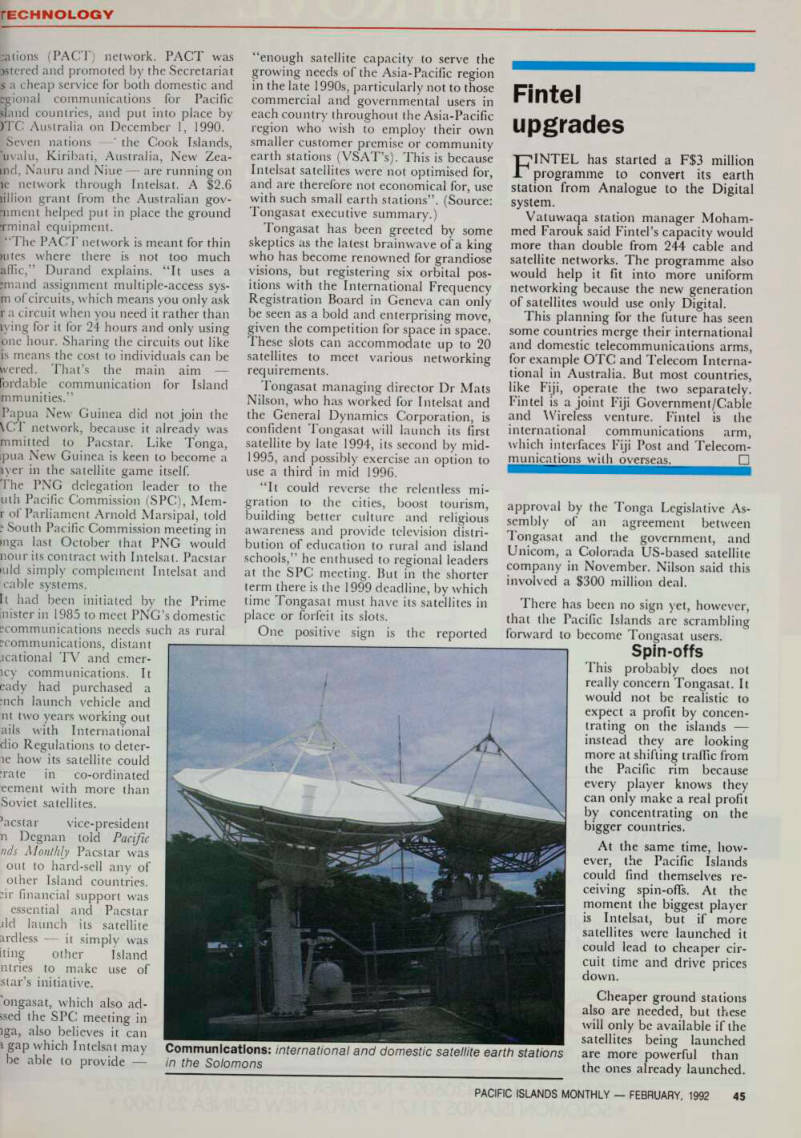
Communications: international and domestic satellite earth stations in the Solomons