Burns Philp changes gear
p. 34 · Read in the full issue
BP is in hot pursuit of automotive industry profits
By Davendra Sharma
WHEN business was booming,
the Pacific islands accounted for 60 per cent of Burns Philp’s overall profits.
But competition early last decade forced BP to wind down operations and focus on a few' industries. It decided to focus the company’s endeavours in fewer areas by streamlining activities in the islands and at home, Australia.
Subsequently SUS3OB million of “non strategic or underperforming assets” were divested, and the money was reinvested primarily in international food/fermentation operations.
Investments were also poured into
Australian hardware and build ing supplies ventures. Business was concentrated in three broad sectors automotive retail, merchandising and ship ping and trading.
It soon found that auto motive business was most viable accounting for half of the group’s sales, 45 per cent of the total profits and holding 35 per cent of all assets. Burns Philp phased out its mainline ship ping services in the late 1960 s due to competition. However, it integrated BP with Papua New Guinea’s P&O shipping inter ests into Century Shipping in 1989. But the contribution of shipping was soon replaced by profits from the growing auto motive operations when BP
started importing and distributing
Toyota vehicles and industrial equip ment.
In Fiji, BP had begun Toyota business before the war. Last May, BP negotiated a deal with Japan’s Toyota Tsusho Corporation, Burns Philp Toyota South Pacific Holdings Ltd. The joint venture company owned 25.5 per cent by TTC and 74.5 per cent by BP and it, in turn, owned the shares previously held by BP in Burns Philp (PNG), BP (Vanuatu), Solomon Islands Investments Ltd, and BP (South Seas) which has outlets in Fiji, Tonga, Western Samoa and American Samoa. “The combination of BP’s ex perience in the region with TTC’s marketing strength will provide the base
for an even more dynamic automotive': distribution business trading throughou the South-west Pacific,” said BP manag; ing director Andrew Turnbull.
He said the formation of the joim venture signals a long-term commitment towards the region’s lucrative and fast expanding automotive industry.
Turnbull expects Burns Philp to pn> gressively reduce its other island trading activities over 1992-1995. “This is in lin# with the desire of local people to control and manage more of their commercial enterprises, particularly in the merchan dising area.” It recently sold its mer chandising operations in Fiji and Vanu atu.
Burns Philp began buying out th* minority shareholders in the South Sea. company last December (Decembe: 1991) in its bid to simplify the adminisi tration, and so it could speed uj streamlining operations. It offered to bin out the 456 shareholders in BP (Souti
Seas) company for SUSI.BO a share. The BPT joim venture has acquired 93. 1 per cent of the South Seai company.
Burns Philp’s Pacific op< erations earned 5U5245.6* million in sales in 19881 5U5254.87 million in 198$ and 5U5276.43 million in 1990. But BP’s assets rosi. rather less significantly fronr 5U5152.46 million in 1981 to 5U5175.56 million a yeaj later, and SUS 158.6 millioi in 1990.
Profit from the region rosi from 5U55.775 million ii 1988 toSUSIO.OI million ii 1990. The Pacific island! now only contribute a tin; 14.4 per cent of profits. C
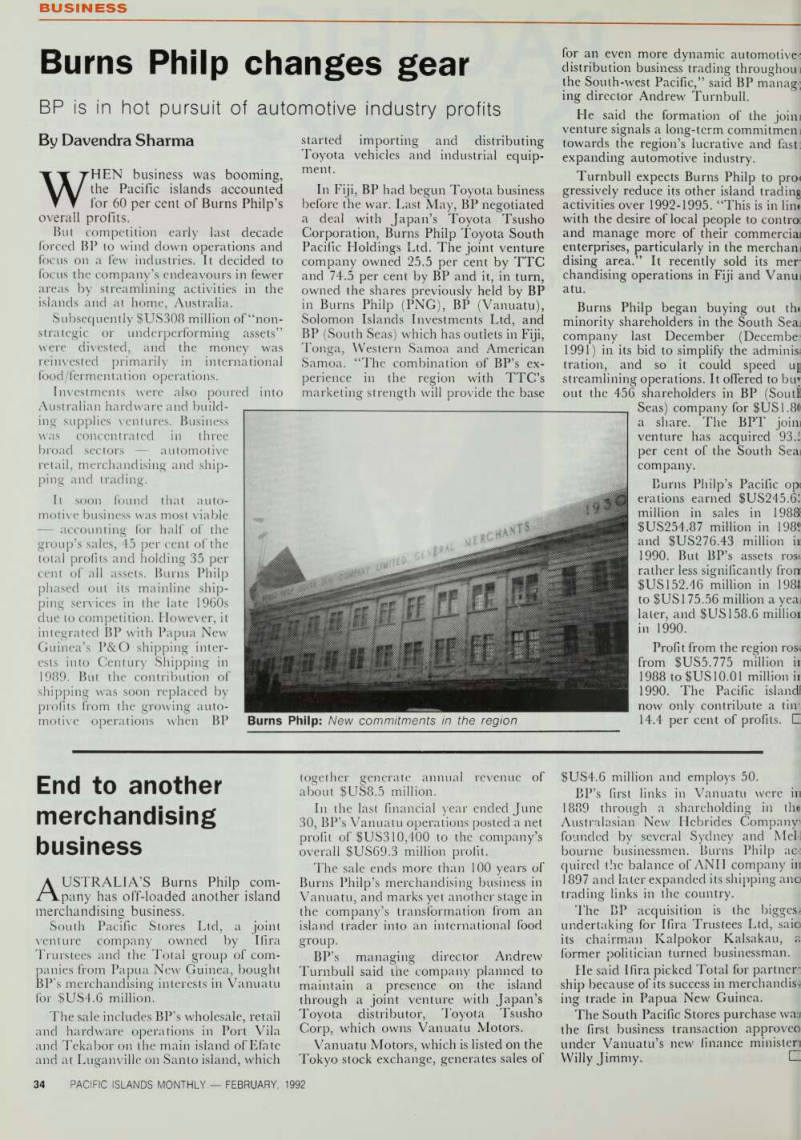
Burns Philp: New commitments in the region