A change in relations, but for the best?
pp. 22-23 · Read in the full issue
ONE of the main findings of the recent Australian parliamentary inquiry into relations with Papua New Guinea is that, despite close official relations and a big aid programme, people-to-people links have dropped off dramatically since independence.
The exhaustive inquiry conducted by the Joint Committee on Foreign Affairs, Defence and Trade, found that “the
understanding the people of each country have of the other is not as deep or as thorough as it should be for such close neighbours.
“Apart from those people whose con nections go back to pre-independence days and the small groups who deal with the relationship at an official level, there are few in Australia who know or understand Papua New Guinea well,” the committee said.
It pointed out that Papua New Guineans, many of whom travel and study in Australia, known us much better than we know Papua New Guinea. For that the committee laid the blame squarely on the Australian side.
Of course, some drop-off in contact after independence was to be expected as large numbers of Australian officials went home, leaving their jobs, as was fitting, to locals.
Seventeen years later, though, Australians are ignorant.
And it is not just the lack of work contacts.
Apart from its role as a battleground in World War 11, PNG is not covered in the school curriculum or to any great extent in universities. Since independence, the number of Australian media organisations with a permanent correspondent based in Port Moresby has more than halved, and few ordinary Australians visit PNG whether as sportspeople or tourists.
The committee’s report Australia’s Relations with Papua New Guinea is the result of more than two years of work which included public hearings from Thursday Island and Cairns in the north, to Melbourne in the south, and a visit to PNG.
The result is one of the most detailed and well-researched reports yet put out by a parliamentary committee.
While the committee saw people-to-people links as import ant, aid and security issues were the most crucial and sensitive.
A quarter of Australia’s aid budget, approximately 5325 million per year, goes to PNG almost all of it straight into consolidated revenue as what has become known as budget aid.
Australian budget aid accounts for 15 per cent of the PNG government’s annual income. That substantial contribution has, in the committee’s words, “dominated the Australia-
Papua New Guinea relationship”.
At independence, budget aid was seen as the best way to give PNG’s new government maximum control over its resources.
Since then, however, there have been concerns that it has swelled PNG’s bureaucracy and skewed its wage rates.
At the village level, people are increasingly asking why the benefits of the massive aid programme are not visible, while in Australia there is pressure for more accountability in the way taxpayer’ funds arc spent.
In response to this rising clamour, Canberra and Port Moresby have come up with a dramatic plan to turn all Australian aid into project aid by the year 2000. That would see Australian money channelled to specific projects which would be monitored for success or failure before new injections of funds.
Achieving the changeover will be no easy task. Project aid, with its careful feasibility and evaluation processes, takes far more bureaucratic effort than lump sum transfers and, with the inevitable discussion over the aims of each project, raises
Australia
difficult questions about just how far Australia should go in setting priorities for PNG.
The parliamentary committee has joined the debate with a compromise solution: “program aid”.
Programme aid involves the direct funding of a particular sector, such as education or the police. While implementation would have the advantage of being undertaken by PNG, rather
than Australian consultants, it would be with specific goals in mind so that progress would be visible.
Along with education and the police, the committees nominated institution-building and agriculture as priorities. That recommendation falls pretty much within the status quo and is likely to leave non-government organisations disap pointed. They have been keen to see much more done to tackle unemployment and rural poverty, a priority which they see as all the more urgent because of the role poverty plays in feeding the law-and-order problem.
The PNG government will not be disappointed by the committee’s recommendation that the total amount of aid remain at its current dollar level.
While this would mean small cuts in real terms it is nothing like the cuts (possibly as much as 50 per cent by the year 2000) which at this stage are still intended to go hand in hand with the move to project aid, and the minerals boom which is
expected over the same period.
On the question of security, the committee found the Bougainville crisis had precipitated “a shift in perception ... as to what constitutes a security threat to the region.
“The conventional view reinforced by the experience of World War 11, that Papua New Guinea formed a natural barrier and defence for Australia, has been modified by the more immediate problem posed by the secession movement on Bougainville.
“The stability and integrity of Papua New Guinea is of strategic importance to Australia and the uprising on Bougainville implied the disintegration of the nation.’
While recognising the seriousness of the threat to PNG’s integrity, the committee was concerned that Australian diplomats had become identified as backing the PNG government; that they had created a situation in which they were not in a position to offer the sort of practical support for a negotiated settlement that New Zealand had been able to offer and that, in attempting to foster a peaceful solution, Australian diplomats had not shown the same resourcefulness and imagination as they had in their work further afield in Cambodia.
Despite these complaints, and a very well-researched chapter outlining all the events surrounding the secessionist rebellion on Bougainville, the committee’s main recommendation was vague; that “Australia adopt a more active diplomatic role in trying to solve the impasse between the Bougainvilleans and the
Papua New Guinea government”.
What that more active role might entail, it did not say.
Australia’s defence aid to PNG was the one subject which caused a break in the otherwise unanimous recommendations of the committee, which included representatives of all political
parties.
Since the Bougainville crisis began, Australia’s defence aid to PNG has jumped from 527 million in 1988/89 to 553 million in 1990/91. At the same lime there have been concerns about Australian-supplied helicopters being used to dump the bodies
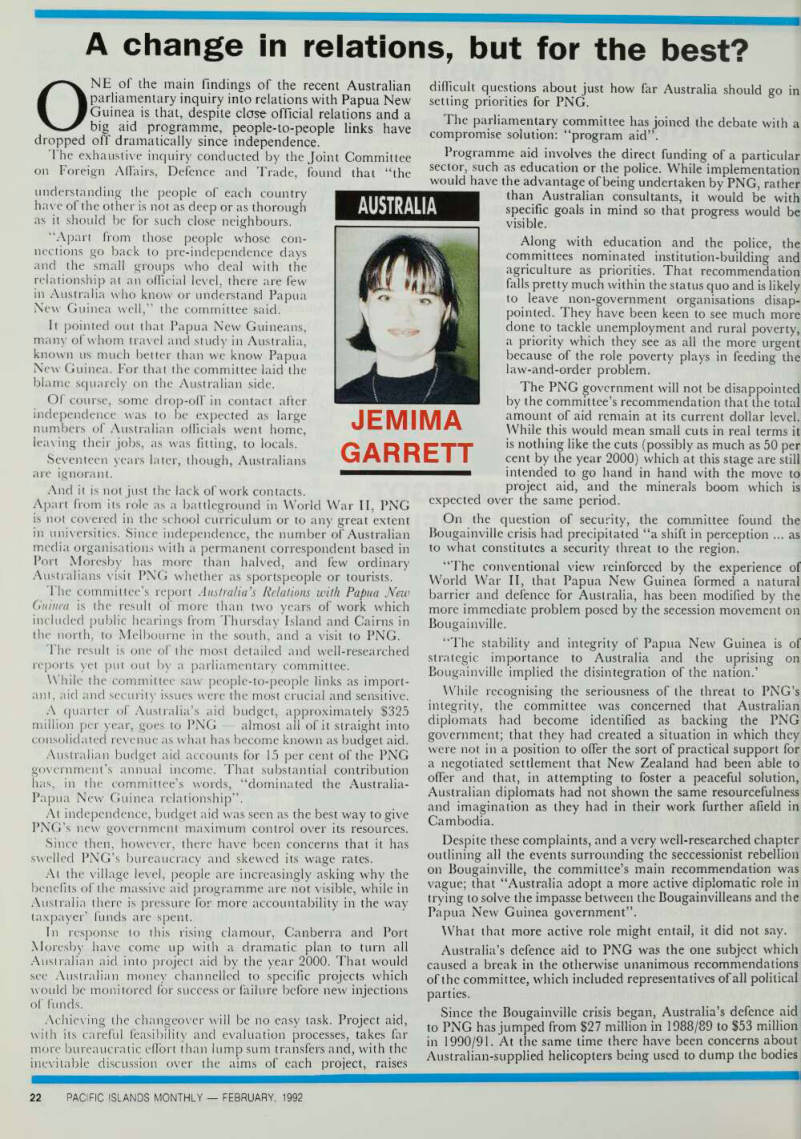
Jemima
Garrett
of people executed by the army at sea, and about human rights abuses by the defence forces.
In a dissenting report Senator Jo Vallentine, nuclear disarmament Senator from Western Australia, recommended “that funds currently provided to the Defence Co-operation Program be re-directed into development assistance via NGOs, and that development assistance programmes be increased”
Although Senator Vallentine was alone in endorsing a dissenting report, she was not alone in expressing deep concern about the dangers of offensively trained armies working in the civilian sphere, or about human rights abuses by the PNGDF.
While the committee in no way underestimated the serious human rights abuses committed by the Bougainville Revol utionary Army, it was more concerned with those by the PNGDF because of the involvement of Australian taxpayers’ funds.
In dealing with Bougainville and Australia’s defence aid to PNG, the committee recommended that “where Australia is involved ... enhanced emphasis be placed on the training of the PNGDF for civilian tasks, encompassing humanitarian law and civic duties.
Regarding military gifts, such as helicopters, it suggested that “the Australian and PNG governments should develop clear and agreed guidelines about how the equipment will be used”.
The committee said it will also urge the Australian government “to press the Papua New Guinea government to lift is restrictions on humanitarian aid to Bougainville and actively co-operate with Australian NGOs in the provision of this aid”.
Since PNG has been pre-occupied with its own secessionist
rebellion, there has been a marked change in its attitude to Melanesian secessionists in the neighbouring Indonesian province of Irian Jaya. A tougher line against Irian Jayan secessionists has taken heat oIT a border which has posed security problems not just for PNG, but for Australia as well.
The parliamentary committee also identified problems with Australia’s border in the Torres Strait.
They include smuggling of marijuana, sometimes in quite large quantities, from PNG to Australia and the possibility of gun-smuggling to Irian Jayan rebels.
Traditional movements have also caused difficulties.
At some points, Australia’s border in the Torres Strait is only three kilometres from PNG. The committee found the treaty allowing Papua New Guineans to cross into Australia for traditional purposes has led to illegal immigration by people seeking better services and employment, and to friction with Torres Strait islanders who complain the Papua New Guineans are bringing diseases like malaria and creating overcrowding.
It recommended greater consultation with local people and strengthening of surveillance systems in those areas.
Despite the ignorance of PNG identified by the parliamen tary committee, there are also signs of a new, more mature relationship between Australians and Papua New Guineans which is seeing them working together on innovative projects.
A good example is the recent album put out by Melbourne based rock band Not Drowning , Waving. Recorded in collabor ation with Pelek and other Rabaul-based musicians, its mix of PNG traditional music and rock sent it to the top of the independent charts and saw it sell out in many city shops.□