Crops in crisis
pp. 11-12 · Read in the full issue
With agriculture ailing, many farmers are turning to lucrative but illegal drug cultivation
Frank Senge Kolma
IN mid-1990 reports reached Port Moresby that coffee growers in the Highlands were turning to mari juana. The news highlighted the big jroblem with cultivation and consump ion of the drug, and revealed a bigger ind more immediate problem the lation’s farmers have been turning away rom traditional crops to other crops
)ecause of falling commodity prices.
East month a Papua New Guinea Jentral Bank economist said the country lad taken a harder blow in the past two ■cars than any of the 164 International ilonetary Fund member nations since ifter the World War Two.
PNG appears to have resisted the louble catastrophic blows of closure of he Bougainville Copper mine and
dunging world-market cash-crop prices,
)ul the latter could yet prove to be just he break in the eye of the storm rather han world-class economic management.
What appears of immediate concern is igricullure the livelihood of 85 per ent of the people in Papua New Guinea.
In just two years half of the cocoa ndustry is gone, one fifth of total coffee iroduclion is down, and nearly one third tf thhc copra industry has disappeared. 1 he Central Bank economist referred o earlier claims that PNG is back to 985, Cocoa Board executive officer dark Ivarami says the agricultural
sector is back to pre-independence days.
Coffee Industry Board economist David Smith said coffee prices are at their lowest since commercial coffee production began in the 19505.
Agriculture is the industry that the World Bank claims has the best prospects for growth outside mining and is the predominant source of employment.
By a consensus of expert opinion, agriculture is the sector that money from the mining and petroleum developments must be channeled into.
The Coffee Industry Board reports that about 20 per cent of plantations have dropped out and a vast number are neglected or producing less and less in the two years between 1989 and 1991.
Production has dropped from 1.2 million bags at the end of 1988 to 938,000 bags in 1990. Exports earned PNG K 209 million in 1986 and K 139 million in 1990, but only K 93 million last year.
CIB economist David Smith said the loss in value of production from 1989 to 1991 is 33 per cent.
The Coffee Stabilisation Fund, the richest in the country with Kl2O million in 1986, was completely drained at the end of June 1991. The board is at present paying out a 35 toea per kilogram bounty to growers from a K 9 million govern ment loan.
Smith said the cause for the collapse of world coffee prices was the lifting of the quota system by the Coffee Industry Organisation in July 1989. Producers
who held large stocks flooded the market with coffee leading to weaker prices.
PNG has fared better than most other coffee producers, Smith said, because of
its good quality Arabica.
“If prices remain at current levels the plantation sector would remain under extreme pressure, especially the 20 hec tare blocks,” Smith said.
“Coffee prices arc at their lowest level in real terms since commercial coffee production began in the 19505.”
He said the outlook for coffee should be favourable if the country could maintain and improve its quality of coffee and increase production.
PNG’s other major tree crop, cocoa, has suffered longer. The Cocoa Board of PNG was already paying bounty out of the stabilisation fund in 1980. Prices ever since have been “going down on a sliding scale”, board Executive Officer Mark Ivarami said.
“What do you mean (when you ask) how close is the industry to collapse. It has collapsed from the day the prices went through rock bottom,” he said indignantly to questions on the state of the industry. “With high interest rates charged by the banks, many plantations have laid off their labour force. Some have walked off or scaled down to absolute minimum.”
He said some are operating without fertilisers and there are no new plots
being developed.
The cocoa industry has lost 40 per cent of its production with the closure of Bougainville. Doubled with the low prices, cocoa has lost more than half of its productive output, Ivarami said.
Out of an annual average of 60,000 bags, the country exported 37,000 bags in 1989 for K 46.3 million; 40,000 bags for K 34.8 million last year and K 32,000 for K 29.5 million this year.
“Half of production is gone. Without
any political solution to Bougainville, not only the cocoa industry, but the agricul tural sector has gone back to pre independence days. We have gone back 20 years. Plantations on Bougainville are completely overgrown, we arc told.
“It will take a lot longer than the government thinks. Even if revived, who is going to work the plantations on
Bougainville?"
T he future is grim on the world market with an over-supply of cocoa, and production growing faster than con sumption. There is hope, however, Ivarami said. Because of the prolonged
depressed prices, producers have
neglected their plantations and turned to new crops. In the medium term, then, production may drop.
He urged cocoa growers to stand firm.
“I think our farmers should not give up hope. Cocoa will be here forever to support us. In times of low' prices w 7 e need to increase production and maintain quality of our cocoa.’’
The scene on the copra front is not much different. During July to October last year a major producer, Coconut Products Limited, was forced to close its mill in Rabaul several times for a w 7 eek in order to allow copra stocks to build up.
This was brought on allegedly by insufficient production of copra by Ga zelle small-holder growers' unwillingness to supply copra because of low prices.
The Copra Marketing Board is now shipping copra to Rabaul from other parts to overcome this problem.
The Catholic Church w as on the verge of closing down its 10 big plantations near Madang on the north coast of the
mainland but Ihe price rise in December averted such action.
Other plantations in Central prov ince and East and West New Britain provinces were considering similar moves.
Copra Marketing Board Gen
eral Manager Joe Bae said: “The last three years have been so terrible. It’s been disaster.
"We went to the brink of nearly falling off. The price increase this month came at the right time.”
The industry in 1988 contrib uted K 32 million to the national purse, but decreased to K2O mil lion in 1989 and Kl 5 million last year. Bae said the industry would be lucky to fetch that this year.
In two years the copra industry has lost 26 per cent of all its
production. Copra prices have
been falling particularly because of oversupply of vegetable oil on the world market, mainly from soya beans, sunflower, rape seed and oil palm. Copra sales also have suf fered due to intense lobbying by soya bean producers, mainly in the
United States, that oil from copra is detrimental to health. First reports from recent studies indicate the opposite may be the case.
The future for copra looks more promising with production in Indonesia and the Philippines dropping substan tially. If the tree crops fail the major coastal agricultural centres such as Rabaul, Madang, Kimbe and Popondetta will become ghost towns.
Unlike the mining towmships, most of the PNG coastal agricultural centres are sustained by the activities of the agricul tural producers, either through buying produce from warehouses to banking their takings in the banks. Overseas freight rates and frequency of shipping arrivals would deteriorate.
The various commodity boards would negotiate lower prices internationally based on lower production and deterio rating quality of products.
Fewer income taxes and sales taxes to national government would result from closure of large plantations. About half the formal labour force would be laid off.
More blows The Harbours Board of PNG has increased certain shipping rates, in some areas increasing them 1000-fold on top of existing wharfage and other fees.
Telephone charges went up nation wide in September and for the rural sector by 25 toea per minute.
The government has been very respon sive under extremely difficult circum stances. Over KBO million in price support has been spent on tree crops, including oil palm. The money, however,
is to be repaid by the various industries when the price improves.
Government has abolished export taxes on commodities and subsidised interest-rate payments on loans to the agricultural sector from commercial banks and abolished interest rates from its own Agriculture Bank.
The way to the future is still uncertain.
The world market trends and prices, which are beyond the control of PNG, are very volatile. Government policies, which are within control, show no clear direction. There is overwhelming sup port for the primary industry sector of the economy (including agriculture, fisheries and forestry) to be given top priority listing, but there is no model yet to pass the moneys from one sector to the next without the cumbersome public service absorbing three quarters of it.
There is an impending fight on the future of stabilisation funds. The Asian Development Bank has openly, and the IMF and World Bank not so openly, wanted the role of stabilisation funds and government price-support mechanisms to diminish and eventually be abolished.
All the commodity boards and growers oppose decreasing the role of stabilisation boards. They have seen the usefulness of these funds, without which some of the industries would not exist.
The government is in a quandary it wants to listen to the local industries which should know best, but it is receiving donor moneys to fund requests for help coming from those industries.
Still, there is much optimism. Now at the bottom of the pit, both the industries and the government can only look up. □
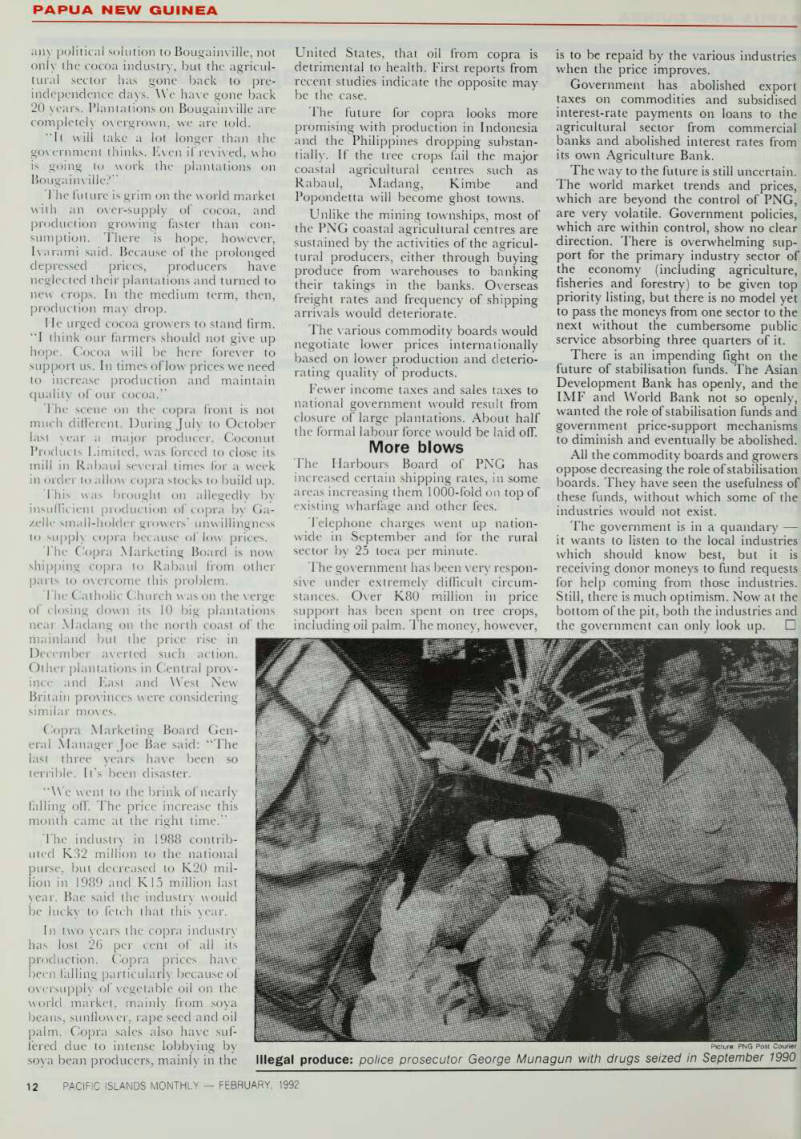
Picture: PNG Post Courier Illegal produce: police prosecutor George Managua with drugs seized in September 1990