A legacy
pp. 6-8 · Read in the full issue
of political scandals
By Evelyn Hogan
MEMBERS of Papua New Guinea’s parliament face the electorate in June this year carrying the legacy of the Diro affair. The day after the vote for Prime Minister, at the beginning of the 1987-92 term, Ted Diro was implicated before the Judicial Inquiry into the Papua New Guinea Forest Industry.
Throughout the term both Paias Wingti and Rabbie Namaliu faced the choice between principle and powers.
The principle of not accepting into the Ministry an elected member who was facing charges under the Leadership Code was in constant tension with the numbers Ted Diro’s Papuan Block could bring.
In August, 1987, Wingti retained the Prime Ministership with Sir Julius Chan as Deputy Prime Minister. Wingti stood firm in January 1988 by refusing to readmit Diro to his ministry while charges of misconduct in office pro ceeded. However, in April, under pres sure from his caucus to forestall the Papuan Block crossing the floor, Diro was made Deputy Prime Minister and Minister for Internal Affairs. With his
image tarnished, Wingti faced the wrath of several of his own party members and coalition partners. In a vote of no confidence on July 4, 1988, Rabbie Namaliu ousted Wingti and became Prime Minister. Diro became his Deputy.
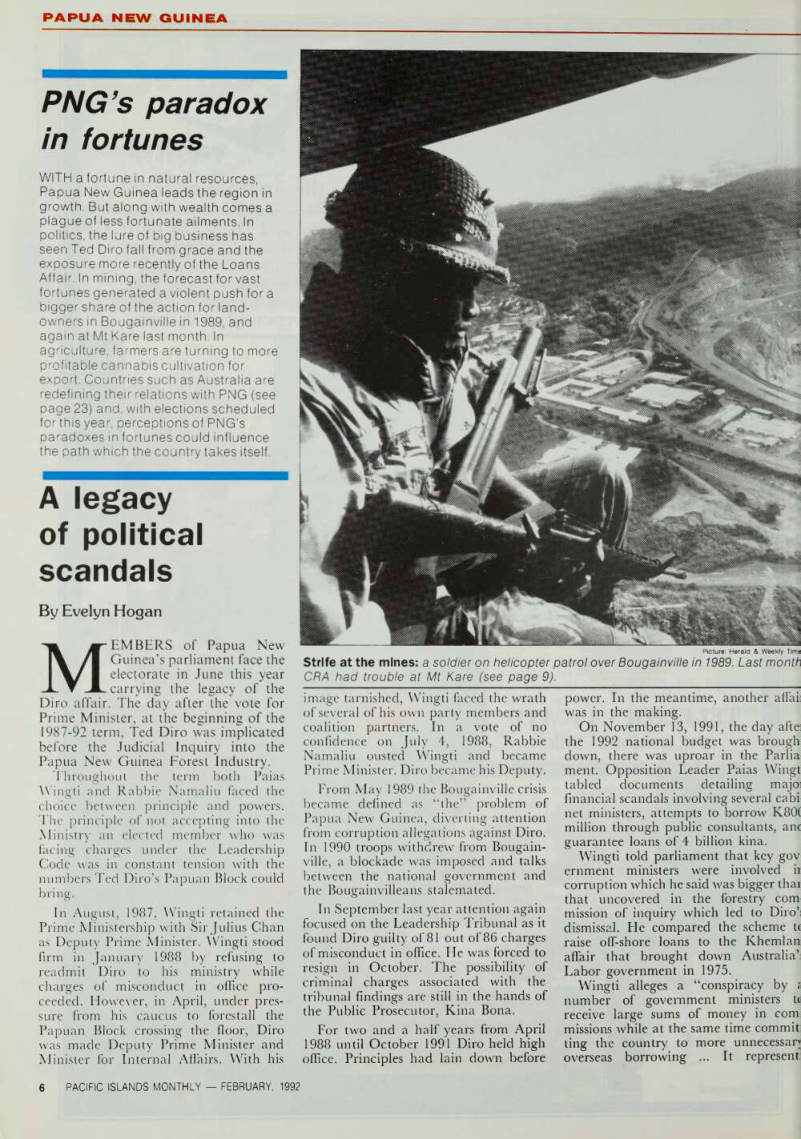
From May 1989 the Bougainville crisis became defined as “the” problem of Papua New Guinea, diverting attention from corruption allegations against Diro.
In 1990 troops withdrew from Bougain ville, a blockade was imposed and talks between the national government and the Bougainvilleans stalemated.
In September last year attention again focused on the Leadership Tribunal as it found Diro guilty of 81 out of 86 charges of misconduct in office. He was forced to resign in October. The possibility of criminal charges associated with the tribunal findings are still in the hands of the Public Prosecutor, Kina Bona.
For two and a half years from April 1988 until October 1991 Diro held high office. Principles had lain down before
power. In the meantime, another aflai was in the making.
On November 13, 1991, the day afte the 1992 national budget was brough down, there was uproar in the Parlia ment. Opposition Leader Paias Wingt tabled documents detailing majo financial scandals involving several cabi net ministers, attempts to borrow K 80( million through public consultants, anc guarantee loans of 4 billion kina.
Wingti told parliament that key gov eminent ministers were involved ii corruption which he said was bigger thai that uncovered in the forestry com mission of inquiry which led to Diro’ dismissal. He compared the scheme t< raise olf-shore loans to the Khemlan affair that brought down Australia’; Labor government in 1975.
Wingti alleges a “conspiracy by <
number of government ministers t( receive large sums of money in com missions while at the same time commit ting the country to more unnecessary overseas borrowing ... It represent;
the looting and mortgaging of our natural resources and our future”.
The matter was first raised in the PNG parliament on August 22, 1991 when John Kaputin, Member for Rabaul, alleged that the Minister for Finance and Planning, Paul Pora, had signed letters of authority for two foreign nationals to raise loans on behalf of the PNG government.
At first John Alexander de LTnstant- Parade (also known as John Alexander) was allegedly authorised to raise kBOO million. When this attempt failed Pora then allegedly authorised an Indonesian woman, Anna Maria Sri Poernawati, to raise k 500,000.
Papua New Guinea’s Ambassador to [apan, Evoa Lalatute, became alarmed when Poernawati turned up in Japan.
He told Pora that the loan proposal to ;he Tokai Bank stated the 500 million dna (US$5OO million) would go to the \griculture Bank, and four billion kina US$4 billion) to be received by her for Drojects she was to undertake with ‘certain PNG partners”.
He questioned the proposal “consider ng that it is the State’s wealth that is )eing used as guarantee to secure the
pan”.
Pora responded saying that his office
vas bombarded with ‘foreigners’ offering
cheap money’ for the State. To refinance ligh interest loans obtained in the 1970 s dth cheaper loans, he engaged Dreigners by asking them to prove their ources of finance to establish their redibility, he said.
Deputy Opposition Leader Sir Julius .lhan scoffed that the answers were shallow and conveniently worded”. He
aid; “The authenticity and credibility of
very person or financial institution importing to have links to the interna onal money market should be aoroughly checked before letters of uthority or intent bearing the official itterhead of the State are issued”.
Pora says he was advised that two -ustralian companies nominated in the ocumentation were: Australian Business upport Groups of Adelaide, and Prime rading Services of Sydney. However, ccording to Mr Turner of Australian
usiness Support Groups, they had
udied documentation submitted by lexander, then written to the minister isassociating themselves from the deal - well before Pora’s statements to the irliament. The two Australian com mies are annoyed at attempts to trade i their good reputation.
The documents submitted by Wingti i November 13, 1991, raise questions of >nflict of interest. On July 26, 1991,
Dra allegedly appointed Theresa’s Pty
td Consultancy Services in an irrevo [ble deed of mandate to raise off-shore
ans for Papua New Guinea. Wingti
said the principals of the company, Theresa Avenell and Stephen Avenell, are close friends and business associates of Pora, The same company is also doing consultancy work for one of the minister’s private companies, Dobel Farming and Trading Pty Ltd, Wingti alleges.
VVingti stated that, after the deed of mandate was signed on June 28 last year, a request was made to Alexander to give k 500,000 to the minister to clear some of his creditors. Several letters tabled in Parliament addressed to Alexander de manded payment. One, dated July 7, said that if the money was not forth coming the three consultants could
“literally kiss everything goodbye”. Let
ters tabled referred to kBO million worth of commission which the consultants would have received for arranging the loans for the government.
Despite pressure from the Avenells, Alexander did not pay the k 500,000.
However, Wingti continued on to allege that a cheque for k 350,000 was paid by the Avenells to one of Pora’s private companies.
On November 26, 1991, the Post Courier reported that on September 2, 1991, the ANZ Bank had demanded from Pora, together with former Min erals and Energy Secretary William David Searson and Wipa Pty Limited, more than k 300,000. When this was not paid, a writ of summons was filed in the National Court. Pora explained person ally to the Post Courier that, because of the slump in prices for tree crops, Members of Parliament and other Papua New Guineans who owned plantations owed
the banks more than kIOO million.
Peter Ryan, in his book The Landslide of Gold: Black Bonanza , writes that during the Mt Kare gold rush of 1988-89 an estimated k3OO million worth of gold was panned by landowners. “Many influen tial men cabinet ministers, members of parliament, officials and powerful businessmen had already become deeply involved in gold-buying, helicopter oper ations and trading,” says Ryan.
In 1988 Deputy Prime Minister Akoka Doi quoted the Bank of PNG as saying that, for every tonne of gold exported with tax paid, four tonnes were exported illegally. According to Ryan, when the PNG government assembled for the first time in 1989 it was startled by a statement by Paul Pora that k4O million worth of gold had been smuggled out of the country from Mt Kare alone. Then he added that he intended to grant a two-month exemption from the five per cent tax on alluvial gold. This, he said, was “to make it fair to legitimate and honest dealers and exporters”. Ryan adds that Pora himself had business interests in and around Mt Kare. So also had his friends, the Avenells.
Steve Avenell is the principal of Bradford Investments Pty Ltd, which owns a gold refinery at six-mile in Port Moresby. Here they convert almost pure gold into gold ingots. Much of Mt Kare gold passed through this refinery.
A National Executive Council (Cabi
net) paper quoted by VVingti proposes
that a major gold refinery be a joint
project financed through a “turn key”
arrangement on a 70/30 basis between
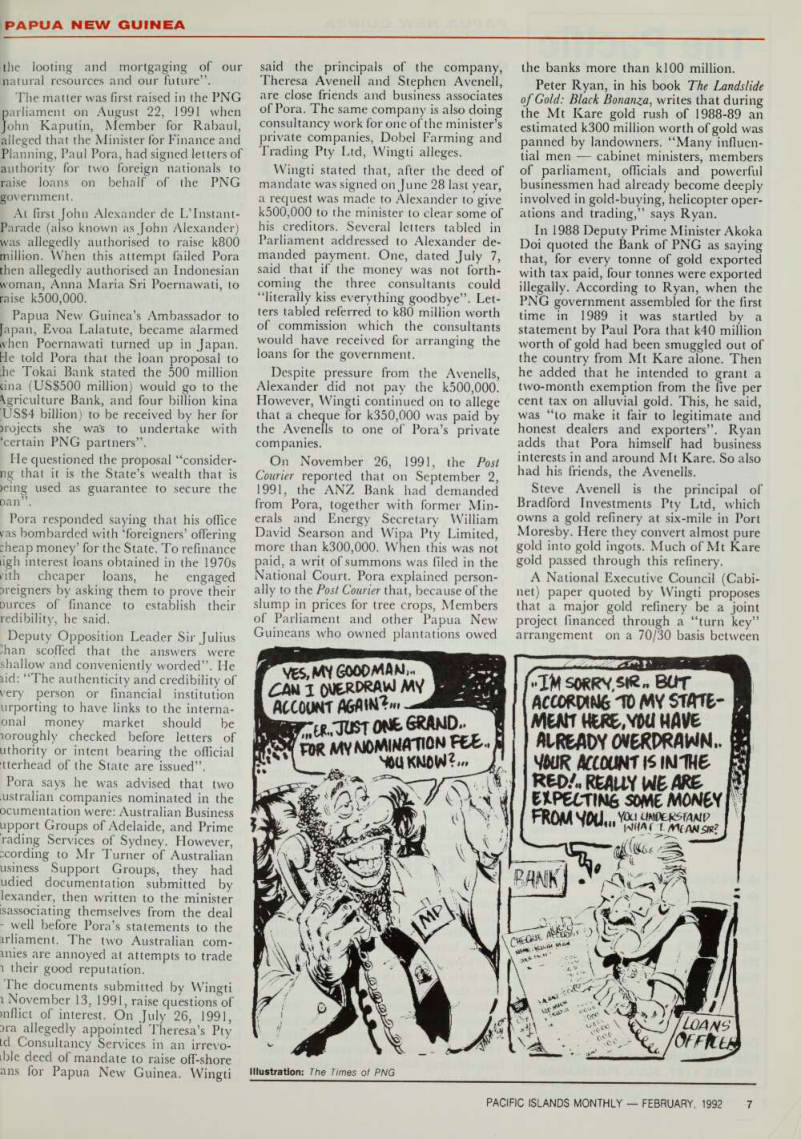
Illustration: The Times of PNG
the PNG government and the Avenells.
Wingti alleges a blatant abuse of power in that Theresa’s Pty Ltd Consul tancy Services have been engaged by the Minister for Minerals and Energy, Patterson Lowa, through a deed of attorney, and principals of the same company are proposed to have 30 per cent of shares in the major joint venture
gold refinery.
Wingti also claimed the Melanesian Alliance political party (MA), which forms part of the Pangu-led coalition government, authorised the Avenells to raise more than k 75 million in offshore loans in July 1990. Two months later, Provincial Affairs Minister Father John Momis, the leader of the MA, recom mended Stephen Avenell for a knight hood for his services to the government and private sector in PNG. According to Wingti the award was intended to reciprocate past or future services such as “raising the k 75 million loan to develop a property in Waigani known as the Melanesian Awareness Foundation”.
Wingti alleges that such loans were mandated to one source and pursued outside of normal practice and procedure in order that secret commissions and kickbacks could then be paid through a merchant bank to be set up by the Avenells, Commissions of 10 per cent of loans were to be paid through nominated banks for the overseas parties while the PNG parties would have its share paid through this new merchant bank to be owned by Theresa Avenell and associ ates.
“This merchant bank would then pay out the commissions to the PNG individ ual syndicates, including Pora and Lowa as loans to conceal the transaction,”
Wingti said.
Wingti alleges that the Avenells had “penetrated and taken control of the Cabinet of the Government” particularly in key economic portfolios. He also alleges that Prime Minister Namaliu must have “been aware and condoned” what was happening because in some of the documents it was reported that the Prime Minister was briefed.
Deputy Prime Minister and Minister for Fisheries and Marine Resources Akoka Doi was asked about alleged close business deals with the Avenells in connection with fishing licences and a tuna cannery project in Madang and Manus. Doi is alleged to have written two letters of reference to the Avenells to raise a loan of k 8.99 million to set up a merchant bank, the same bank which was to receive the 10 percent commission from thee kBOO million loan.
Communications Minister Brown Sinamoi was asked to explain how he had signed deeds of mandate authorising Theresa Consultancy to raise k3OO mil lion off-shore loan for PTC through an Arab bank.
Wingti said the Avenells were also appointed by former Housing Minister and current Environment and Conser vation Minister Michael Singan to raise funds for a housing scheme of the State.
The Opposition Leader called for the resignation of the ministers implicated in the allegations and called for an indepen dent inquiry to fully investigate the involvement of ministers with the Avenells in this loans affair.
In the days following these allegations of corruption several of the named ministers responded.
Patterson Lowa admitted: “Yes I went and saw Mr and Mrs Avenell about some projects in Papua New Guinea. One project was the oil refinery, because the advice of the department is that an oil refinery in the country is not viable. The consultants of the department and the government have given the same advice.
Therefore I asked the Avenells to look around for anyone interested in submit ting some proposals . . . The couple came up with the name John Alexander.”
“I have met with Mr Alexander twice, once in Port Moresby and once in Brisbane. In Brisbane it was not my wish to see him but the wish of a man by the name of Peter Salaka, a Solomon Islander,” Lowa stated.
Akoka Doi said he would welcome a commission of inquiry into alleged cor rupt dealings. He admitted to signing two letters to Theresa Avenell but added that they were only “explanatory letters” requesting any interested investor to establish a domestic fishing industry.
The former Housing Minister Michael
Sangan Singan admitted responding to
the approaches by the Avenells to assist with a venture to build houses to accommodate ministers. On November 18 the Post Courier quoted Singan: “I am not too definitive (sic) on whether I had written and signed a letter or whether they had written the letter and I signed it ... this letter authorised them to raise finance to build State houses”.
During a grievance debate, Prime Minister Namaliu accused Wingti of
abusing parliamentary privilege. He said
that from what he had heard and read, there was only evidence of corruption against Pora but not the other four' ministers. Despite this admission, with the precedent set by the Diro affair, Namaliu still retains Pora in his ministry.
Brown Sinamoi denied any contact with the Avenells. He lamented: “The elections are just around the corner and with all this mud-slinging I feel my name will be discredited and I do not know how to defend myself. I know that the Post Courier will spoil me and the other ministers who were named. Some of us have done a good job but because the Leader of the Opposition put us all in one basket, the single rotten egg will make us all stink.” □