Fast forward for Videopac
p. 47 · Read in the full issue
By Martin Tiffany
A BOUT 17 years ago Mike Brook found himself in Fiji % “thanks to the grace of God”.
JLA little over two years ago he md himself in the video production
lustry.
He has never regretted either.
Fhe Canadian entrepreneur’s arrival Fiji as managing director of Castaway md resort was the beginning of a erse working life.
Dver the next four to five years he jght out the family interest and >anded the Castaway group with the "chase of two hotels the Castaway
veuni and the Castaway Gateway,
n 1980, with businessman Don ilingwood, he started Sunflower Air 's to put together holiday packages for : of his hotels on the island of Taveuni.
“ airline has since expanded into one he largest domestic carriers. ©flowing the sale of the Castaway up in 1987 Brook dabbled in a few tures including garments, advertis pu Wishing, and holding the fran ie in Fiji for JCB credit cards, ht, in 1989, a business idea was )ted which Brook developed to be le what he hopes is the “beginning of future”. n September of that year an Austra , Doug Meredith, suggested video Juction for Fiji. A number of people
were interested and Brook was asked to chair the company South Pacific Production and Broadcasting Ltd
(SPPB), or Videopac.
With no technical skills or knowledge in the video industry (“I didn’t know a Kodak camera from a Beta Cam SP”) he did what any good businessman would do. He set up the company and took it as far as he could with his business skills.
“I didn’t have the skills and qualifica tions to make the technical decisions necessary to move forward and was very fortunate to get a couple of young Australians who had a lot of experience in the industry.”
With their help and the help of general manager Glen Hughes, Brook was able to move forward and plan what capital expenditure would be, as he was advised what equipment was needed to meet projected future needs.
The idea behind Videopac was to produce videos for several different markets corporate, training, educa tional sales and promotional.
After beginning production as recently as 1990 they have many videos and many large clients under their belt.
Their first major one was the Carpenter Group who wanted a corpor ate image video. The Shangri-La Hotel chain, the International Labour Organ isation, the government of Tonga, Tonga Visitors Bureau, Fiji Visitors Bureau, SOPAC, Tourism Council of the South
Pacific, Mobil Oil and a number ol tourist resorts followed.
Videopac is in the enviable position of being the only video production com pany in Fiji and one of the very few in the region. This has seen them with a very full programme and unable to do as many videos as the market is demanding.
In the midst of all this industrious work, the Fiji government decided to allow Television New Zealand to broad cast for the one month duration of the
Rugby World Cup.
As Brook explained: “We were going at full speed when, all of a sudden, in came people saying they needed com mercials done.”
He took on the challenge, which saw Videopac working 20 hours a day on a shift basis. (Fiji One has since been granted a three-month extension and broadcasting extended to the west of Fiji’s main island of Viti Levu.) With the population tuning into the prospect of full-time television, Videopac hopes to grow with it.
“We are hoping to take advantage of that (television) and while we have established a video company, we’ve established it with a quality of equipment far superior than which is necessary for
just video.
“It is all broadcast-quality equipment which is capable of producing material which can go directly to air on TV.”
Brook believes a production company in Fiji capable of television production will be attractive to a TV company as part of infrastructure.
In addition, his company is gaining experience and training locals on tele
vision production equipment. Brook
hopes the natural flow from there is that, when television comes full-time to Fiji, they will be involved in producing not
just advertising but programmes.
Long-term he talks of producing family entertainment and general inter est television programmes, and it is his dream to one day be able to produce a local situation comedy. “So we can sit back and laugh at ourselves a little bit.”
But Brook believes there is no substi tute for hard work and is critical of short cuts that lead to poor foundations.
“I think there is a prevalence in the Fiji market that it’s easy to short-cut, that you start at the top. In business you’ve got to have certain tools before you can be successful, it might take us a little longer but we are trying to build a good foundation.”
The emphasis on video production is not being wiped. The company hopes to become the regional video production leader, outside Australia and New Zea land, and already anticipates more work in Tonga and some in the Solomon Islands. Again Brook points out there is a long way to go but he is confident that “with God’s help” they will. □
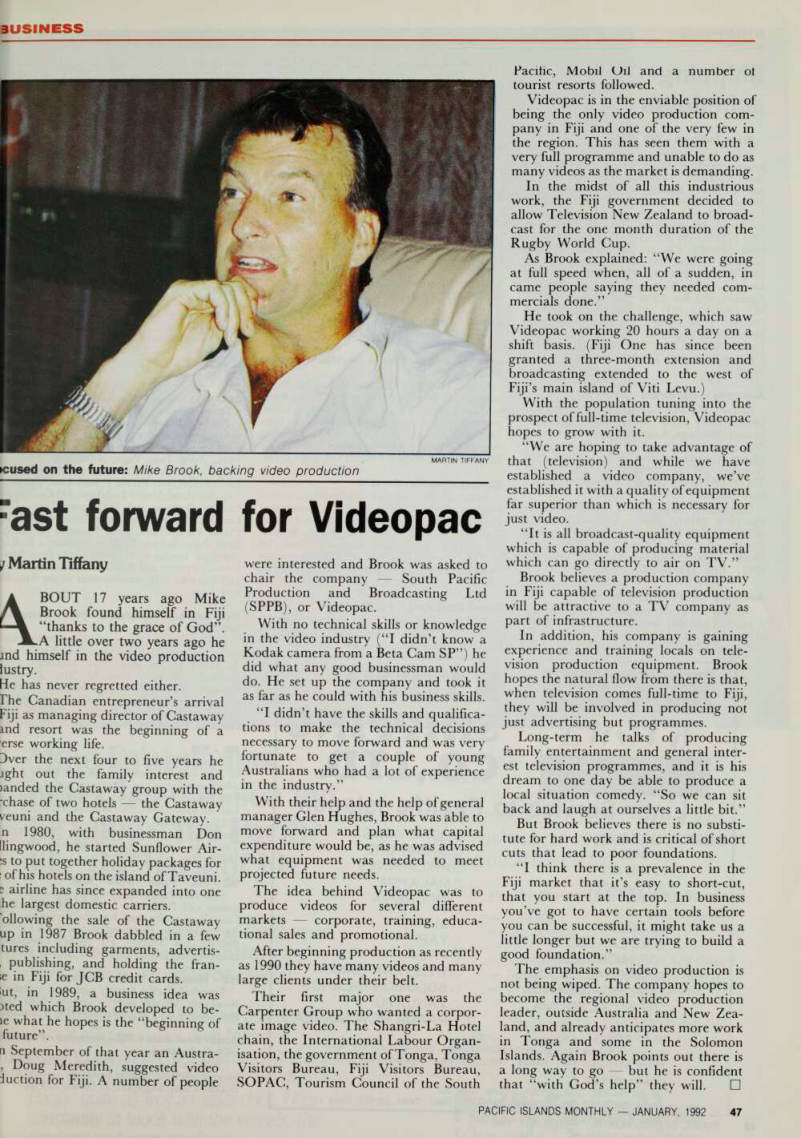
[?] eused on the future: Mike Brook, backing video production