After the cyclone, a storm brews ...
pp. 36-38 · Read in the full issue
For the people of Western Samoa, this is just the beginning. Martin Tiffany reports.
LIFE goes on as the people of countries ravaged by Cyclone Val literally pick up the pieces after the most devastating cyc lone in living memory hit last month.
But while homes and businesses are being patched up, Western Samoa’s economy is falling to pieces.
Its richer neighbour, American Samoa, suffered enough with 60 per cent of residences damaged and 95 per cent of subsistence crops destroyed. The Governor of American Samoa, Peter Tali Coleman, estimated about US$lB to 25 million would be needed to get the country back on its feet. But the United States moved quickly to assist its protec torate, bringing in personnel and funds.
Cyclone Val and Cyclone Wasa, which hit the Cook Islands two days later, caused about US$2 million dam age to the Cooks. Western Samoa, however, has been the hardest hit with what has proved a double blow.
When Val hit last month, Western Samoa was still licking its wounds after Ofa in February 1992 one of the most
devastating cyclones it experienced in 169 years. According to one observer, '■‘Compared to Wasa, Ofa was just a baby.”
Ofa was estimated to have caused at least VVSS3O6 million damage, but by mid-December the Australian Interna tional Development Assistance Bureau (AIDAB) in Fiji estimated destruction by Val at WSS662 million.
Cyclone Ofa had left the nation and its economy in tatters. After the immediate loss of business premises and homes, the loss of crop exports had been felt by Western Samoa and other Island countries long-term. After Ofa, the price of taro in Fiji shot up to about Fs3o a bundle as it moved to fill the New Zealand export vacuum which Western Samoa could no longer fill.
A big banana crop had been planted soon after Ofa to help get the economy back on its feet. The bananas had been accepted by New Zealand and the crop was about to be harvested when Cyclone Val struck last month. The crop had been described as Western Samoa’s “new hope”, but the hope was crushed by
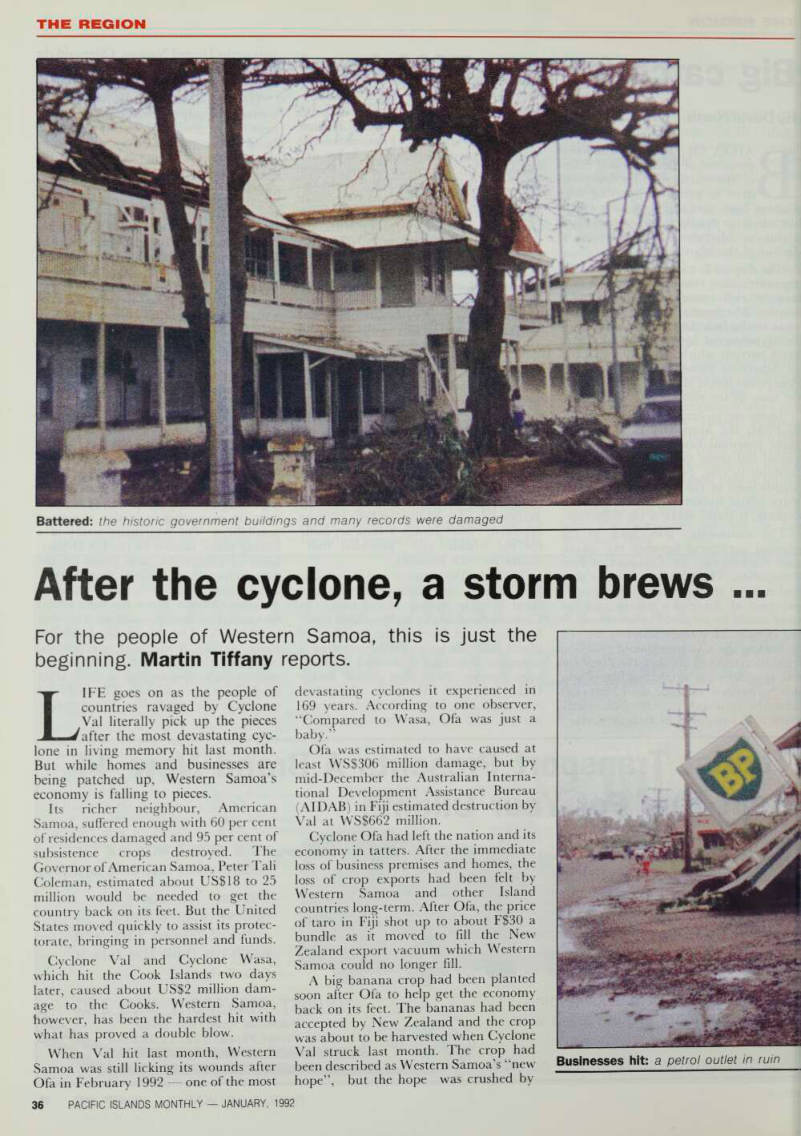
Battered: the historic government buildings and many records were damaged
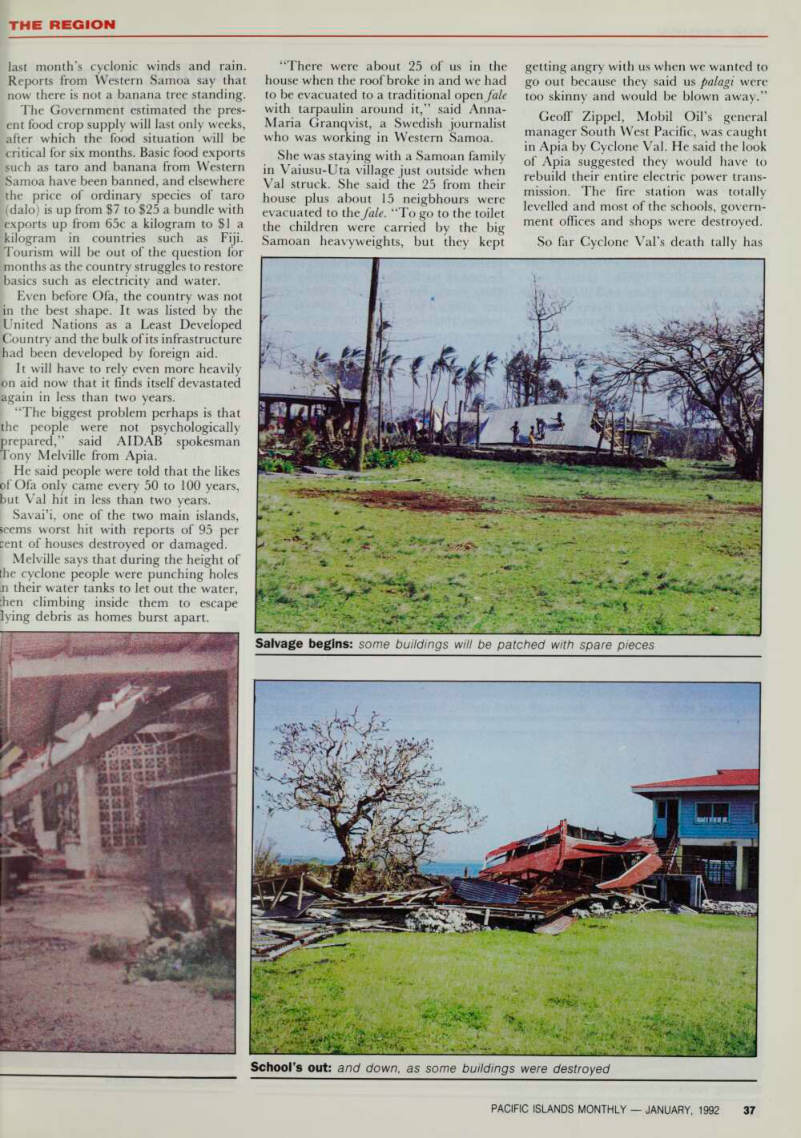
Businesses hit: a petrol outlet in ruin
last month’s cyclonic winds and rain.
Reports from Western Samoa say that now there is not a banana tree standing.
The Government estimated the pres ent food crop supply will last only weeks, after which the food situation will be critical for six months. Basic food exports such as taro and banana from Western Samoa have been banned, and elsewhere the price of ordinary species of taro (dalo) is up from $7 to $25 a bundle with exports up from 65c a kilogram to $1 a kilogram in countries such as Fiji.
Tourism will be out of the question for months as the country struggles to restore basics such as electricity and water.
Even before Ofa, the country was not in the best shape. It was listed by the United Nations as a Least Developed Country and the bulk of its infrastructure had been developed by foreign aid.
It will have to rely even more heavily on aid now that it finds itself devastated again in less than two years.
“The biggest problem perhaps is that the people were not psychologically prepared,” said AIDAB spokesman Tony Melville from Apia.
He said people were told that the likes of Ofa only came every 50 to 100 years, but Val hit in less than two years.
Savai’i, one of the two main islands, seems worst hit with reports of 95 per
cent of houses destroyed or damaged.
Melville says that during the height of the cyclone people were punching holes n their water tanks to let out the water, hen climbing inside them to escape lying debris as homes burst apart.
“There were about 25 of us in the house when the roof broke in and we had to be evacuated to a traditional open fale with tarpaulin around it,” said Anna- Maria Granqvist, a Swedish journalist who was working in Western Samoa.
She was staying with a Samoan family in Vaiusu-Uta village just outside when Val struck. She said the 25 from their house plus about 15 neighbours were evacuated to the fale. “To go to the toilet the children were carried by the big Samoan heavyweights, but they kept
getting angry with us when we wanted to go out because they said us palagi were too skinny and would be blown away.”
Geoff Zippel, Mobil Oil’s general manager South West Pacific, was caught in Apia by Cyclone Val. He said the look of Apia suggested they would have to rebuild their entire electric power trans mission. The fire station was totally levelled and most of the schools, govern ment offices and shops were destroyed.
So far Cyclone Val’s death tally has
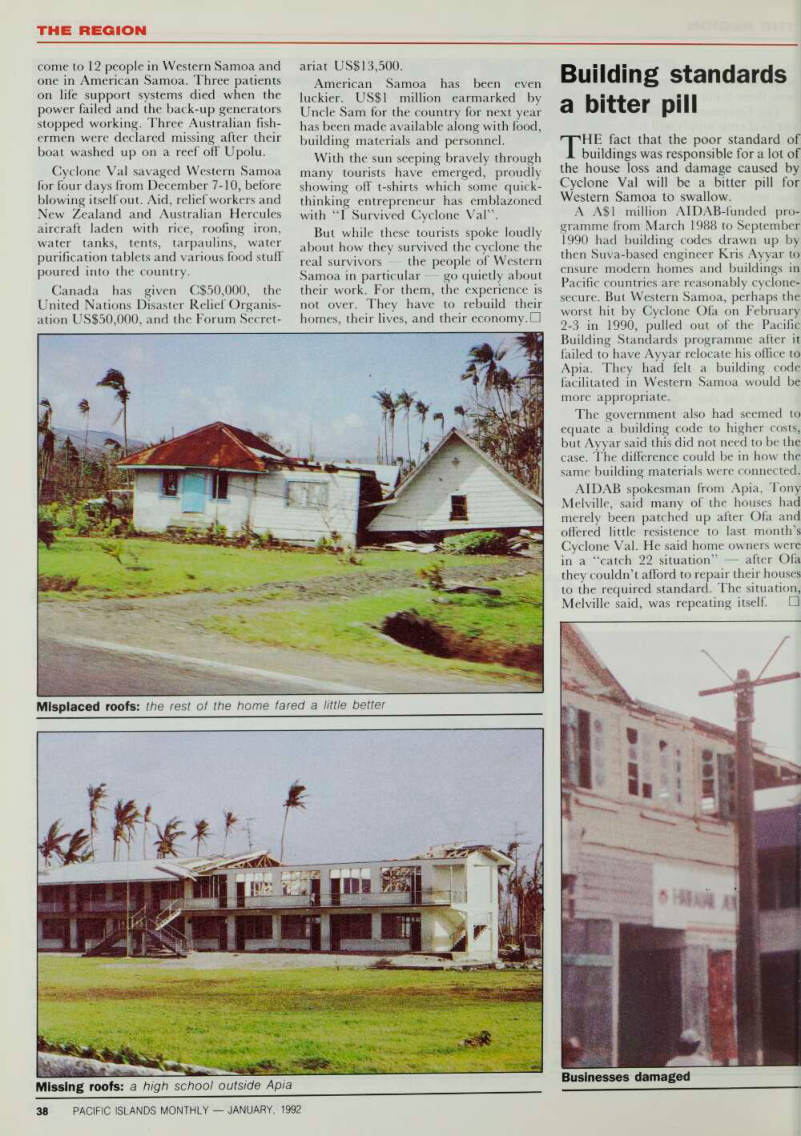
Salvage begins: some buildings will be patched with spare pieces
School’s out: and down, as some buildings were destroyed
come to 12 people in Western Samoa and one in American Samoa. Three patients on life support systems died when the power failed and the back-up generators stopped working. Three Australian fishermen were declared missing after their boat washed up on a reef off Upolu.
Cyclone Val savaged Western Samoa for four days from December 7-10, before blowing itself out. Aid, relief workers and New Zealand and Australian Hercules aircraft laden with rice, roofing iron, water tanks, tents, tarpaulins, water purification tablets and various food stuff poured into the country.
Canada has given C 550,000, the United Nations Disaster Relief Organisation US$5O,OOO, and the Forum Secret-
ariat USS 13,500.
American Samoa has been even luckier. US$l million earmarked by Uncle Sam for the country for next year has been made available along with food, building materials and personnel.
With the sun seeping bravely through many tourists have emerged, proudly showing off t-shirts which some quick thinking entrepreneur has emblazoned with “I Survived Cyclone Val”.
But while these tourists spoke loudly about how they survived the cyclone the real survivors the people of Western Samoa in particular go quietly about their work. For them, the experience is not over. They have to rebuild their homes, their lives, and their economy. □
Misplaced roofs: the rest of the home fared a little better
Missing roofs: a high school outside Apia