When a dream turns
pp. 33-34 · Read in the full issue
into a nightmare
By Lito Vilisoni
|-OB losses in New Zealand have I forced many Pacific Islands people to I tighten their belts. It’s also made them realise New Zealand isn’t the nd of milk and honey. For years, Pacific lands people have flocked to New ealand in the belief its streets were ived with gold, a view reinforced by iose who’ve downplayed its warts.
Today, the struggle to survive in a .untry shattered by a recession has well id truly dispelled the myth And as any observers have noted, it’s been a tter pill for the community to swallow. <iTu r p> c 0 „ nele Duituturaga, manager r n 8 1 ttr 8 ur >» ’ g ?
David Isaia, who’s been in New
Zealand 35 years sum, it up well. “It’s been every Pacific Islander s dream to c ° me t 0 N r ew Z eala " d > « et a J°, b . and educat !° 1 n [ or the ch'ldren. That s gone I ; ow , wlth the unemployment situation as 1 IS ' Hopes of a better standard of living and opportunities for their children, have lured 80 many Pacific Islands people to New Zealand that places such as Niue have lost most of their population. In Western Samoa and Tonga, the know ledge of tough , ™ try re r st " c j lons and overstayer crackdowns failed to stop dr °T eS leavm S A P ia and Nukualofa each wee ** But with Pacific Islands unemploy ™ent at P" c( j nt “ the hi in the country it s almost twice the na per cent) New Zealand offers few prospects of prosperity today. Without jobs and reduced welfare benefits, famil
ies are struggling to make ends meet, many living hand-to-mouth.
In South Auckland, where the Pacific Islands population is high, a third of the 250 food parcels the Salvation Army distributes a month goes to Polynesian families. They also make up 60 per cent of the group’s emergency housing clients.
Failing to keep up with the mortgage or rent has led to scores of families losing their homes. One newwspaper reported early this year that 37 Samoan families lost homes in one mortgagee sale.
“That’s only the tip of the iceberg,” says a South Auckland social worker.
“Heaps of families are getting their power or phone cut off every week because they can’t afford it. Lots more don’t go to the doctor unless it’s life or death. That’s how bad things are.”
Social and welfare agencies have had their work cut out as the unemployment rate climbs. Lay-offs and cut-throat competition for work have disrupted many families, causing break-ups, cus tody battles and the young to roam the streets aimlessly, many taking to crime.
“It’s not something they like hearing,” says one lawyer. “But we’ve had to be honest with them. There’s little chance of them finding work or even getting
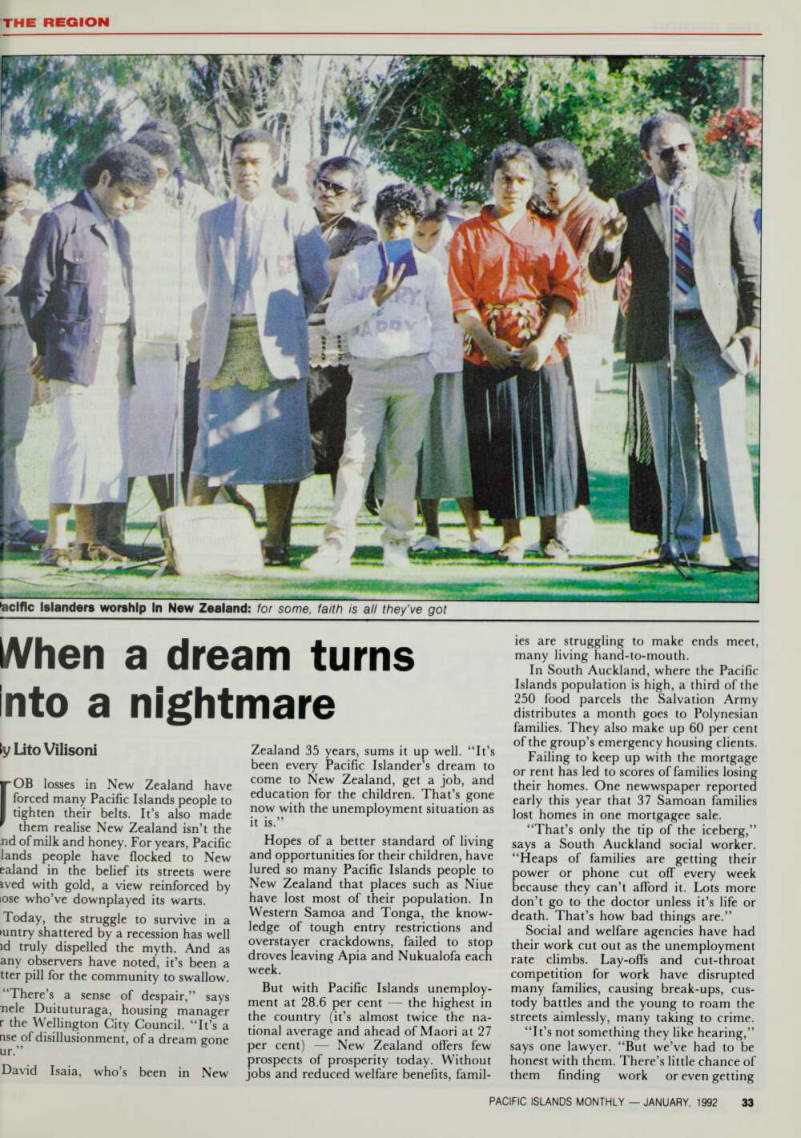
Pecific Islanders worship In New Zealand: for some, faith is all they’ve got
residency at the moment. In the end, some of them are just a burden to their families. Unfortunately, New Zealand is so hard at the moment, that I think people would be better off at home.”
Isaia, an advisory officer to Social Welfare’s head office in Wellington, agrees. In fact, he recently braved the wrath off the Cook Islands community by publicly urging those out of work to return home.
In a story which led to an editorial titled ‘Better Off At Home’ in the New Zealand Herald (the country’s biggest paper), Isaia called on fellow countrymen to consider resettling in the Cooks as an alternative to struggling on in New Zealand. Isaia said people who had been laid off and who were unlikely to work again because of their age and lack of skills, could lead quite a comfortable life at home. With money from their redundancy they could work the land or sea, and enjoy the bonus of a stress-free life.
“We are not trying to push people, or make the decisions for them,” he told Parific Islands Monthly. “All we’re saying is consider the option. We’ve got to face
reality,”
Isaia, who’s offended some people with
his comments, says several Cook Islands people have returned home, in the hope of making a fresh start. They, and others who follow, have been asked to open the eyes of those at home to the realities in New Zealand.
“To the people who return home we say, ‘Please take this message with you to those at home New Zealand is not the land of milk and honey.’ Please, also try to discourage them from coming here because there are no jobs.”
Folks at home can’t have missed the money troubles of their New Zealand kin. Remittances have dropped mark edly and are expected to keep falling for some time. Western Samoa is apparently expecting a 10 per cent drop this year.
Yet, Pacific Islands people continue to flock to New Zealand. And those already there find the idea of going home inconceivable. Many feel they have nothing to return to, and others worry about going empty handed. And many would rather be poor in New Zealand, than in the islands.
“It’s a really tough thing to ask of people,” says one Auckland journalist.
“Pacific islanders came here for oppor tunity, not only for themselves, but for the future generation. Things are tough,
but that dream is still alive for man) people. You can’t take that away frorr them.”
Auckland trade union official Phillip Field agrees. He says Pacific Islands people should ride out the economic downturn, and build on what they’ve already achieved to provide a secure future for the coming generation.
“Our expectations of life in Nev\ Zealand have been high,” he says. “Bui I still believe New Zealand offers the potential of great advancement foi Pacific Islands people. This is a transi tional period we are going through Things should be better for the nexi generation. What we need to do now is harness our skills so that we are no longei considered expendable as workers.”
Duituturaga sees a similar rosy future A member of an advisory committee tc Employment Minister Bill Birch Duituturaga is spearheading a study into the place of Pacific Islands workers especially women, today and where the) want to be by the year 2000. Much of the study is still being fine-tuned, but its airr is to push Pacific Islands people up the work ladder. Says Duituturaga: “It’: revitalising that dream our parents came with that somehow got lost in thi: economic crisis.” G