God bless
pp. 12-13 · Read in the full issue
Vanuatu
God bless the coalition
The churches pray for unity as Carlot tries to keep his promises for a better future
By Davendra Sharma
ON the eve of Vanuatu’s fourth general election, the churches called for a na tional prayer. They asked God for a government which would cherish Christian values and respect ni- Vanuatu customs and traditions.
Their prayers, it seemed, were answered.
The election results gave the French-aligned Union of Moder ate Parties 19 seats, the same number it won in 1987. Three smaller parties which some church leaders believed “had worked for their money”, won a seat each.
The factions of former premier Father Walter Lini’s Vanua’aku Party won 24 seats.
If the Vanua’aku Party (VP) was united it would have been back in power without a sweat.
Too bad for them they were not. In the place of that once powerful organisation were: • Lini’s National United Party, formed after Lini was ousted from power through a vote of no confidence in September. • The Vanua’aku Party, or what remained of it. This was led by Donald Kalpokas, the former party general secretary who took over as prime minister after Lini’s ouster
• The Melanesian Progressive Party. This was formed by former Cabinet minister Barak Sope and former Vanuatu President George Sokomanu after a failed attempt in 1988 to oust Lini through a constitutional coup “God has answered our prayers,” said influential Presbyterian pastor Allan Nafuki, a senior government political secretary, a week after the December 2 elections. “He has reacted in a mysteri ous way ... He has left it to the divided VP groups to come together.”
But how could a merger be organised of factions who were divided on personalities? Anglican church priest Father Lini wanted VP finance minister
Sela Molisa out of any coalition govern ment. Lini claimed Molisa instigated his ousting. But VP claimed they dumped Lini amid charges of corruption and
incompetence.
The power-play between Kalpokas’s moderate and Lini’s left-wing Vanua’aku Party factions opened the door for the third group, Sope’s Melanesian Progressive Party (MPP), to join in the talks. MPP said it would join the coalition and return Vanua’aku Party to power if Sope was the prime minister.
“We have no problems with NUP or with VP but the two of them have many personality problems,” Sope’s deputy, William Edgel, told Pacific Islands
Monthly. “So for the sake of compromiii and getting in, we pushed our leader \ be prime minister.” Lini and Kalpok; said: no deal.
Edgell, Pastor Nafuki and Sokoman spearheaded the reconciliation talks ths tried to bridge the personality gaps an return the anglophone Vanua’aku Part to office. But the mainstream churc groups that worked under the umbrell of the Vanuatu Council of Christiai Churches wanted a change of goverr ment. It preferred the Union of Model ate Parties (UMP), which had won th most seats in the election, to form th government. VCCC secretary-generz Pastor Nippy Aiong said the council di not believe a coalition of reunited V factions could remain united for long.
“As we claim to be a Christia: country, we should allow the majorit party to rule with one of the others,” hi said. “Those who have lost power shoul* move aside and let’s see some new ideas
new developments.”
The UMP needed five seats to form ; majority government. On December 1C Lini offered a coalition. UMP agreed.
“We didn’t have any conditions, w< just took what they offered,” said NUP’ 1 chief negotiator, party assistant secretary Charles Bice. “It was not like othe; parties the VP and MP demanded portfolios.” MPP had wanted the finano and education portfolios while VI wanted finance and foreign affairs.
UMP agreed that NUP will fill fom out of the 10 portfolios and provide the deputy prime minister, a post Lini hac created in his last few months in office: Lini opted to stay out of cabinet and his family sources said he even turned dowr an offer to be the Speaker a post which would have given him enormous powei in the house, considering the fact that nc party had absolute majority in parlia ment.
“He wanted to be out of the coalition government for personal and health reasons,” said Bice. “He prefers to stay out of the limelight but will probably concentrate on consolidating the party.”
Long-time Lini loyalist Sethy Regenvanu became Deputy Prime Min ister and Minister for Justice. Othen NUP people in Cabinet are: former Speaker Onneyan Tahi, agriculture,, livestock and fisheries; Hilda Lini (Lini’s? sister), health; Edward Tambisiri, tele communications.
The UMP took the key jobs: party\
vice-president Maxime Carlot, prime;
minister; party president Serge Vohor,< foreign affairs; party treasurer Willie; Jimmy, finance. Carlot, though UMP’s?
longest-serving parliamentary leader, t
did not have it all his way. Vohor alsot
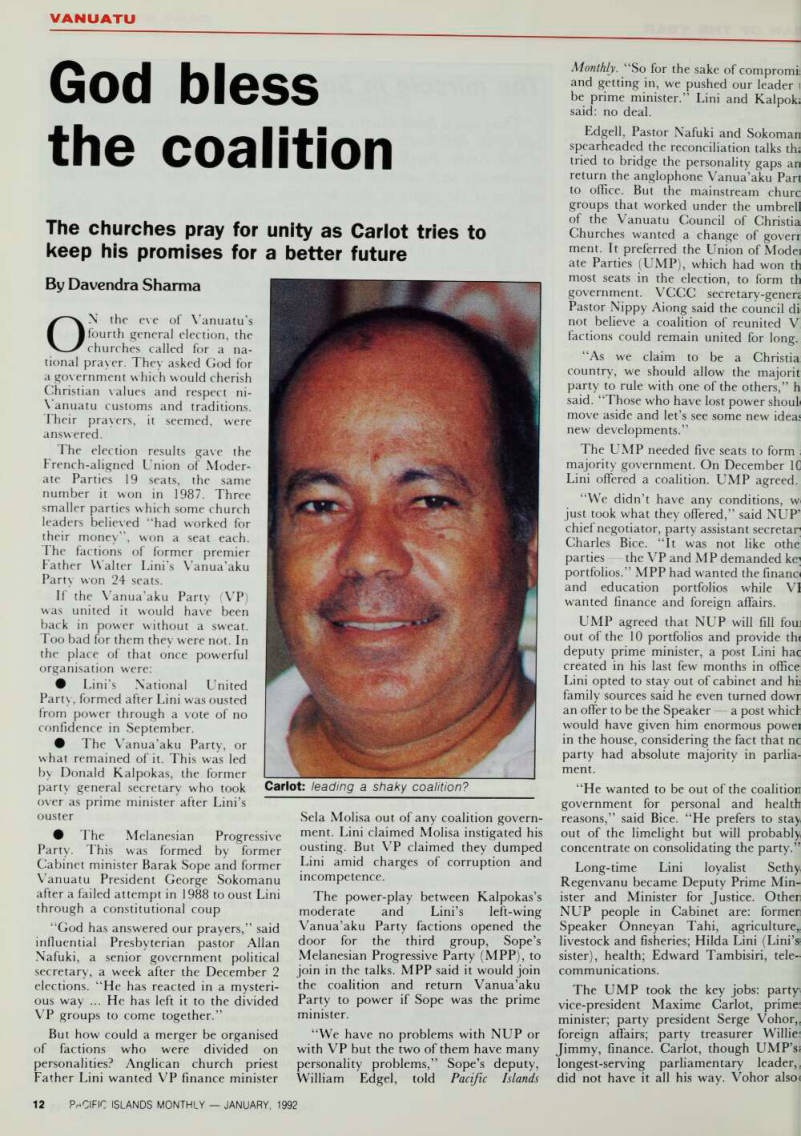
Carlot: leading a shaky coalition?
wanted the prime ministership and put up a good fight in the party caucus. He commands strong support in UMP’s traditional rural strongholds.
There is concern within the governing UMP-NUP coalition that Vohor, a former medical officer, would challenge Carlot, a prominent businessman on the main island of Efate, when he has mustered enough support. UMP execu tive Petre’ Malsugai, hopes not. “It’s in
the party’s interest that this govern ment lives for the full term and not je divided like the ITP,” Malsugai old PIM.
The UMP’s pri nary power base las been the 35 per :ent French
peaking elector
ite. But Malsugai ontends that it /as a turnaround n anglophone otes that got bem the numbers ist month.
People became
tally sick of the ini government, ’hey made profil es they couldn’t
eep. Not to mention the infighting,” he lid.
Pastor Aiong, of the Vanuatu Council f Christian Churches, backs the UMP rgument that past Vanua’aku Party jvernments had failed to deliver the )ods. “You can see physical things, like »ads, airports and schools but these were jilt with the money from other govern ents,” he said. “The local people have ffered. Economic problems are world ide but for a small country like us, we in easily handle things with the sort of oney we get from overseas.”
What is UMP’s promise of hope for a :w era? Listen. • Policy One: Opening political id economic links with the United
ates and European Community. “We
ink Vanuatu’s non-alignment stance is too inward looking and preached cialism,” said Malsugai. “We want to leralise the system. We can also work
military ties.”
An American military base? “We can k about it but we’ve got to have nsultation on that.” An American base ►rried some civil servants. “Look at the dal effects of a base in the Philippines,” d foreign affairs official, Jerry Boe. • Policy two: Allowing the sale of ehold land, even to foreigners. This licy ignited much election debate, >ecially from Sope’s party, whose
slogan was: “My land, my life”.
Malsugai explains that the freehold land in question refers to just parts of land around Port Vila and Lugainville, in Santo. The government, he said, would only sell the land after the consent of the customary owners has been acquired. • Policy three: Free education and health services, special pensions for the elderly, and raising the minimum wage level. This policy worries the churches.
“Where will we get the money from?” said Pastor Aiong, the general secretary of the Vanuatu Council of Christian Churches.
The Secretary of Finance, George Pakos, who has
helped prepare
several Vanuatu government budgets, believed the UMP finance
policies would
bankrupt the
country in six months. “They’ve promised the im possible, only to appeal to the low, uneducated class,”
said Pakoa. “There were 400 projects we couldn’t fund (last year) because there was no money.
“The country would not last. The promises could bankrupt the country.” • Policy four: Equal anglophone and francophone representation in the civil service and government statutory organisations. “Francophones and
anglophones should be looked at on an even keel,” said Malsugai.
“The last government looked down on the francophones in terms of education government staff, schools, public works and health. It’s the belief of the UMP to promote both systems and languages.”
Unionists oppose the idea of seeing the civil service in terms of
francophones and
anglophones. “It’s not that we don’t have
francophones. We
already have them in the service,” said Vanuatu Public Servants Association treasurer, Ori Simon. “Just because you’re francophone should not guarantee you jobs. The same applies to
anglophones. People have to be qualified and chosen on merit.” Simon warned that political influence in the service could “be slippery in the future”.
Will a coalition government last? The churches were divided on this issue.
Pastor Kami Shing, of Holiness Fellow
ship, felt political instability and changes
in government would characterise the next four years of a two-party govern ment in Vanuatu. “Every party has its own set of beliefs and they cannot work harmoniously with each other,” he said.
“Coalitions will only last for a short time.
Eventually it will split up.”
Even Hilda Lini, during her cam paign, warned that Vanuatu will follow the political turmoils of the Solomon Islands and Papua New Guinea when
they encountered parliamentary insta
bility under various coalition govern ments. “You can expect up to three or four changes in government in a coalition situation,” she told her party’s final election rally of 350 supporters. “Gov ernment will keep breaking up like in PNG and the Solomon Islands.” Besides, she warned, the country could lose foreign investors whose confidence would be shaken by frequent changes in government.
The core executive of the churches’ council however contend that a two party government will alleviate one party “becoming too dictatorial”. The VCCC, said Pastor Aiong, believed it would be good to have a coalition because it would bring “collective think ing and not just one-party system.
“Issues would be more debatable and it would be a test to see whether they are truly committed to democracy and for the sake of unity.”
It may have been God’s wish to unite
the rival anglophone
and francophone
groups “for the good of the nation,” he said. One theory
among anglophone
parties is that Lini could force a second election in 12 months by simply withdraw ing support from the UMP-led govern ment. Some, like
MPP vice-president
William Edgell, be lieve that the parties are “tied down to one year and we can not do anything”.
A second election can only be called 12 months after the dissolution of parlia ment for the first poll, said the principal electoral officer, Roy Yosef. But, prays Pastor Aiong: “I hope God is on our side.” □
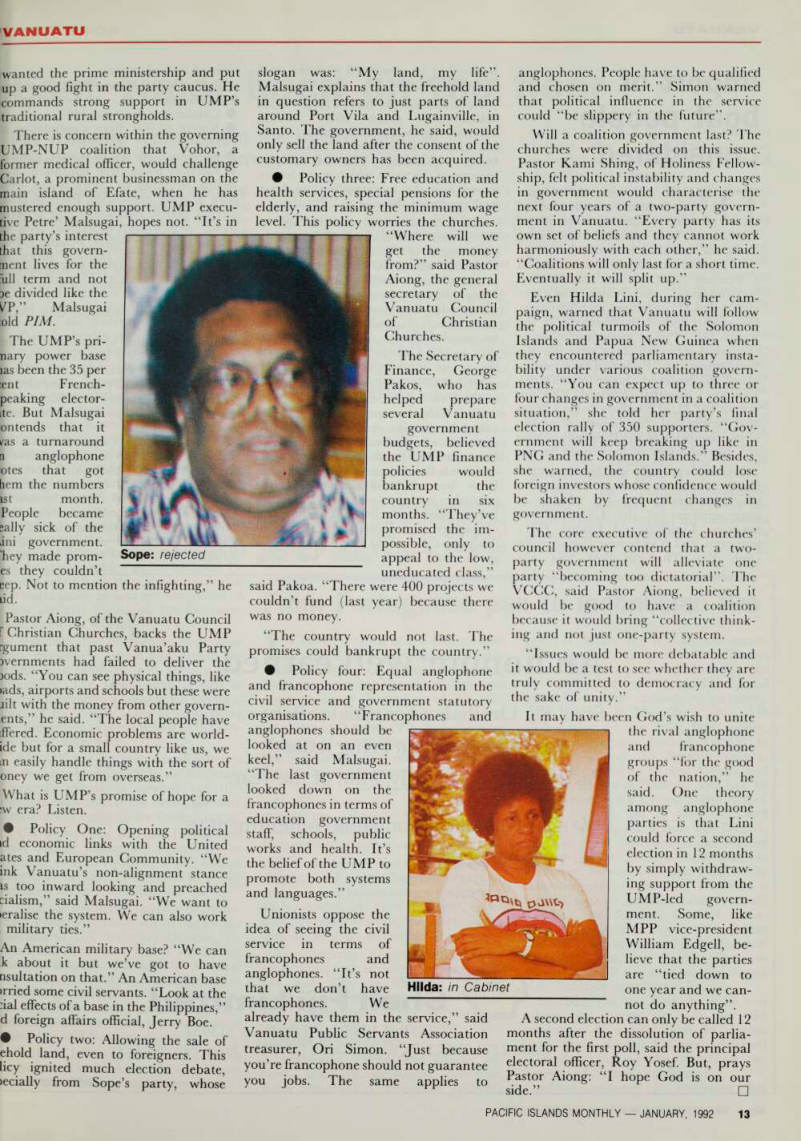
Sope: rejected
Hilda: in Cabinet