Year
pp. 8-11 · Read in the full issue
Man Of The Year
By Sir Leonard Usher
THE same sort of wisdom and foresight that made Ratu Sir Lala Sukuna an outstanding leader of his people in colonial Fiji pre pared Ratu Sir Kamisese Mara to become, later in the same century, the honoured political leader of an independent, multiracial nation and a figure of high importance in the regional South Pacific.
Ratu Sukuna’s father, Ratu Joni Madraiwiwi, foresaw that contact with the outside world would have an impact that would profoundly change the Fijian way of life. So he sent his son to school in New Zealand and later to Wadham
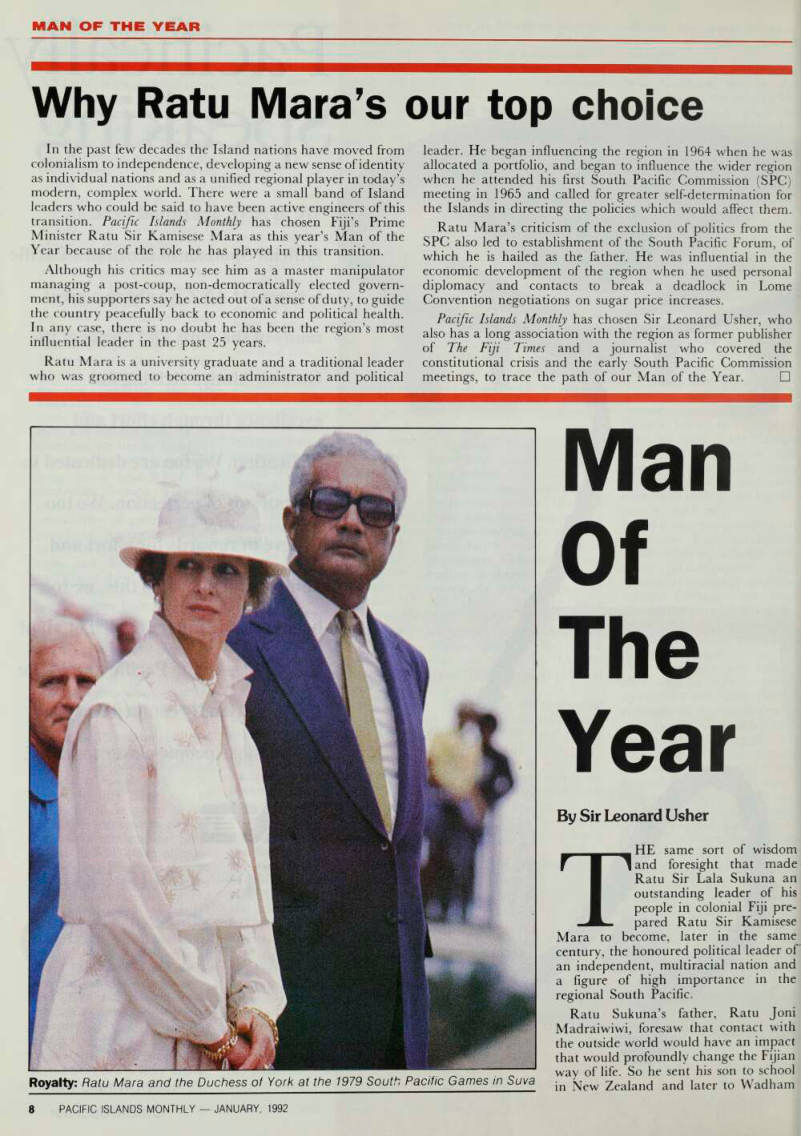
Royalty: Ratu Mara and the Duchess of York at the 1979 South Pacific Games in Suva
College of Oxford University in Great Britain to gain the knowledge and personal understanding which would equip him to provide a bridge of guidance and understanding between the Fijian people and the Western world.
A generation later, Ratu Sukuna, too, looked ahead. He realised that Fiji would, and could, not remain forever a colony of Britain, but would need administrators and political leaders of its own. He chose Ratu Kamisese Mara as the man to be prepared to fill the political leadership role.
Ratu Mara had been to school in Fiji and New Zealand, and was well on the way to completing a degree in medicine
at Otago University when Ratu Sukuna told him that he was to forsake his aim of becoming a doctor, and was to go to England to read modern history at Oxford University.
He did this at Ratu Sukuna’s own College of Wadham and followed it with the Devonshire course in public administration.
He graduated a Master of Arts and in 1969 he was made a Fellow of Wadham.
He returned to Fiji to join the colonial administrative service and 10 years later he went back to England on a Ford Foundation grant to earn a Diploma in Economic and Social Administra tion at the London School of Economics, where the atmosphere was one of challenge to
conventionally accepted political
and economic wisdom.
In Fiji, the way to parliamen tary experience was opened to him in 1953 when he became one of the Fijian members of the Legislative Council nominated by the Council of Chiefs. Cabinet experience came through mem bership of the Governor’s Execu tive Council.
So he was well prepared for the roles that fell to him as Fiji moved along the road of independence.
His political destiny was matched by personal recognition as a high chief. In 1969 he was installed as Tui Nayau, with the more recent title of Tui Lau added. No-one
who saw the exaltation that radiated from him as he emerged in the early morning from the ceremonial bath that was part of the ancient installation ceremonies for Tui Nayau can have any doubt of his consciousness of his chiefly
destiny.
In another context, he has himself written of his sense of mission. In the introduction to a book of speeches which was published in 1977 he turned, charac teristically, to the Bible.
He quoted from Joshua 1:9: “Have I not commanded thee? Be strong and of good courage: be not afraid neither be thou dismayed, for the Lord thy God is with thee whithersoever thou goest.”
“That”, Ratu Mara wrote, “is the exhortation and promise that guides my life.”
There was never any doubt about who was destined to be, and was accepted as, the political and administrative leader of the new Fiji.
The process began in 1964, when three members of the Executive Council, Ratu Mara, John (later Sir John) Falvey and A.D. Patel, were allocated portfolios, with the title of “Member” as a prelude
to full Cabinet responsibility. Ratu Mara was Member for Natural Resources.
It was at this time that his influence began to be felt in the wider South Pacific region. In 1965 he represented Fiji at a meeting of the South Pacific Commission at Lae, in Papua New Guinea. The Commission had been conceived by Australia as an institution through which the metropolitan powers could advise and help the less economi cally advanced Pacific Islands territories,
most of them still colonies. The island territories themselves would be part of an accompanying South Pacific Conference, where there would be an exchange of ideas but little authority. Ratu Mara demanded that the tail should wag the dog, and that paternalism should be replaced by direction of policy by the islands people themselves.
The result was the elevation of the South Pacific Conference to the domi nant place in the organisation.
Ratu Mara was also critical of the exclusion of politics by the South Pacific Commission and from this emerged the parallel South Pacific Forum, a specifi cally political body, of which he is justly
hailed as the father.
A by-product of the South Pacific Commission was the remarkable re birth of recognition by South Pacific peoples of their common origins and interests, (boxes plO,ll) Back in Fiji, in the mid-60s, for the first time in the country’s history, two political parties came into being. The predominantly In dian Federation Party, led by A.D.
Patel, was developed from an exist ing cane-growers organisation. A multi-racial Alliance Party was built on existing associations of Fijians, Indians and the remaining communities, who took on the name “General”. Again, there was never any doubt about who the leader of this party was to be.
In 1965, all the members of the Legislative Council flew to London for the first of two constitutional conferences to decide on the form which future governments of Fiji, now firmly on the way to indepen dence, would take. From this con ference emerged the idea, of great practical value in the governing of a multi-racial, multi-cultural, multi-anything State, of a Consti tution guaranteeing each of the major groups representation in the law-making body, and thus in national decision-making, so that no group could feel left out.
In an election in 1966, held under the constitutional system evolved at the London conference, The Al liance Party was victorious, and it remained in power, except for a few
days in 1977, for the next 20 years.
There was never any meeting of minds between the two opposing political parties on the Fiji voting system while A.D. Patel remained the unchallenged and unchallangeable leader of the Fed eration Party.
He did not deviate from a demand that Legislative Council elections should be on a common roll unyieldingly opposed by Fijian and other communi ties who saw it as a way of leading to
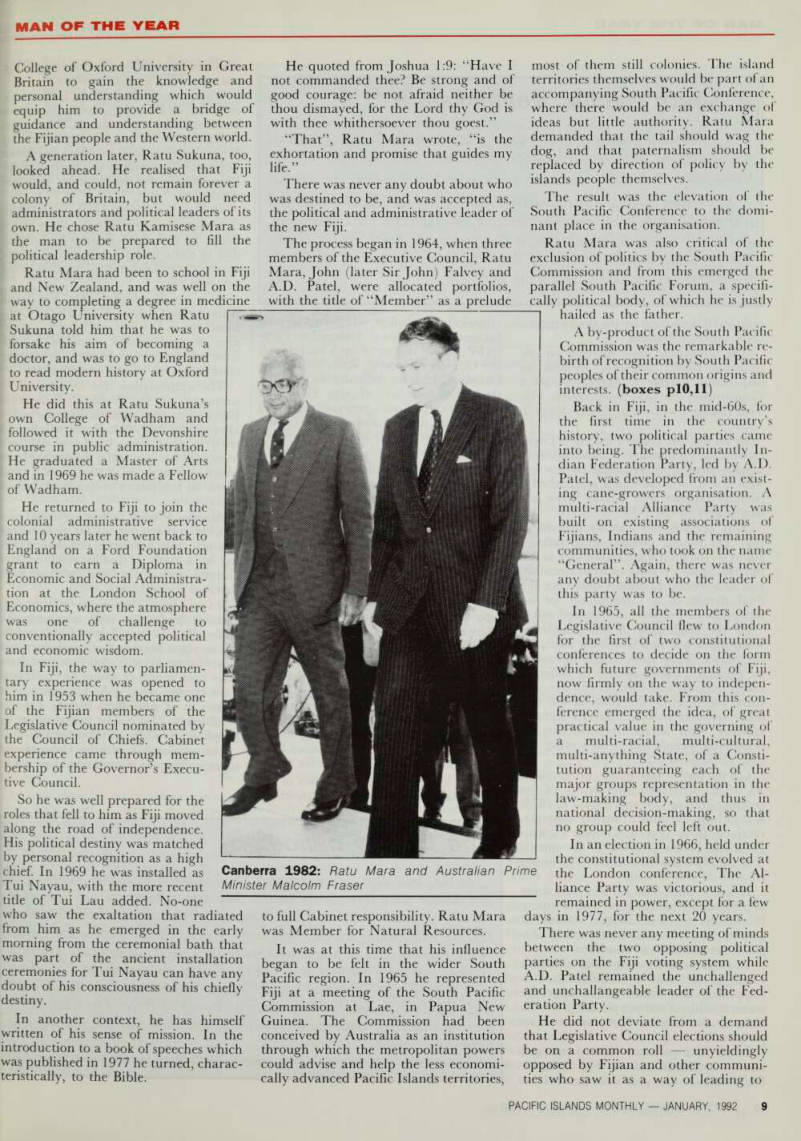
Canberra 1982: Ratu Mara and Australian Prime Minister Malcolm Fraser
political domination by the then numeri cally superior Indians.
The irresistible force meeting an im movable object situation seemed an impassable barrier to agreement on a Constitution for an independent Fiji.
This changed with A.D. Patel’s death in 1969.
In an historic contact during a Legis lative Council meeting - its significance almost certainly un-realised by the few who saw it Ratu Mara established a friendly rapport with Siddiq Koya, the new leader of the NFP.
This opened the way to agreement that Fiji should proceed to Dominion status the final stage on the way to full independence - without fresh elections, and at a second London Conference the final details of a Constitution for an independent Fiji were hammered out.
At the beginning of the conference Ratu Mara put into words his hopes for the future. They were that a Fiji could be created “where people of different races, customs and cultures can live and work together for the good of all; can differ without rancour; govern without violence; and accept responsibility as reasonable people intent on serving the best interests of all.”
On the day of Independence, October 10, 1970, the 106th anniversary of the ceding of Fiji to Queen Victoria in 1874, Ratu Mara, as Prime Minister-designate, received from Queen Victoria’s great grandson, Prince Charles, the documents that signified that henceforth Fiji would control its own destiny.
It was typical that he accepted them as a Fijian, by bending low and clapping the hands together in the traditional gesture which marks the receiving of a gift from someone of honoured status.
In a tribute to the long years of British tutelage, he said; “Nothing that is happening here today can change the warm feelings of our people of Fiji for the Crown, the United Kingdom and its
peoples.”
In 1977, a personal victory emerged from a political defeat. The Alliance Party had lost that year’s election but the
victorious Federation, which had by now become the National Federation Party (NFP), could not agree on a leader, and the Governor-General, Ratu Sir George Cakobau, had no difficulty in deciding that the member of the House of Representatives who personally enjoyed the greatest support among the members of the House, of all parties, was Ratu Mara.
Consequently, as he was required to do under the national constitution, he re appointed Ratu Mara as Prime Minister.
This was the year when, as an international tribute to Ratu Mara, the nations of the European Economic Com munity (EEC) and those of the African, Caribbean and Pacific group (ACP) which had earlier negotiated the wide reaching trade agreement named Lome after the first meeting-place, had decided to meet in Suva.
Ratu Mara’s part in successive Lome negotiations ranks high among his per sonal triumphs. The original Lome Agreement gave sugar producers in the Pacific, as in former colonies in the Caribbean and Africa, a guaranteed market for their product at a guaranteed price which in most years has since been above the world market price for sugar.
This, and subsequent revisions of the Lome Agreement, has put many thou
sands, in fact millions, of dollars into the pockets of Fiji’s sugar producers.
When negotiations on the Lome price on which all subsequent levels have been based stalled because the AGP delegates thought that the price being offered by Britain on behalf of the European Economic Community was too low, Ratu Mara broke the deadlock by personal! diplomacy.
Making use of a previous contact with the British Minister of Agriculture, Fred Peart, he flew from Brussels to London and in some friendly bargaining he got agreement to a substantial increase in the previous offer.
It is small wonder that Sir Josua Rabukawaqa, then Fiji’s High Com missioner in London, said later: “Mess ages of appreciation accorded to him from other ministers of sugar-producing countries were almost embarrassing.”
The appreciation did not extend to supporters of the National Federation Party when they went to the polls in Fiji after the NFP in election campaigns had tried to play down his Lome achieve ments. This is one of the things that have weighed heavily in Ratu Mara’s mind when he has talked critically of Indian
ingratitude.
Another is what he has perceived as a lack of appreciation of his painstaking efforts to cross barriers of misunderstand ing by a study of Indian religions and customs and a conscious cultivation of
personal friendships.
Ratu Mara’s character is complex, and his leadership style an intriguing study. He has been helped in his public life by some good and wise advisers, not least of them his wife, Adi Lala, but there have been others of whom he could well have heeded what T.E. Lawrence once wrote to a publisher friend, Frances Doubleday: “Do not be pulled down by people lesser than your past tradition.”
His relationship with his Cabinet and other colleagues is reminiscent of what
Ben Bolt was told about Sweet Alice: She wept with delight when you gave her a smile, And she trembled with fear at your
frown.
But Ratu Mara is far from being a dictatorial tyrant. There is an illuminat ing passage in his personal introduction to a book of his collected speeches. He says: “The more power and authority we ire given the more need for us to remain humble, to be ready to admit our jhortcomings, to be ready to learn, and :o be tolerant of others. To know and relieve this is not always easy to achieve, nit the knowledge is a constant re ninder, and chastening when we fail.”
But he adds a practical and perceptive ider: “But I do not believe humility neans softness or indecision,”
Ratu Mara often finds it difficult to >ut thanks into words, but he is likely to ignal gratitude later by some act of pecial kindness or consideration.
He is essentially practical. When he ilks of fishing or shipping it is as a sherman or a sailor. When he talks of re use of land it is as someone who has ctually grown the crops he talks about nd has learned at first-hand about their ossibilities and problems.
If forestry is the subject, he has itablished forests on his home island of akeba and has himself joined in the [anting of trees. In sport, there are few imes or competitive activities in which ; has not himself taken part and in any of them he has excelled.
He has won blues in athletics and icket at Otago University and in hletics at Oxford. He played rugby and icket for the province of Otago in New ;aland.
Ratu Mara is never pompous. He is o much a man of the Pacific Islands id has too great a sense of humour for at to happen. He is likely to relieve en the most serious moments with a uckle and a humorous or quick witty mment.
The only time his sense of humour or fun fails him is when he nurses icntment of a slight or a personal )uff. When he is hurt or frustrated he nts to hit back. This is characteristic many people perhaps most. Psy- Dlogists speak of it as varying degrees paranoia an aspect of the mind ich is far from being an illness but :omes of concern when it is allowed to /e a serious effect on judgment, fhe full story of what happened in Fiji ore and after the first 1987 coup has to be told and much of what has been Dlished about Ratu Mara’s role is
:orted or often deliberately
rue. But some things are beyond ibt. One is that he had no part in the spiracy that led to the recruitment of third-ranking officer of the Fiji
Military Forces, Lt. Col Sitiveni Ra buka, to organise and carry out the coup.
He may well have understood some of the feelings and aims of the conspirators but the methods they employed to achieve their aims were totally foreign to the philosophy and practice he had pursued throughout his political life.
His agreement to join the post-coup government stemmed from his sense of mission, supported by knowledge of his own 20 years of experience and service, and a conviction that although the coup itself had been conducted with high efficiency and without bloodshed Lt. Col.
Rabuka was not capable of assembling and leading a civilian government that would bring political and economic health back to Fiji.
It can never be claimed that such a many-sided man has never been without fault. But some of his most strident critics
have grossly misjudged him and he is justified in claiming that they do not understand the Pacific or its people.
On the credit side, he has gathered about him a host of friends and has a record of leadership achievement un matched by any other man of his generation in Fiji, and indeed in the South Pacific.
Whatever his future when he steps down as Prime Minister early in 1992, whether it be translation to Government House as President, or to the quiet of a university to write his memoirs; or whether he plans to be host at a resort he has established at Lomaloma; or whether he will just settle peacefully at Lakeba to tend his gardens and his trees between excursions to a golf course or supervision of his cane plantation at Seaqaqa, his place of honour in the annals of the people he has served well is assured. □