The question of origin
p. 47 · Read in the full issue
IN this column in October I pointed out some of the ways islands businessmen, and govern ments, fail to make use of many of the opportunities of the South Pacific Regional Trade and Economic Co-operation Agreement,
or Sparteca.
My piece was sparked by comments made by Fiji’s Deputy Prime Minister and Minister for Finance and Economic Planning, Josevata Kamikamica, that the agreement looked gen erous and accommodating to many island countries but on closer inspection many of them found it irrelevant. He said the agreement might even have diverted the attention of small island businessmen from more promising opportunities in other parts of the world, and he thought the time was ripe to consider changes to it.
Kamikamica particularly mentioned inefficiencies that he said were brought about by the rules of origin.
The point I made was that Sparteca was still a very useful tool, but many who could take advantage of its many provisions weren’t doing so because they had failed to fully examine them. That point needed to be made, and it needs
repeating.
There are some things Sparteca does not or cannot do. There can be improvements in what it does do, such as in the rules of origin. Networking South Pacific, the big internationally attended Fiji investment and trade forum that has just concluded in Nadi, is a reminder that while Sparteca can
promote investment in the islands, and it does, it cannot necessarily locate an investor and deliver him running and ready to go. Identifying specific, serious investors takes a great deal of time and resources, and while the South Pacific Trade Commission can help, great input is required from the island businessees or governments that, in the end, will benefit (which is only fair.
Sparteca is a tool to be used, not a substitute for local initiative or
action.)
The rules of origin are another matter. If they need fixing the repairs have to be made in the agreement itself. The rules of origin define the “local content” requirements of goods that can be admitted tariff free to Australia and New Zealand. The problem is that business is inclined to developed at a faster pace than the wording of agreements like Sparteca can keep up with, even taking into account the changes so far made to the Sparteca.
In the case of manufactured
goods, island business complains that the more efficient a manufacturer becomes the more difficult it could be for him to meet the rules of origin, which require that at least 50 per cent of the labour costs and material must originate from within Forum countries.
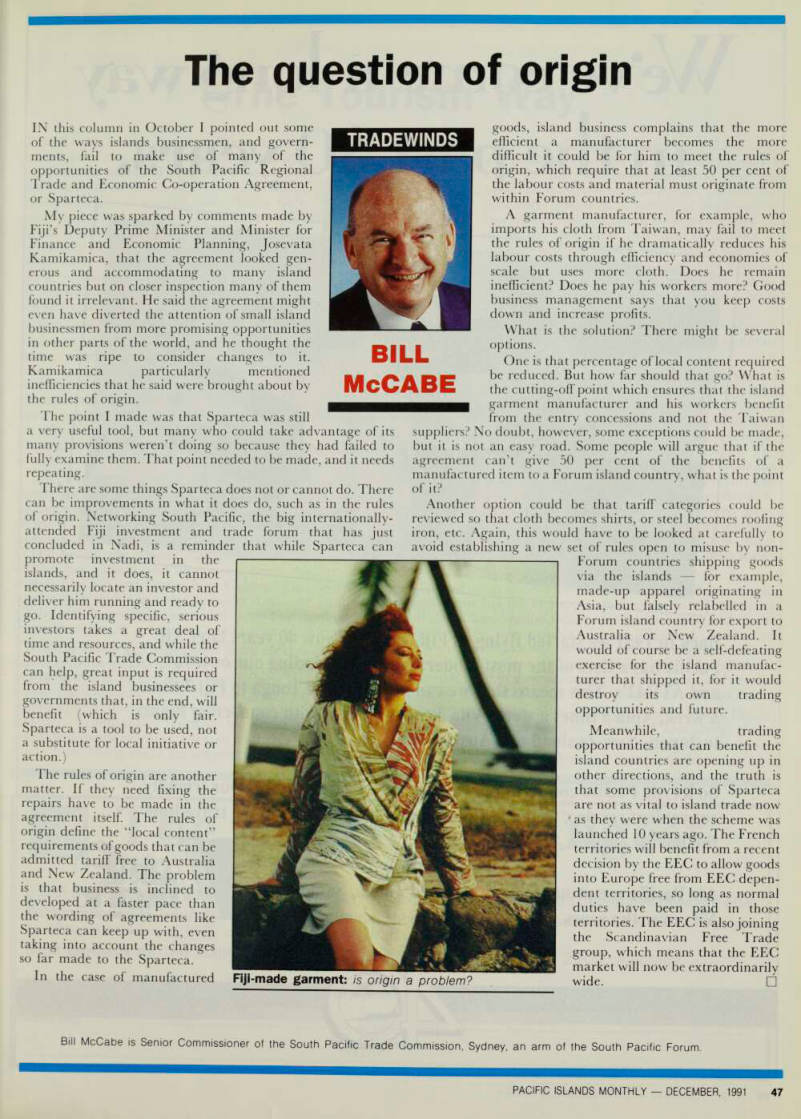
A garment manufacturer, for example, who imports his cloth from Taiwan, may fail to meet the rules of origin if he dramatically reduces his labour costs through efficiency and economies of scale but uses more cloth. Does he remain inefficient? Does he pay his workers more? Good business management says that you keep costs down and increase profits.
What is the solution? There might be several options.
One is that percentage of local content required be reduced. But how far should that go? What is the cutting-off point which ensures that the island garment manufacturer and his workers benefit from the entry concessions and not the Taiwan
suppliers? No doubt, however, some exceptions could be made, but it is not an easy road. Some people will argue that if the agreement can’t give 50 per cent of the benefits of a manufactured item to a Forum island country, what is the point of it?
Another option could be that tariff categories could be reviewed so that cloth becomes shirts, or steel becomes roofing iron, etc. Again, this would have to be looked at carefully to avoid establishing a new set of rules open to misuse by non-
Forum countries shipping goods via the islands for example, made-up apparel originating in Asia, but falsely relabelled in a Forum island country for export to Australia or New Zealand. It would of course be a self-defeating exercise for the island manufac turer that shipped it, for it would
destroy its own trading
opportunities and future.
Meanwhile, trading opportunities that can benefit the island countries are opening up in other directions, and the truth is that some provisions of Sparteca are not as vital to island trade now as they were when the scheme was launched 10 years ago. The French territories will benefit from a recent decision by the EEC to allow goods into Europe free from EEC depen dent territories, so long as normal duties have been paid in those territories. The EEC is also joining the Scandinavian Free Trade group, which means that the EEC market will now be extraordinarily wide. □
Bill McCabe is Senior Commissioner of the South Pacific Trade Commission, Sydney, an arm of the South Pacific Forum.
Tradewinds
Bill
Mccabe
Fiji-made garment: is origin a problem?