Flying time
pp. 41-45 · Read in the full issue
Pacific
Islands
Monthly
Business
Flying time
As the big flyers leave the islands new airlines spring up to carry the flags
By Martin Tiffany
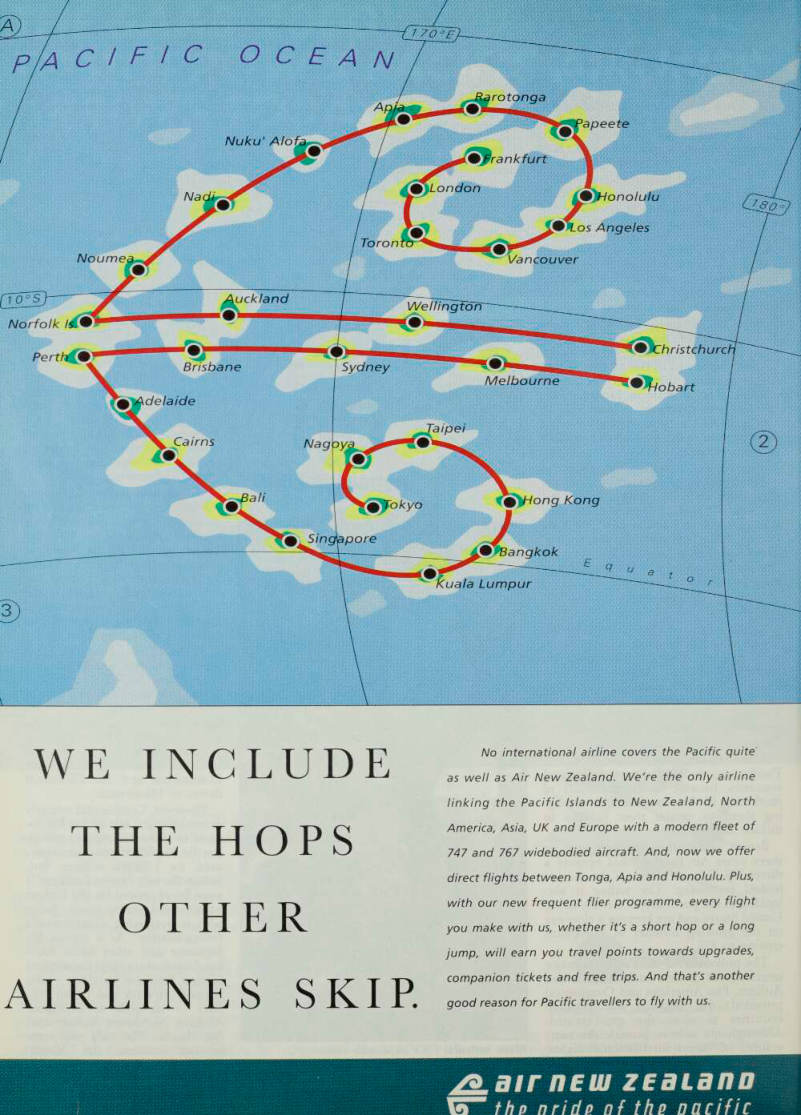
IF you took a plateful of cooked spaghetti and threw it on a map of the Pacific you may get some idea of air routes in this region. It is not that there is anything messy about aviation into, out of and between the many island nations in this area of the world. It is just that if you drew in all the Pacific air routes on a map you would end up with something resembling, well, a lot of spaghetti on a map of the Pacific.
Air traffic in this part of the globe is intensifying in a market that is already
fairly busy. Although it does not have airports to rival the likes of Los Angeles or London’s Heathrow it does have its fair share of flights and airlines.
One major reason for the increase in regional intensity is the growth of Pacific domiciled airlines as more Pacific Island governments risk the heavy financial burden and start their own airlines.
This is a direct response to major foreign carriers overflying the islands resulting in irregular services. This causes havoc to many island nation’s plans of building a strong tourism base.
The latest to take the plunge into the tough international market is Royal
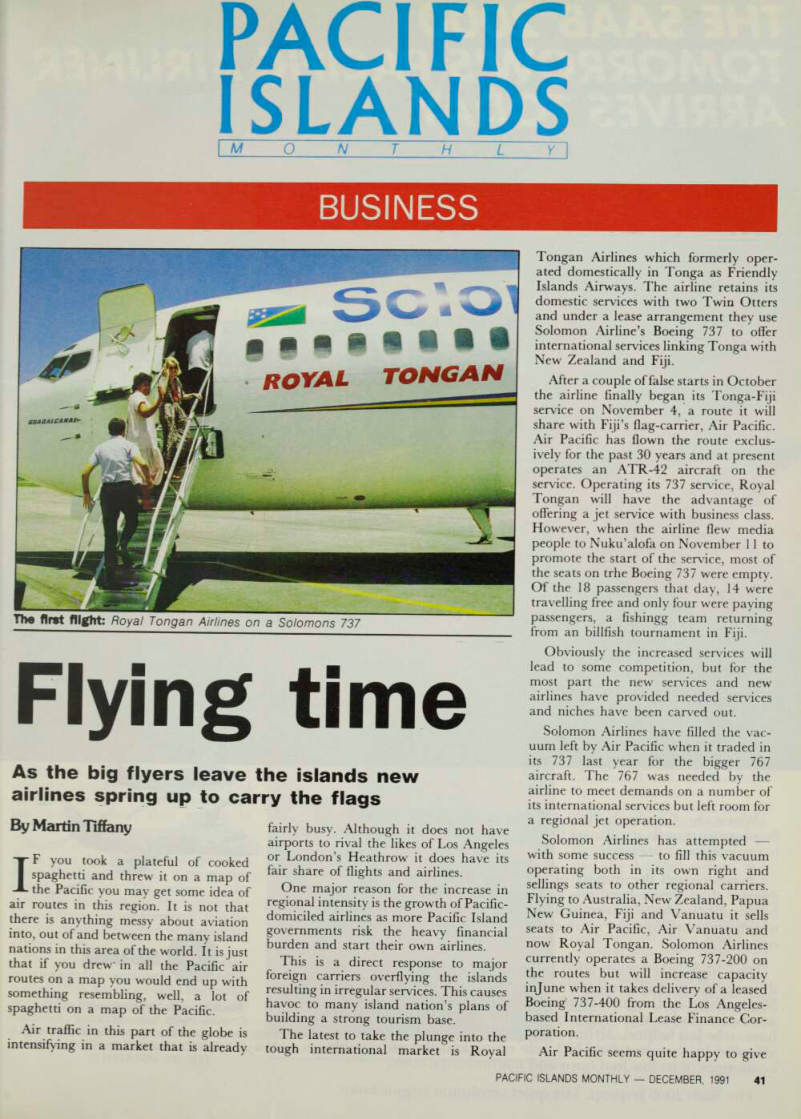
Tongan Airlines which formerly oper ated domestically in Tonga as Friendly Islands Airways. The airline retains its domestic services with two Twin Otters and under a lease arrangement they use Solomon Airline’s Boeing 737 to offer international services linking Tonga with New Zealand and Fiji.
After a couple of false starts in October
the airline finally began its Tonga-Fiji
service on November 4, a route it will share with Fiji’s flag-carrier, Air Pacific.
Air Pacific has flown the route exclus ively for the past 30 years and at present operates an ATR-42 aircraft on the service. Operating its 737 service, Royal Tongan will have the advantage of offering a jet service with business class.
However, when the airline flew media people to Nuku’alofa on November 11 to promote the start of the service, most of the seats on trhe Boeing 737 were empty.
Of the 18 passengers that day, 14 were travelling free and only four were paying passengers, a fishingg team returning from an billfish tournament in Fiji.
Obviously the increased services will lead to some competition, but for the most part the new services and new airlines have provided needed services and niches have been carved out.
Solomon Airlines have filled the vac uum left by Air Pacific when it traded in its 737 last year for the bigger 767 aircraft. The 767 was needed by the airline to meet demands on a number of its international services but left room for a regional jet operation.
Solomon Airlines has attempted with some success to fill this vacuum operating both in its own right and sellings seats to other regional carriers.
Flying to Australia, New Zealand, Papua New Guinea, Fiji and Vanuatu it sells seats to Air Pacific, Air Vanuatu and now Royal Tongan. Solomon Airlines currently operates a Boeing 737-200 on the routes but will increase capacity injune when it takes delivery of a leased Boeing 737-400 from the Los Angeles based International Lease Finance Cor poration.
Air Pacific seems quite happy to give
The first flight: Royal Tongan Airlines on a Solomons 737
up some regional routes as it eyes the large international markets with tourism in mind. One gamble that paid off handsomely is the airline’s second service to Tokyo’s Narita airport which began in May. “Thank God we did it,” was how Air Pacific’s chief operating officer, Stephen Brown, responded when asked how the service was going.
“The Japanese increase is really filling a lot of the void created by the vanishing Australians. The Japanese market for Fiji (tourism) hasn’t slowed and the growth is very exciting. The question we would like to ask is where would Fiji be without our second service to Japan we would have suffered there are fewer Austra lians, and fewer (visitors) from other source markets like America.”
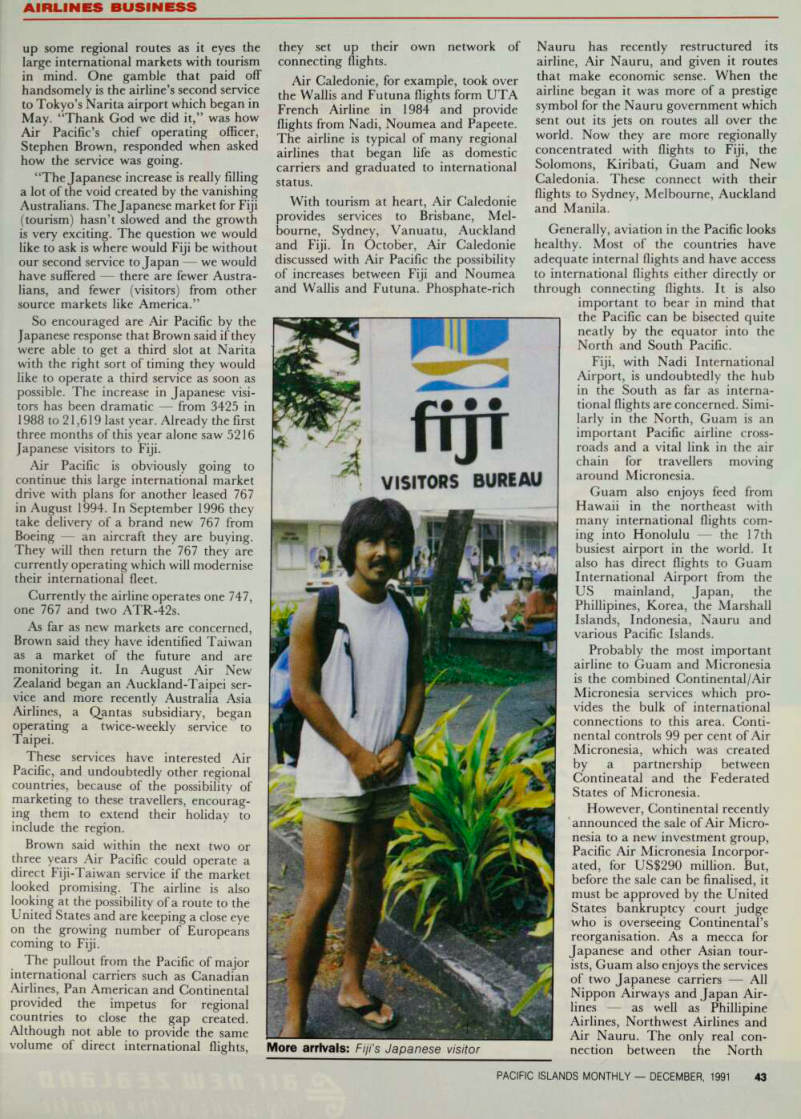
So encouraged are Air Pacific by the Japanese response that Brown said if they were able to get a third slot at Narita with the right sort of timing they would like to operate a third service as soon as possible. The increase in Japanese visi tors has been dramatic from 3425 in 1988 to 21,619 last year. Already the first three months of this year alone saw 5216 Japanese visitors to Fiji.
Air Pacific is obviously going to continue this large international market drive with plans for another leased 767 in August 1994. In September 1996 they take delivery of a brand new 767 from Boeing an aircraft they are buying.
They will then return the 767 they are currently operating which will modernise their international fleet.
Currently the airline operates one 747, one 767 and two ATR-425.
As far as new markets are concerned, Brown said they have identified Taiwan as a market of the future and are monitoring it. In August Air New Zealand began an Auckland-Taipei ser vice and more recently Australia Asia Airlines, a Qantas subsidiary, began operating a twice-weekly service to
Taipei.
These services have interested Air Pacific, and undoubtedly other regional countries, because of the possibility of marketing to these travellers, encourag ing them to extend their holiday to include the region.
Brown said within the next two or three years Air Pacific could operate a direct Fiji-Taiwan service if the market looked promising. The airline is also looking at the possibility of a route to the United States and are keeping a close eye on the growing number of Europeans coming to Fiji.
The pullout from the Pacific of major international carriers such as Canadian Airlines, Pan American and Continental provided the impetus for regional countries to close the gap created.
Although not able to provide the same volume of direct international flights,
they set up their own network of connecting flights.
Air Caledonie, for example, took over the Wallis and Futuna flights form UTA French Airline in 1984 and provide flights from Nadi, Noumea and Papeete.
The airline is typical of many regional airlines that began life as domestic carriers and graduated to international status.
With tourism at heart, Air Caledonie provides services to Brisbane, Mel bourne, Sydney, Vanuatu, Auckland and Fiji. In October, Air Caledonie discussed with Air Pacific the possibility of increases between Fiji and Noumea and Wallis and Futuna. Phosphate-rich
Nauru has recently restructured its airline, Air Nauru, and given it routes that make economic sense. When the airline began it was more of a prestige symbol for the Nauru government which sent out its jets on routes all over the world. Now they are more regionally concentrated with flights to Fiji, the Solomons, Kiribati, Guam and New Caledonia. These connect with their flights to Sydney, Melbourne, Auckland and Manila.
Generally, aviation in the Pacific looks healthy. Most of the countries have adequate internal flights and have access to international flights either directly or through connecting flights. It is also
important to bear in mind that the Pacific can be bisected quite neatly by the equator into the North and South Pacific.
Fiji, with Nadi International Airport, is undoubtedly the hub in the South as far as interna tional flights are concerned. Simi larly in the North, Guam is an important Pacific airline cross roads and a vital link in the air chain for travellers moving around Micronesia.
Guam also enjoys feed from Hawaii in the northeast with many international flights com ing into Honolulu the 17th busiest airport in the world. It also has direct flights to Guam International Airport from the US mainland, Japan, the Phillipines, Korea, the Marshall Islands, Indonesia, Nauru and various Pacific Islands.
Probably the most important airline to Guam and Micronesia is the combined Continental/Air Micronesia services which pro vides the bulk of international connections to this area. Conti nental controls 99 per cent of Air Micronesia, which was created by a partnership between Contineatal and the Federated States of Micronesia.
However, Continental recently announced the sale of Air Micro nesia to a new investment group, Pacific Air Micronesia Incorpor ated, for US$29O million. But, before the sale can be finalised, it must be approved by the United
States bankruptcy court judge
who is overseeing Continental’s reorganisation. As a mecca for Japanese and other Asian tour ists, Guam also enjoys the services of two Japanese carriers All
Nippon Airways and Japan Air
lines as well as Phillipine Airlines, Northwest Airlines and Air Nauru. The only real con nection between the North
More arrivals: Fiji's Japanese visitor
Pacific and the South is the twice weekly Air Marshall Islands flight between the Marshalls and Fiji via Kiribati and Tuvalu. This is a vital link to the Nadi hub.
Air Marshalls also provides a jet service between Majuro and Honolulu.
The forward-looking, 10-year-old airline plans to seek landing rights in other Pacific Rim countries and has implemen ted a five-year plan which includes the acquisition of new aircraft.
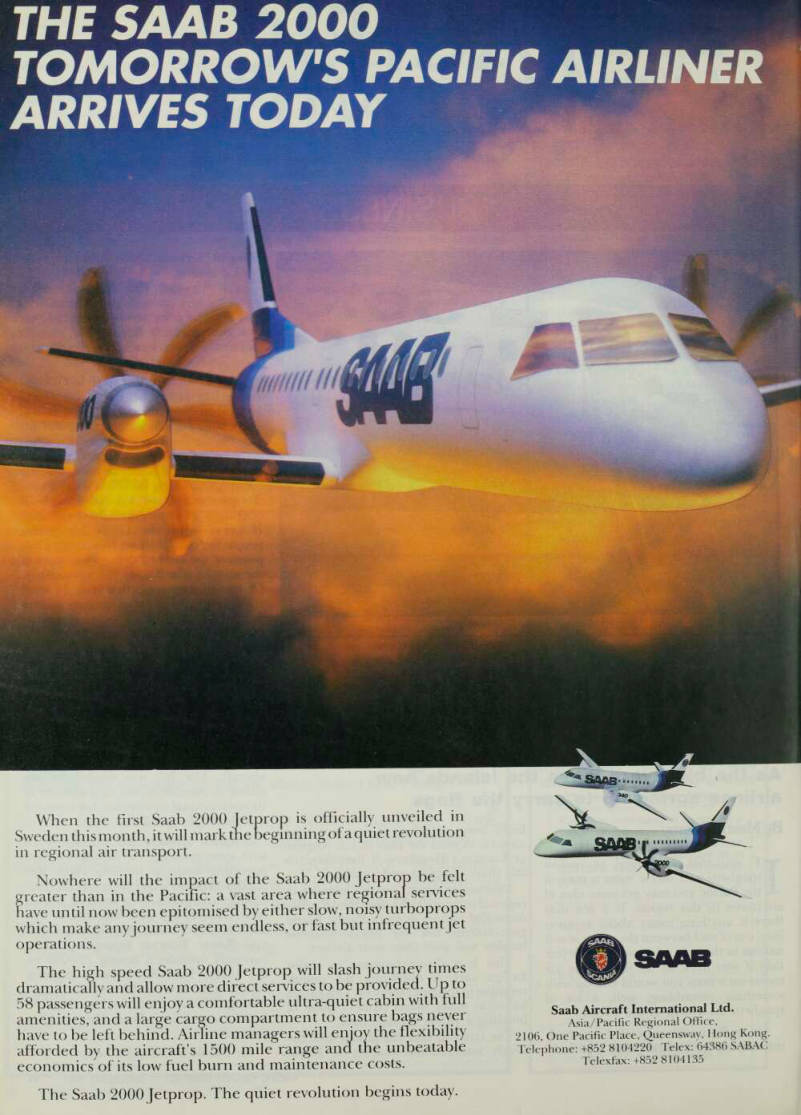
Air Marshalls already has an order with Swedish company SAAB Aircraft International for a SAAB-2000 jetprop aircraft, due for delivery in 1994. It has an option for two more. The airline will be the first in the region to use the 58-seater plane and plans to fly it on both its domestic and international routes.
As mentioned, tourism plays a major role in the establisment of routes with even small nations like Tuvalu getting in on the act now that it has regular services. Apart from the Air Marshall service it also has a weekly service from Nadi provided by Fiji domestic airline,
Fiji Air.
The hopes of the tiny atoll are high following its inclusion in package tours of the South Pacific.
In August a group of 14 Italian tourists visited Tuvalu as part of a tour which included Tonga and Western Samoa.
However, the total number of visitors is expected to be modest. The country has one hotel with 16 rooms.
Tuvalu’s neighbour Kiribati is also anticipating heavier air traffic. It re cently obtained a US$6.3 million dollar loan from China to develop Bonriki International Airport. The runway is being lengthened to accommodate 767 aircraft.
Kiribati’s airline, Air Tungaru, flies internally after failed attempts to go international.
The potential in the Pacific is obvi ously being seen with a number of private airlines being established. The Tongan government recently granted approval to a Tongan businessman to operate an air service from Hawaii to Tonga via American Samoa. So the list of new routes, new airlines, new aircraft, new markets and future plans goes on.
The Pacific is seeing a lot more activity which potentially will lead to more competition. But as long as there is not an excess of capacity, which could lead to routes being abandoned, the compe tition should result in better service and
cheaper fares.
Hopefully, this will open up many of the smaller island nations to the world. □