you can play again
pp. 38-39 · Read in the full issue
Touch your scar, Joyce, you can play again
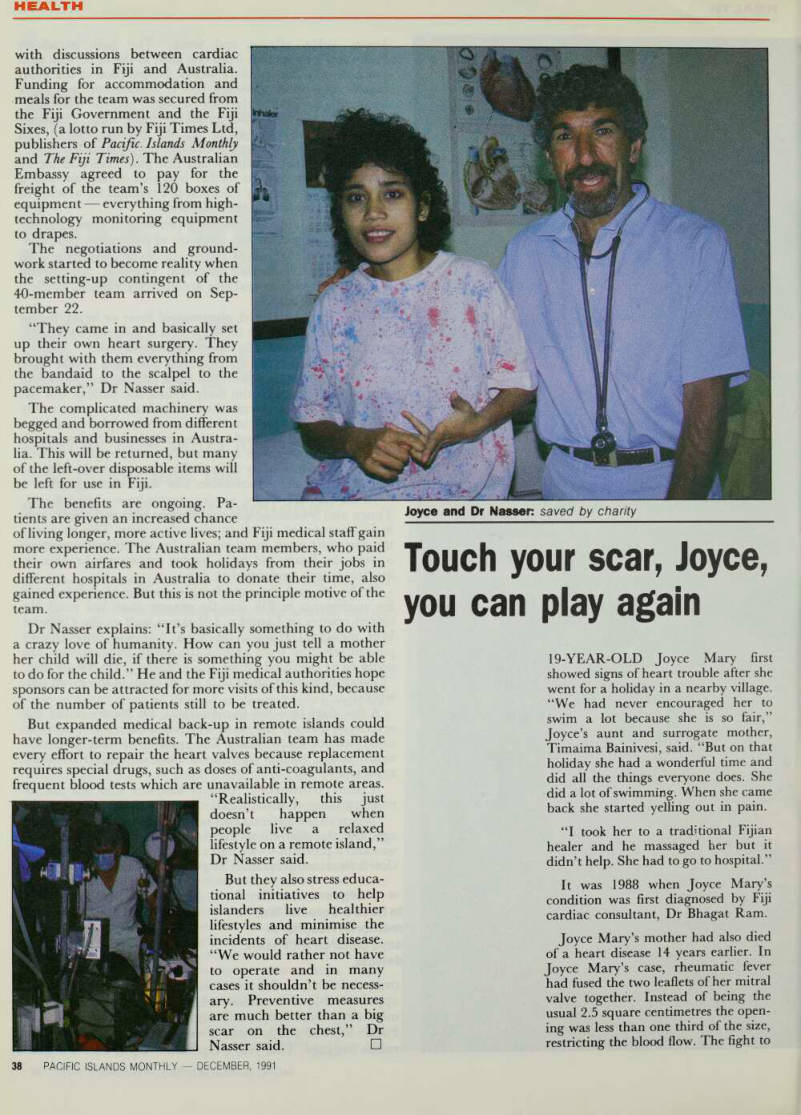
19-YEAR-OLD Joyce Mary first showed signs of heart trouble after she went for a holiday in a nearby village.
“We had never encouraged her to swim a lot because she is so fair,”
Joyce’s aunt and surrogate mother, Timaima Bainivesi, said. “But on that holiday she had a wonderful time and did all the things everyone does. She did a lot of swimming. When she came back she started yelling out in pain.
“I took her to a traditional Fijian healer and he massaged her but it didn’t help. She had to go to hospital.”
It was 1988 when Joyce Mary’s condition was first diagnosed by Fiji cardiac consultant, Dr Bhagat Ram.
Joyce Mary’s mother had also died of a heart disease 14 years earlier. In Joyce Mary’s case, rheumatic fever had fused the two leaflets of her mitral valve together. Instead of being the usual 2.5 square centimetres the open ing was less than one third of the size, restricting the blood flow. The fight to
Joyce and Dr Nasser: saved by charity
save her went like this: Monday, September 30, 3.15 pm. Joyce Mary has been brought from the ward down to the anaesthetic room. She has been given pentothal to make her sleep, and a morphine-like compound is now given to her intravenously to paralyse her musics, 3.30 pm. She has been transferred to the surgery next door, and gases are used to keep her asleep and breathing. A probe is inserted into an artery in her neck and three sensors measure her heart beat, the level of oxygen in her blood, and the pressure in the heart.
The operation begins. Theatre nurse Pat Saar paints the front, left part of Mary Joyce’s torso with iodine to sterilise the area. The excess is wiped off and a “drape” or adhesive, transparent sheet is stuck to the area. This “drape” allows a clear view of the wound. It also keeps the area clean and sterile but allows air to circulate to the skin.
The operating team assembles around Mary Joyce. Dr Terry Mau takes a scalpel and makes a long, light cut through the skin. A thin trickle of blood marks the line he will follow with the cautery, like an electric drill, which cuts the skin and flesh using electrical heat. A light trail of smoke and the smell of burning flesh are obvious, but the heat also cauterises, or assists clotting, so there is very little bleeding.
Joyce Mary’s beating heart is exposed.
Head surgeon Dr Alan Farnsworth and the assisting nurses calmly help Dr Mau open the wound between Joyce Mary’s ribs (these days it is not necessary to cut out a rib). They position a clamp and hold the incision open. Dr Mau punc tures the heart and inserts a tube. He then.uses the same puncture to insert two fingers into Joyce Mary’s heart and feel blindly for the mitral valve. It is a cruder way of exploring the heart, but in some ways less traumatic than linking the body to a bypass machine, redirecting the blood through artificial tubes, and taking over the body’s heartbeat and oxygen flow.
When Dr Mau has finished his physi cal exploration, he inserts a Tubbs, or dilator, to force the valve to stretch open.
In most cases the complexity of the operation is now over. But the heart is a sensitive organ, and Joyce Mary’s begins to “fibrillate” or beat irregularly because of the intrusions.
The team moves quickly to give the heart electric shock therapy. Dr Farnsworth considers whether to proceed to more complicated surgery and replace the mitral valve with a man-made one.
Dr Mau begins to retreat back through the operation, removing all instruments and finally stitching the incision back together. 4.30 pm. Joyce Mary, still unconscious,
is being wheeled back to the intensive care unit.
Evening: Recovery should start from now, but Joyce Mary begins to bleed externally. She is taken back to the surgery, the incision reopened and a visual check is done. Her heart stops twice during the night and her lungs are not working well.
Tuesday morning: Another scan is done using the echogram, a machine which uses sound waves to plot the heart’s contours and show the valve in operation on a computer screen. The echogram shows the valve opening is still too small.
Joyce Mary has been weakened by the operation, but the heart function is unsatisfactory and Dr Farnsworth de cides that the team must proceed to a
more complicated, open-heart operation.
Tuesday afternoon: Joyce Mary is back in the operating theatre. She has been connected to the bypass machine which takes over the flow of her blood and the functions of the lungs and heart. Her natural heart has stopped. Her heart is now opened and the team examines the mitral valve. The dilator had not opened the valve as much as usual it has only split one side; the other is too thick. It is now necessary to use a scalpel to split the other side. After the operation, Joyce Mary’s heart began to function well, although she had to recover from the effects of three operations in just two days. Her rehabilitation took about six weeks in hospital.
Joyce Mary will have a scar for life, but her heart will be stronger. She may need to have a valve replacement in the years to come but meanwhile, if her body accepts the operation, she can do all the normal things a young women does even have children with less risk of a heart failure. □