Moti’s Law
p. 22 · Read in the full issue
Calling for changes to find uniformity in modern day Pacific
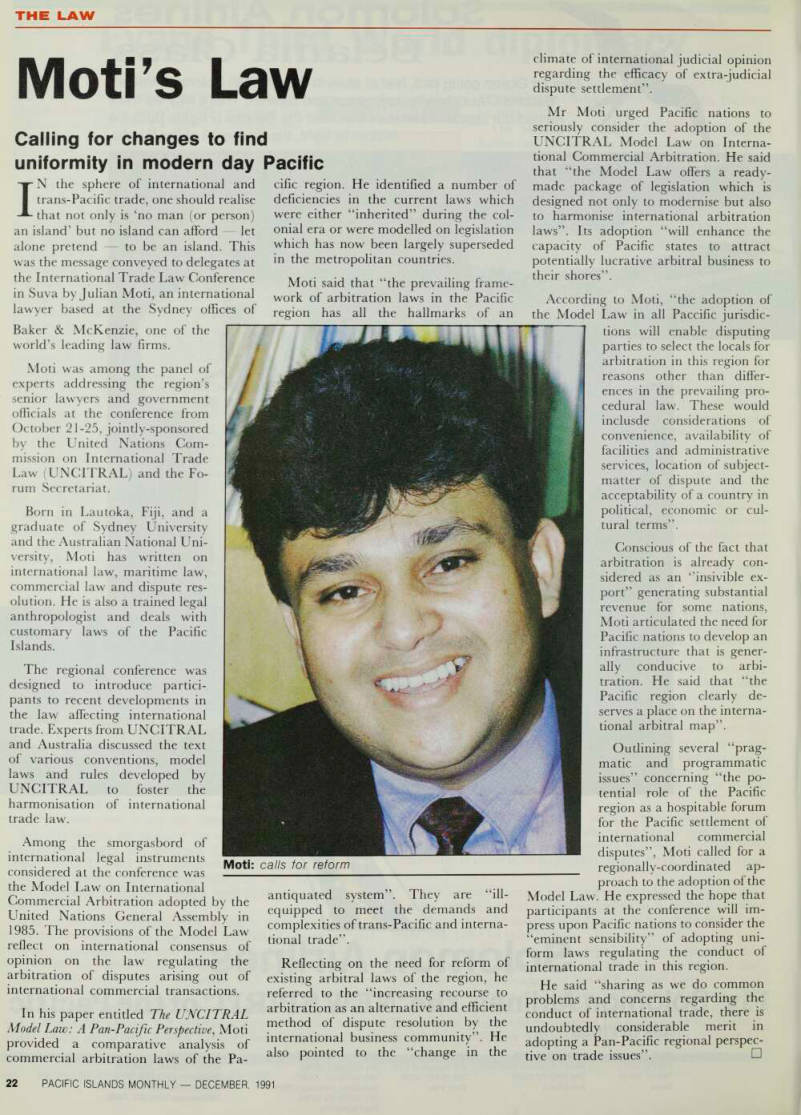
IN the sphere of international and trans-Pacific trade, one should realise that not only is ‘no man (or person) an island’ but no island can afford let alone pretend to be an island. This was the message conveyed to delegates at the International Trade Law Conference in Suva by Julian Moti, an international lawyer based at the Sydney offices of
Baker & McKenzie, one of the world’s leading law firms.
Moti was among the panel of experts addressing the region’s senior lawyers and government officials at the conference from October 21-25, jointly-sponsored by the United Nations Com mission on International Trade Law (UNCITRAL) and the Fo rum Secretariat, Born in Lautoka, Fiji, and a
graduate of Sydney University
and the Australian National Uni versity, Moti has written on international law, maritime law, commercial law and dispute res olution. He is also a trained legal anthropologist and deals with customary laws of the Pacific Islands.
The regional conference was designed to introduce partici pants to recent developments in the law affecting international trade. Experts from UNCITRAL and Australia discussed the text of various conventions, model laws and rules developed by UNCITRAL to foster the harmonisation of international trade law.
Among the smorgasbord of international legal instruments considered at the conference was the Model Law on International
Commercial Arbitration adopted by the United Nations General Assembly in 1985. The provisions of the Model Law reflect on international consensus of opinion on the law regulating the arbitration of disputes arising out of international commercial transactions.
In his paper entitled The UNCITRAL Model Law: A Pan-Pacific Perspective , Moti provided a comparative analysis of commercial arbitration laws of the Pa
cific region. He identified a number of deficiencies in the current laws which were either “inherited” during the col onial era or were modelled on legislation which has now been largely superseded m t^ie metropolitan countries.
Moti said that “ the preva ii ing f rame .
WO rk of arbitration laws in the Pacific region has all the hallmarks of an
antiquated system”. They are “ill equipped to meet the demands and complexities of trans-Pacific and interna tional trade”.
Reflecting on the need for reform of existing arbitral laws of the region, he referred to the “increasing recourse to arbitration as an alternative and efficient method of dispute resolution by the international business community”. He also pointed to the “change in the
climate of international judicial opinion regarding the efficacy of extra-judicial
dispute settlement”.
Mr Moti urged Pacific nations to seriously consider the adoption of the UNCITRAL Model Law on Interna tional Commercial Arbitration. He said that “the Model Law offers a ready made package of legislation which is designed not only to modernise but also to harmonise international arbitration laws”. Its adoption “will enhance the capacity of Pacific states to attract potentially lucrative arbitral business to their shores”.
According to Moti, “the adoption of the Model Law in all Pacciflc jurisdic
tions will enable disputing parties to select the locals for arbitration in this region for reasons other than differ ences in the prevailing pro cedural law. These would inclusde considerations of convenience, availability of facilities and administrative services, location of subject matter of dispute and the acceptability of a country in political, economic or cul tural terms”.
Conscious of the fact that arbitration is already con sidered as an °insivible ex port” generating substantial revenue for some nations, Moti articulated the need for Pacific nations to develop an infrastructure that is gener ally conducive to arbi tration. He said that “the Pacific region clearly de serves a place on the interna tional arbitral map”.
Outlining several “prag matic and programmatic issues” concerning “the po tential role of the Pacific region as a hospitable forum for the Pacific settlement of international commercial disputes”, Moti called for a
regionally-coordinated ap
proach to the adoption of the
Model Law. He expressed the hope that participants at the conference will im press upon Pacific nations to consider the “eminent sensibility” of adopting uni form laws regulating the conduct of international trade in this region.
He said “sharing as we do common problems and concerns regarding the conduct of international trade, there is undoubtedly considerable merit in adopting a Pan-Pacific regional perspec tive on trade issues”. □
Moti: calls for reform