An Era
pp. 8-11 · Read in the full issue
The Region
Fiji
An Era Ends
And Ratu Mara tells what it was like from the start and what the future might hold
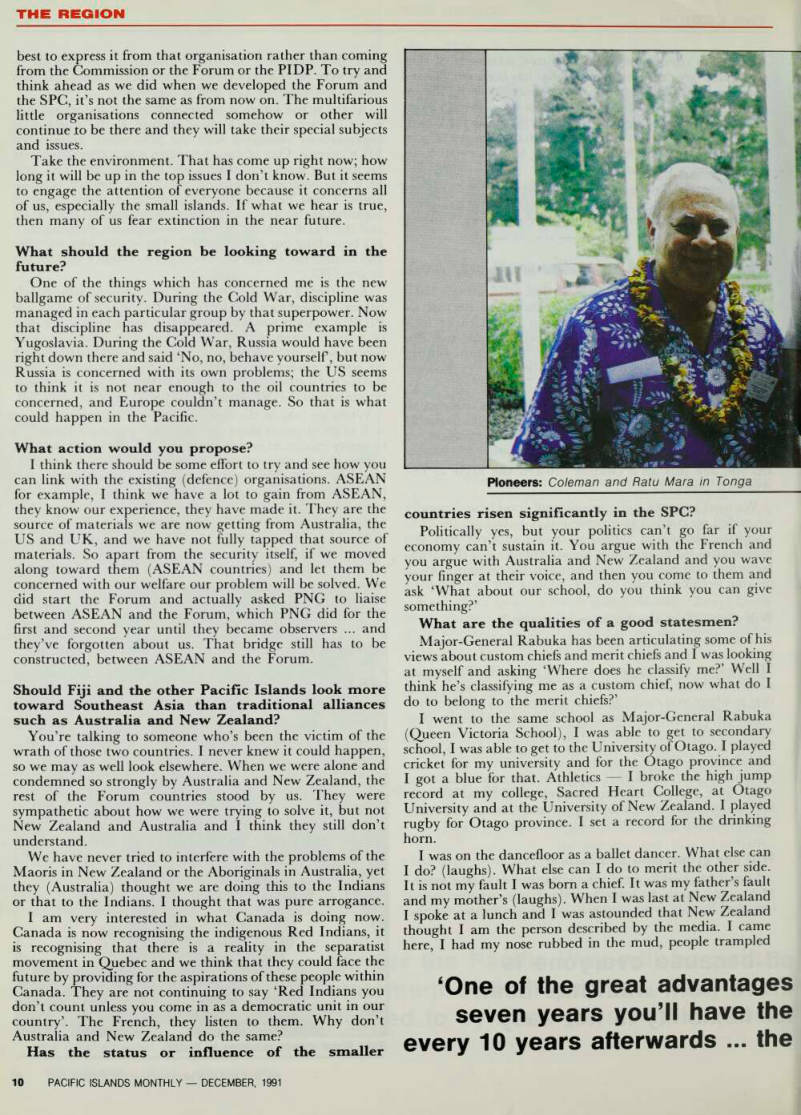
AT the opening ceremony of the South Pacific Conference, King Taufa’ahau Tupou, of Tonga, arose from his chair to greet only two of the regional heads of government. It was a mark of respect and affection for the Governor of American Samoa, Peter Tali Coleman, and the Prime Minister of Fiji, Ratu Sir Kamisese Mara. If the SPC meetings have been likened to King Arthur’s meetings around the round table, then these three could be the three musketeers. Together, they have pioneered and played leading roles in the evolution of the South Pacific Commission, its member countries, and the region.
The attendance of Ratu Sir Kamisese Mara at this year’s South Pacific Commission (SPC) meeting in Tonga from October 28 - 30 marked the end of an era for the region and for Fiji, because he plans to hand the reins over to a new Fiji Prime Minister after elections scheduled for March next year.
Ratu Mara spoke to Pacific Islands Monthly’s Beryl Cook about changes in the region, its statesmen and their style of decisionmaking; his concerns for Fiji and the region; and his fears that the Pacific Way may be lost.
What are the most significant changes you have seen in the SPC and the region?
The South Pacific Conference is really the ground where the young leaders in my time met frequently and discussed issues common in our region, and then formulated policies.
I used the term, the “Pacific Way” of discussion in about
1970. Looking back as to how that phrase came about, it was mainly because our discussion usually ended up in a consensus rather than raising hands and dividing the groups, and this is actually
what happens in each of our own countries.
Why it was perpetuated in the South Pacific conferences was because we never used to speak from notes and I fear there is a danger the Pacific Way will be written off because
‘I fear there is a danger the Pacific Way will be written coming on with a written statement of their position. They can’t written and apparently agreed to by their government. Room
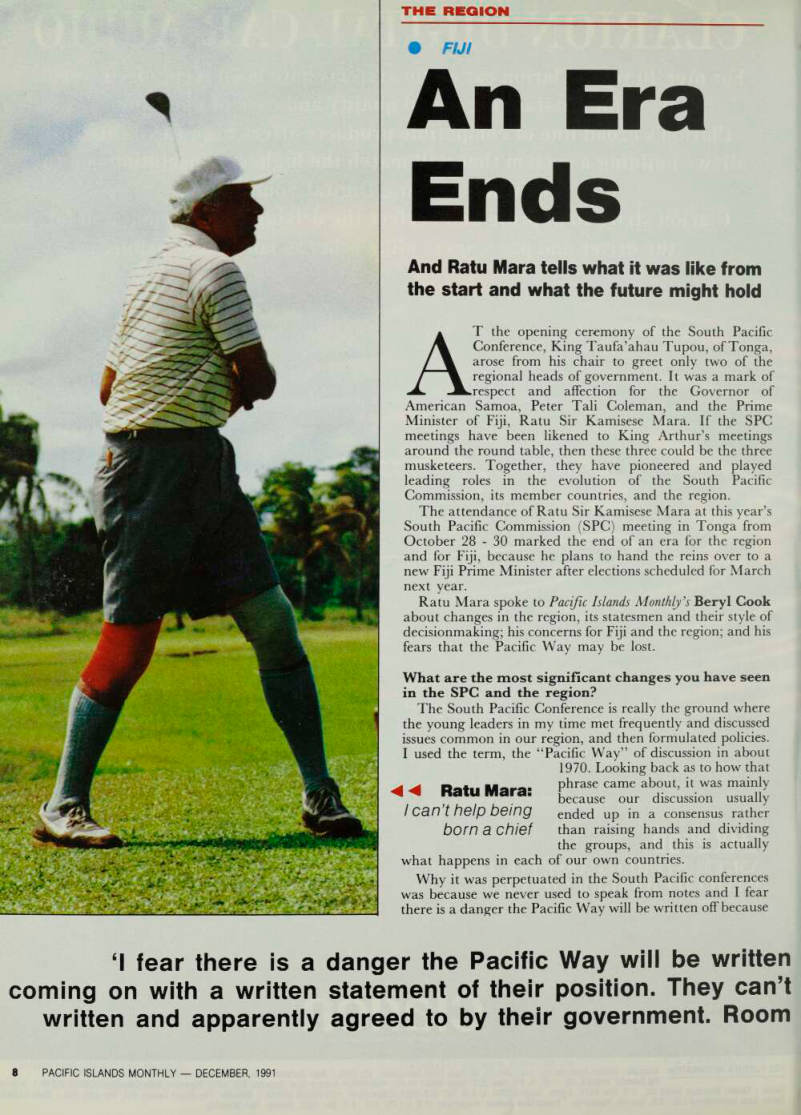
Ratu Mara: I can’t help being born a chief
everyone is coming on with a written statement of their position. They can’t move from what has been written and apparently agreed to by their government. Room for flexibility is not easy. I don’t know how they manage to get their consensus because they are simply following the United Nations system you come and read a statement of your government and you let someone else, the chairman or so, try and find a consensus.
And that is now gone right down to the selection of officials where voting is a must. It never used to be; in our day it was by a consensus. Now you go lobbying and you count the number of votes.
What effect will this new style of reaching agree ments have?
I think that will have its affect on the future. Because we (the SPG) are larger in size there is bound to be little enclaves of views, and I think this will become manifest particularly when you select officials. The groups will try and coalesce in order to get the numbers to elect whoever it is.
And I see that the original founders, the Polynesian countries, are now in the minority, and you will probably find this also will be reflected in the official positions.
Do you see this as a change toward the style of the western powers?
We used to speak quite openly and frankly and usually we ended up coming to a consensus. I talked (at the SPG opening) about the intrusion of the traders and the missionaries. Although there are advantages and disadvan tages the total effect was divisive, and this western way of making decisions is also divisive (among our own people).
Will this affect the balance of power?
It is a new ballgame altogether as far as I’m concerned because we now have a larger number of Micronesians.
Melanesians and Polynesians and I think the Polynesian nature of things is you have a structure of leadership, and that is where you easily get your consensus. The difference is that for the Polynesian, you have an all-embracing structure. Although I’m from Fiji, if there is someone from Samoa and someone from Tonga we soon find who is the eldest and we put him as the leader and you have that pyramid. I don t think that applies in Melanesia; there are many little groups and they themselves make an effort to find a consensus through their Spearhead Group, and that’s only instigated by the New Caledonia issue.
Will one group gain dominance?
I know Michael Somare, who represented the first purely Melanesian group to come into the Forum easilly melled into the consensus. When there were more of them, by the
3ff because everyone is move from what has been or flexibility is not easy’
time they formed a Spearhead Group it was difficult there were two distinct views in most of the issues and they had to get together and find a consensus.
As far as the future is concerned, one of the things that is an advantage and a disadvantage is the number of organisations associated with the SPG which necessitated SPOC over it. One of the advantages was it provides places for aspiring leaders to play a role in leadership. This may be a disadvantage in having one single regional organis ation. I was never enthusiastic about a single regional organisation because I have been responsible for the Forum and the PIDP (Pacific Islands Development Programme).
It’s branching out from the SPG. The reason why we went and formed the Forum was because we couldn’t talk politics in the SPG.
And then I found there were little groups who didn’t belong to these two organisations and they came in on the PIDP. I think it was when the PIDP came in that the idea of a single regional organisation was also voiced because people were afraid there were so many organisations that we were spending time and money trying to attend them.
But we did a study in the PIDP as to the number of regional organisations that we have and we found there are over 300.
When we take in the non-governmental organisations as well as government there are others such as choir groups so many groups in which the people of the region wanted to organise themselves into reegional organisations. So there was therefore a need for many regional organisations the choir master wouldn’t be anywhere in the society if there wasn’t any competition. PASOWA, the women’s organis ation, women come up through there.
And that is one advantage. And as we see, as each issue comes up, the number of these organisations compete to carry the baton and you will then find leaders who are the
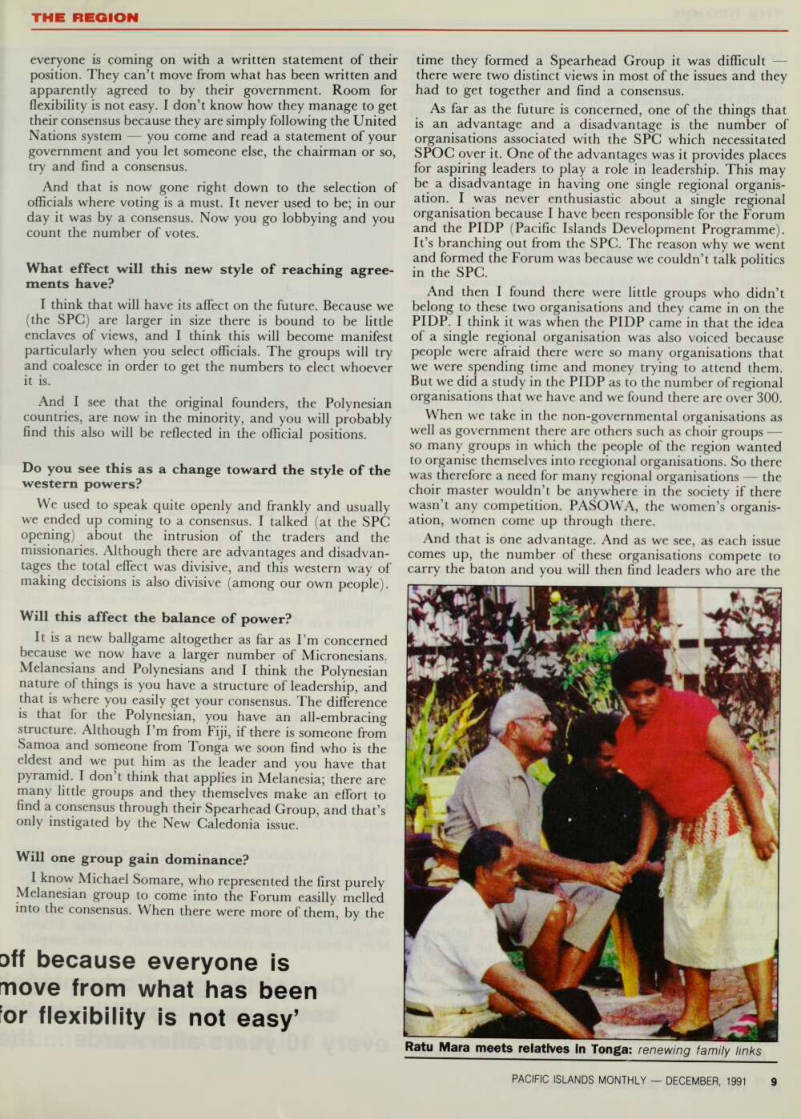
Ratu Mara meets relatives in Tonga: renewing family links
best to express it from that organisation rather than coming from the Commission or the Forum or the PIDP. To try and think ahead as we did when we developed the Forum and the SPC, it’s not the same as from now on. The multifarious little organisations connected somehow or other will continue to be there and they will take their special subjects and issues.
Take the environment. That has come up right now; how long it will be up in the top issues I don’t know. But it seems to engage the attention of everyone because it concerns all of us, especially the small islands. If what we hear is true, then many of us fear extinction in the near future.
What should the region be looking toward in the future?
One of the things which has concerned me is the new ballgame of security. During the Cold War, discipline was managed in each particular group by that superpower. Now that discipline has disappeared. A prime example is Yugoslavia. During the Cold War, Russia would have been right down there and said ‘No, no, behave yourself, but now Russia is concerned with its own problems; the US seems to think it is not near enough to the oil countries to be concerned, and Europe couldn’t manage. So that is what could happen in the Pacific.
What action would you propose?
I think there should be some effort to try and see how you can link with the existing (defence) organisations. ASEAN for example, I think we have a lot to gain from ASEAN, they know our experience, they have made it. They are the source of materials we are now getting from Australia, the US and UK, and we have not fully tapped that source of materials. So apart from the security itself, if we moved along toward them (ASEAN countries) and let them be concerned with our welfare our problem will be solved. We did start the Forum and actually asked PNG to liaise between ASEAN and the Forum, which PNG did for the first and second year until they became observers ... and they’ve forgotten about us. That bridge still has to be constructed, between ASEAN and the Forum.
Should Fiji and the other Pacific Islands look more toward Southeast Asia than traditional alliances such as Australia and New Zealand?
You’re talking to someone who’s been the victim of the wrath of those two countries. I never knew it could happen, so we may as well look elsewhere. When we were alone and condemned so strongly by Australia and New Zealand, the rest of the Forum countries stood by us. They were sympathetic about how we were trying to solve it, but not New Zealand and Australia and I think they still don’t understand.
We have never tried to interfere with the problems of the Maoris in New Zealand or the Aboriginals in Australia, yet they (Australia) thought we are doing this to the Indians or that to the Indians. I thought that was pure arrogance.
I am very interested in what Canada is doing now.
Canada is now recognising the indigenous Red Indians, it is recognising that there is a reality in the separatist movement in Quebec and we think that they could face the future by providing for the aspirations of these people within Canada. They are not continuing to say ‘Red Indians you don’t count unless you come in as a democratic unit in our country’. The French, they listen to them. Why don’t Australia and New Zealand do the same?
Has the status or influence of the smaller
countries risen significantly in the SPC?
Politically yes, but your politics can’t go far if your economy can’t sustain it. You argue with the French and you argue with Australia and New Zealand and you wave your finger at their voice, and then you come to them and ask ‘What about our school, do you think you can give
something?’
What are the qualities of a good statesmen?
Major-General Rabuka has been articulating some of his views about custom chiefs and merit chiefs and I was looking at myself and asking ‘Where does he classify me?’ Well I think he’s classifying me as a custom chief, now what do I do to belong to the merit chiefs?’
I went to the same school as Major-General Rabuka (Queen Victoria School), I was able to get to secondary school, I was able to get to the University of Otago. I played cricket for my university and for the Otago province and I got a blue for that. Athletics I broke the high jump record at my college, Sacred Heart College, at Otago University and at the University of New Zealand. I played rugby for Otago province. I set a record for the drinking horn.
I was on the dancefloor as a ballet dancer. What else can I do? (laughs). What else can I do to merit the other side.
It is not my fault I was born a chief. It was my father’s fault and my mother’s (laughs). When I was last at New Zealand I spoke at a lunch and I was astounded that New Zealand thought I am the person described by the media. I came here, I had my nose rubbed in the mud, people trampled
‘One of the great advantages seven years you’ll have the every 10 years afterwards ... the
Pioneers: Coleman and Ratu Mara in Tonga
f this constitution is that in pportunity to change it, and iji constitution is one of the best’
over me. They made a man out of me. And that is part of my character, and now I am a ‘traditional chief, a ‘conservative’ and I don’t know anything about it. Where do we stand. What do we have to do?”
What about the role of the emerging group of educated leaders who may not have traditional ties or chiefly blood?
We the cheifs, in the olden days, would recognise a warrior, a good one who sails and saved the people of the fleet, a good producer of dalo and other things. We recognise them. There are more opportunities to recognise them now. If they have done well as a doctor or scientist, yes. Someone must do something well, and someone must do something else well. So what is the distinction between tradition and merit? Where is the country which is run by meritocracy.
What are your plans for the future?
I want to retire. I have had enough. I have worked for 20 years to try and bring the two races (in Fiji) together. I thought I succeeded. I went through the colonies in 1967 and I came back from that tour really enthusiastic, thinking T can fix this, I can get the races together’. And I worked hard for it. The result of it is the Indians blame me for breing pro-Fijian and the Fijians blame me for being pro-Indian. So you’re not honoured in your own country (laughs).
Was the coup in Fiji in 1987 a Ratu Mara initiative?
I cannot lead a country that does not accept a leader who
will serve both sides. I have done my best, I’m rejected as such.
This constitution is not the type of constitution I’d like to serve under. Because I’ve served for 20 years under a constitution that has been displaced. I had to come in to help bring things back to normal.
One great advantage of this constitution is that in seven years you’ll have an opportunity to change it, and every 10 years afterwards. I think this is a feature which makes the Fiji constitution one of the best in the world. They boast about the US constitution which is 200 years old, and they only got to about the fifth amendment. Well I think it’s long overdue for overhauling.
What about negatives of the constitution?
They say that it shouldn’t have racial divisions. I think if you don’t have that you’d have the instability that Gyana has, Trinidad has, Mauritius no longer has because they’re completely dominated by the Indians. But you don’t have it in Malaysia because they’re in the minority, in Singapore because they’re in the minority. But whenever they get up to almost a majority you have problems. You have it in Sri Lanka.
Are you only talking about political power?
This is the danger of the Fijian constitution and I think Rabuka is trying to express it in another way. He didn’t expect economic power to be obtained in about four years or overnight when he took over power. Your political power will not go very far if it is not sustained by economic power, and there is some economic power as far as the Fijian is concerned in the ownership of the land, but they have not flexed their muscles in that.
Will we always be tied to relations with Australia a nd New Zealand?
I hope not, I sincerely hope not. If we, are tied to anyone at all I would like to be tied to Asian countries, Southeast Asian
countries, Malaysia, Singapore, Indonesia. Their people
understand our mind. The Australians and New Zealanders I think they prefer not to understand our minds. They want their way to be the way we live by rather than trying to understand us.
Will we have to rely on them for some years to come though because of economic considerations?
If they buy our goods then we buy theirs. But we now want to get out of the dependence on oil and look at the row they’ve kicked up.
What are your plans for the future?
I have to hand over to the new Prime Minister after the next election.
And what then?
That’s my problem ... a trade secret (laughs). (Fiji’s Prime Minister slipped on the black sandals which one of his aides had put beside him, and headed toward the same garden where he had been guest of honour in a traditional ceremony with his mother’s Tongan relatives just an hour before. The woven mats had been replaced by a temporary cocktail bar, and the elder statesman merged into the throng of today’s regional heads of government.) □