Tales from the Fellowship
pp. 55-56 · Read in the full issue
Sally Andrew begins her yachting yarns of the Pacific with a stop on Fanning Island in Kiribati
THE sights and sounds of coconut palms swaying on a tropical atoll, the peace of secluded anchorages, the beauty of lush islands and placid lagoons . . . these en hance the romantic vision of cruising the
South pacific.
But, when people ask us why we are visiting their islands, we explain that we are here to meet new people, visit their villages and cities, and to learn about their culture and families. These are the real rewards of our Pacific wanderings.
Our first landfall south of Hawaii was Tabuaeran in the Line Island Group.
Tabuaeran or Fanning Island, a name
still used by many of the islanders is located 1200 miles south of Honolulu.
We departed on the tail end of a Kona storm and had a pleasant run south for the first four days.
Suddenly, huge waves like pyramids attacked us, beam on, and our perfect sail turned into a roller coaster ride. We double-reefed the main, hanked on our storm jib and flew close to six knots.
At 1800 on the seventh day out we had 188 miles to go. GPS positioning allowed us to press on more sail and to close on the island without fear of running up on the reef. The strong currents in this neck of the ocean can run east or west up
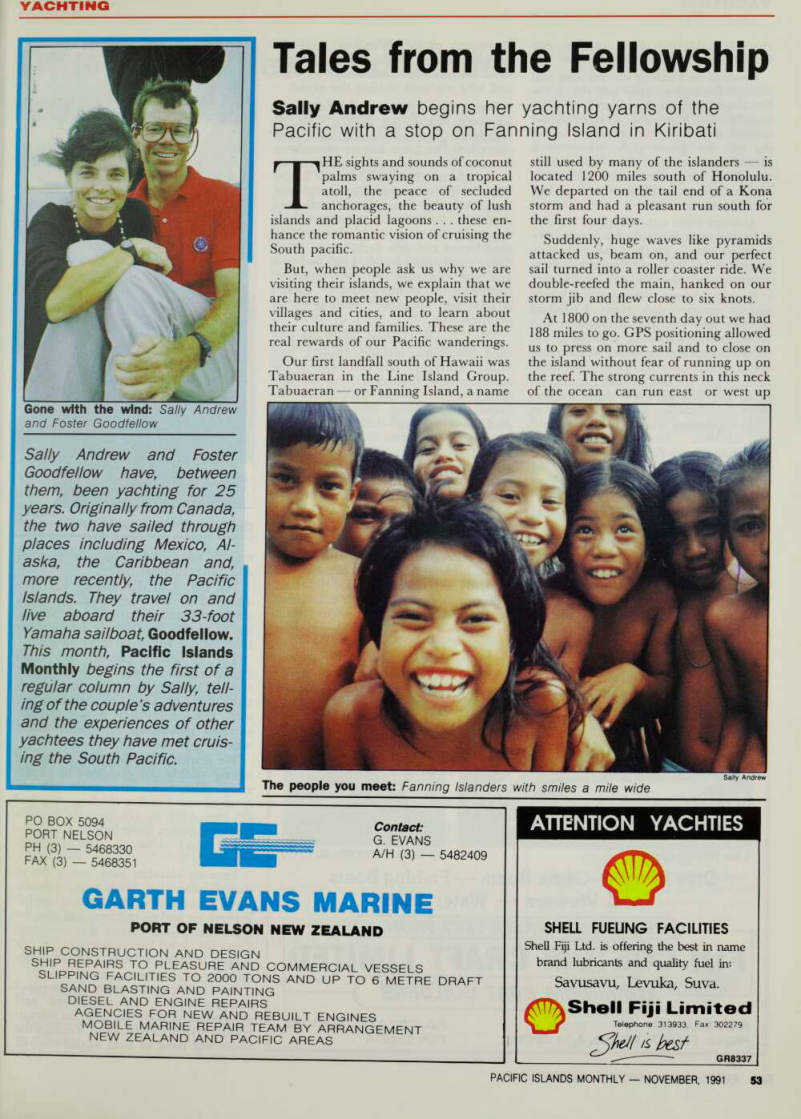
Sally Andrew The people you meet: Fanning Islanders with smiles a mile wide
currents in this neck of the ocean can run east or west up to two plus knots!
Landfall on Fanning was exciting and sudden. Because an atoll only rises a few feet above sea level, the island is virtually invisible. But from about 13 miles out we spotted the “loom” of the island in the sky the green glow which is a reflection of the lagoon. The Micronesian navigators recognised this more than 1000 years ago and kept it in their bag of navigational tricks.
At seven miles out we sighted the tops of the palms at Whaler’s Anchorage. We knew we were in the right place when we spotted the Gilbertese fishermen in their outrigger canoes. “Mauri!” we called.
Fanning Island belongs to Kiribati and in recent years many I-Kiribati families have relocated to Fanning and Washington Islands in a program to relieve population pressures on the main island group near Tarawa, 1800 miles west. When we first visited Fanning in 1978, only 400 Gilbertese copra workers (with their families) lived there as Burns Philp employees, until BP sold the island to Kiribati. Today,' nearly 1400 I-Kiribati live on Fanning. Most arrived in the last 18 months but, despite the rapid influx, the island is well-run.
Anticipated population is 5000!
The life of the village centres around the traditional maneaba, or community meeting place. On our first day ashore, we were invited in. Inside men sat cross legged around the perimeter of the barn like structure. We were treated to a cup of hot sweet tea and welcomed.
We sat on pandanus mats beside the
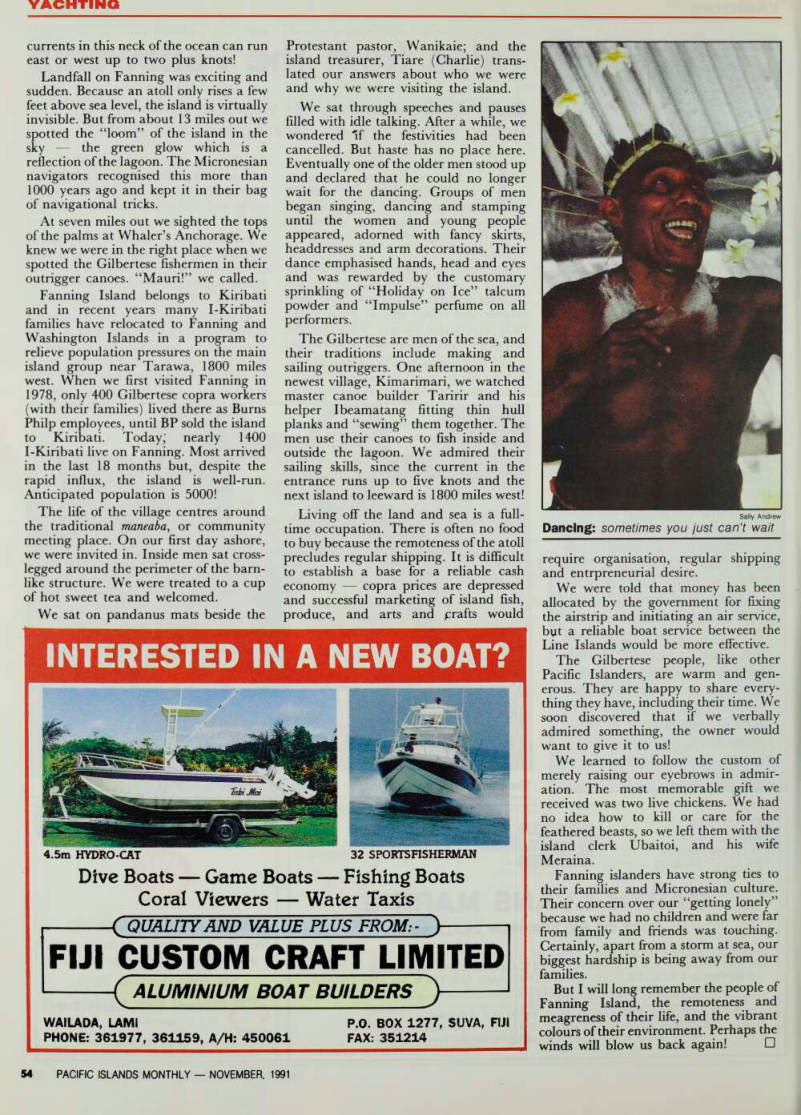
Protestant pastor, Wanikaie; and the island treasurer, Tiare (Charlie) trans lated our answers about who we were and why we were visiting the island, We sat through speeches and pauses filled with idle talking. After a while, we wondered “if the festivities had been cancelled. But haste has no place here, Eventually one of the older men stood up and declared that he could no longer wait for the dancing. Groups of men began singing, dancing and stamping until the women and young people appeared, adorned with fancy skirts, headdresses and arm decorations. Their dance emphasised hands, head and eyes and was rewarded by the customary sprinkling of “Holiday on Ice” talcum
powder and Impulse perfume on all
performers.
The Gilbertese are men of the sea, and their traditions include making and sailing outriggers. One afternoon in the newest village, Kimarimari, we watched master canoe builder Taririr and his
helper Ibeamatang fitting thin hull
planks and “sewing” them together. The men use their canoes to fish inside and outside the lagoon. We admired their sailing skills, since the current in the entrance runs up to five knots and the next island to leeward is 1800 miles west!
Living off the land and sea is a full time occupation. There is often no food to buy because the remoteness of the atoll
precludes regular shipping. It is difficult
to establish a base for a reliable cash economy copra prices are depressed and successful marketing of island fish, produce, and arts and prafts would
require organisation, regular shipping
and entrpreneurial desire.
We were told that money has been allocated by the government for fixing the airstrip and initiating an air service, but a reliable boat service between the Line Islands would be more effective.
The Gilbertese people, like other Pacific Islanders, are warm and gen erous. They are happy to share every thing they have, including their time. We soon discovered that if we verbally admired something, the owner would want to give it to us!
We learned to follow the custom of merely raising our eyebrows in admir ation. The most memorable gift we received was two live chickens. We had no idea how to kill or care for the feathered beasts, so we left them with the island clerk Übaitoi, and his wife Meraina.
Fanning islanders have strong ties to their families and Micronesian culture.
Their concern over our “getting lonely” because we had no children and were far from family and friends was touching.
Certainly, apart from a storm at sea, our biggest hardship is being away from our families.
But I will long remember the people of Fanning Island, the remoteness and meagreness of their life, and the vibrant colours of their environment. Perhaps the winds will blow us back again! □
Sally Andrew Dancing: sometimes you just can’t wait