Status move losing steam
pp. 26-27 · Read in the full issue
The Region
Poll results raise some doubts about Guam’s Commonwealth movement.
LEADERS of Guam’s Common wealth movement are in an unenviable position. While maintaining a united
front and “full steam” ahead posture with Federal negotiators on a new political status, the island’s Commission on Self- Determination appears to be los
ing public support.
An independent University of
Guam telephone poll of about 400 voters, published in May, con cluded that a 60 per cent majority of those polled, including 52 per cent of Chamorro voters, do not believe or are unsure whether Guam needs a Commonwealth status. A 53 per cent majority agreed with Guam Delegate Ben Blaz that Guam should negotiate changes in the Draft Bill and when necessary break out sections of the bill to introduce as separate legis lation.
Finally an 89 per cent majority, including 90 per cent of the Chamorros, wanted a public edu cation program to clarify what the Commission was doing.
Commission spokesmen poo
pooed the survey as a “hatchet job” by Professor Bob Rogers, ex-Commission Executive Director under former
Governor Ricardo J. Bordallo. But then another voter poll, conducted on behalf of the island’s Gannett Company daily newspaper, the Pacific Daily News and K 57 Radio, and taken by a private, highly reliable polling agency, confirmed the results. It also indicated public support for Commonwealth had dropped to 27 per cent compared to the initial 49 per cent voter support provided in the 1982 plebiscite. That lost support ap
peared to be switching to status quo, which received 25 per cent in the Pacific Daily News survey, up 15 points from the 10 per cent it garnered in 1982; and statehood, which received 28 per cent in the PDN poll, up from 26 per cent in 1982. Independence was up 1.3 points to 5.3 while free association was down from the 4 per cent of 1982 to 2.4 per cent.
Many political observers on Guam speculated that the gradual shift was due not least to the time passed getting from the plebiscite to meaningful negotiations with the US government. Several Guam Commissions under Governors Calvo, Bordallo and Ada took six years to draft the proposed bill. It was introduced into Congress by Guam’s Delegate in 1988. The Commission and a Federal Task Force have since been discussing a compromise version, which they hope to have for Congress next year. The delay
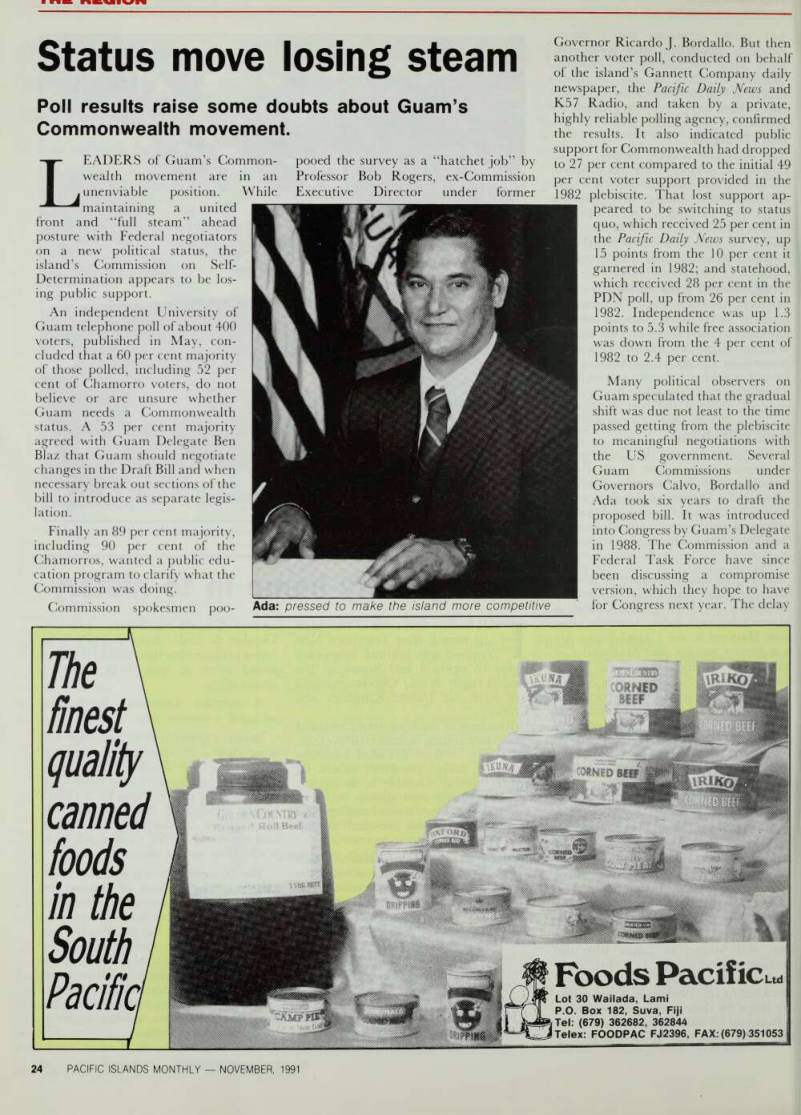
Ada: pressed to make the island more competitive
was partly caused by the Commission’s original position that it could not negotiate any part of the bill.
After a heated face-off with a Con gressional sub-committee in December 1989, the Commission resolved that it could negotiate “technical changes” but that the principles of the bill’s provisions could not be changed. Talks were resumed but the Commission’s uncom promising stance also confused voters.
Another aspect of the problem may be that during that six-year period, and the three years since the bill’s introduction, Guam has experienced unprecedented economic growth. Since Guam leaders envisioned and touted the Common wealth movement primarily as a way to remove federal constraints on the island’s commercial expansion, some segments of the population are asking why Common wealth is needed. Moreover political conservatism normally runs wide and deep during healthy economic times.
Then, there always has been a segment of Guam’s population, coalesced around the Filipino-American minority, that feared provisions of the Bill that would confer some exclusive political and econ omic rights on the Chamorro indigenous group. This group appears to be gaining economic allies and others who are tired of the drawn-out process or confused about it.
Disunity continued to grow in July as the Guam Chamber of Commerce reignited a bitter feud between the Commission and Delegate Blaz. The Chamber, concerned about what it saw as declining quality of service in the tourism industry, asked for the immigra tion section to be taken out of the Commonwealth Bill and given expedited treatment by separate track legislation in
the US-Congress.
The immigration compromise worked out by the Commission and the feds provides for a special guest worker program that would allow non-US citizen, alien, skilled, unskilled and professionals to come to Guam for six year periods. They could full permanent as well as temporary jobs and the Governor could control their numbers.
But the guest workers would not be allowed to use their Guam time toward eventual naturalisation. The US govern ment, under the proposal, would retain overall authority under Commonwealth for Guam’s immigration.
The Chamber had pressed Ada throughout the summer to address the changing nature ofjapanese tourism and make the island more competitive. “ITwe don t manage to raise our level of service, we will suffer more and more,” said Manfred Piper, president of the Guam Hotel and Restaurant Association. Piper and other tourism leaders believe the dearth of skilled labor on the island is the
main reason for low quality of tourism service.
Several Commission members ex pressed dismay and alarm at the pros pect. The Governor and the Commission have been engaged in a nasty little public dispute over the past two years with Guam Delegate to Congress Ben Blaz who had proposed a similar “separate track approach” to other section of the Draft Commonwealth Bill. Blaz wanted to move quickly and separately on the return of excess federal land, the exten sion of Supplemental Security Income to Guam residents, and war reparations.
As Commission member David Lujan said, “Where are we going to draw the line when it comes to introducing separate bills. Congress is going to be faced with one major bill and many sub bills. Congress will say ‘Let’s put this big bill aside and put attention to the smaller ones’.”
But Ada, in a surprise mood that caught the Commission offguard, dis
agreed. Perhaps partly in response to business community criticism that his administration was not adequately res ponding to changing trends in Japanese tourism, Ada supported the Chamber’s request. “It’s important to note that if there are certain problems that need to be attended to immediately, then we can’t be steadfast,” Ada told the Com mission on July 28. “We’ll have to be open-minded. I’ll advise tthe Chamber the Commission does not like the idea, but is willing to discuss it.”
The Guam Commission continues its schedule of meetings with federal officials and has not publicly indicated any need to change its strategy or tactics. But public disillusionment with the process of status change, and growing economic pressures for separate track solutions to current problems will continue to com plicate the Commission’s task. It also may delay an already drawn-out process and, after all, the next gubernatorial election is only three years away. □