New face, new ideas
pp. 33-37 · Read in the full issue


THE election of Paul Wallwork as President of the South Pacific Games Council just might inject new life into this often boring or ganisation.
Wallwork, Western Samoa’s
secretary for youth, sport and culture, is a former Games weightlifting champion and is known for his no-nonsense ap proach to administration. In Papua New Guinea last month, he blasted the organisers of the 9th South Pacific Games for putting too much emphasis on the sponsors. “The South Pacific Games are for the sportspeople of the South Pacific,
not for the sponsors, not for the poli ticians . . . ,” he said. Wallwork spoke to Pacific Islands Monthly: On sponsorship: The sponsorship marketing idea like at the South Pacific Games in Papua New Guinea is an excellent one. But this cannot work for the rest of the countries in the region unless the South Pacific Council establishes a marketing and sponsorship programme whereby it can obtain some of the sponsorship funds to assist the smaller countries to host the games. In Papua New Guinea, the sponsorship money is solely for the sponsorship of sport in Papua New Guinea, which is unfortunate, simply because we don’t have a programme with which we can help other countries as well. The smaller countries don’t have the market to sell sponsorships. The
bigger countries like Western Samoa, Fiji, Tonga, New Caledonia, and Tahiti can because of their larger markets. We have to develop a way in which the Council can attract sponsorship for all the countries in the region especially for the next Games.
On how sponsorship has helped sports in Papua New Guinea: Sponsorship has done a lot for Papua New Guinea, It certainly has developed a lot of very nice and beautiful facilities in Port Moresby and Lae. These would not be possible without the kind of sponsors that they had.
Unfortunately the organisers of the Papua New Guinea Games have focussed too much on the sponsors. . . these Games are not for the sponsors, they are for the sportspeople of the South Pacific.
The sponsors have taken the attention of Papua New Guinea’s South Pacific Games Foundation and the organisers when it should be the other way around it should be the sportspeople of the region who should draw attention. I’m not denegrating the organisers of the Games here. No. I think a lot of pressure has been put on them, too, which is understandable. But at the same time the priority should be the sportspeople.
It is my intention to put this into the South Pacific Games Charter to make clear that the Games are for the sportspeople, sports officials, sports ad ministrators of this region. Sponsors come second. Politicians come second.
On the Games being used as a public relations tool for Papua New Guinea: It may be, at least that’s my view now.
It’s a beautiful organisation, it’s a massive organisation, there’s no doubt about it. I give 10 for facilities, 10 for food and accommodation, 10 for the wonderful friendship of the people of Papua New Guinea, 10 for the sport speople themselves, who have done a lot of work to help this. But I will only give 3 for organisation because of this empha sis on sponsors. I cannot give you examples because there are many ex ample? and I don’t wish to do that. But there has been a neglect, almost disre gard, for the interest, not only of the athletes and officials but sports adminis trators of the various countries. I’ve already voiced my opinion on some of these matters to the Foundation.
On the standard of competition: I’ve noticed tremendous progress and advancement in standards in the quality of performance. Now, we should not do
anything to hamper that development
after all we live in the nineties, almost into the 21st century. We haven’t made the same depth in our development as
Photo On Fujicolor
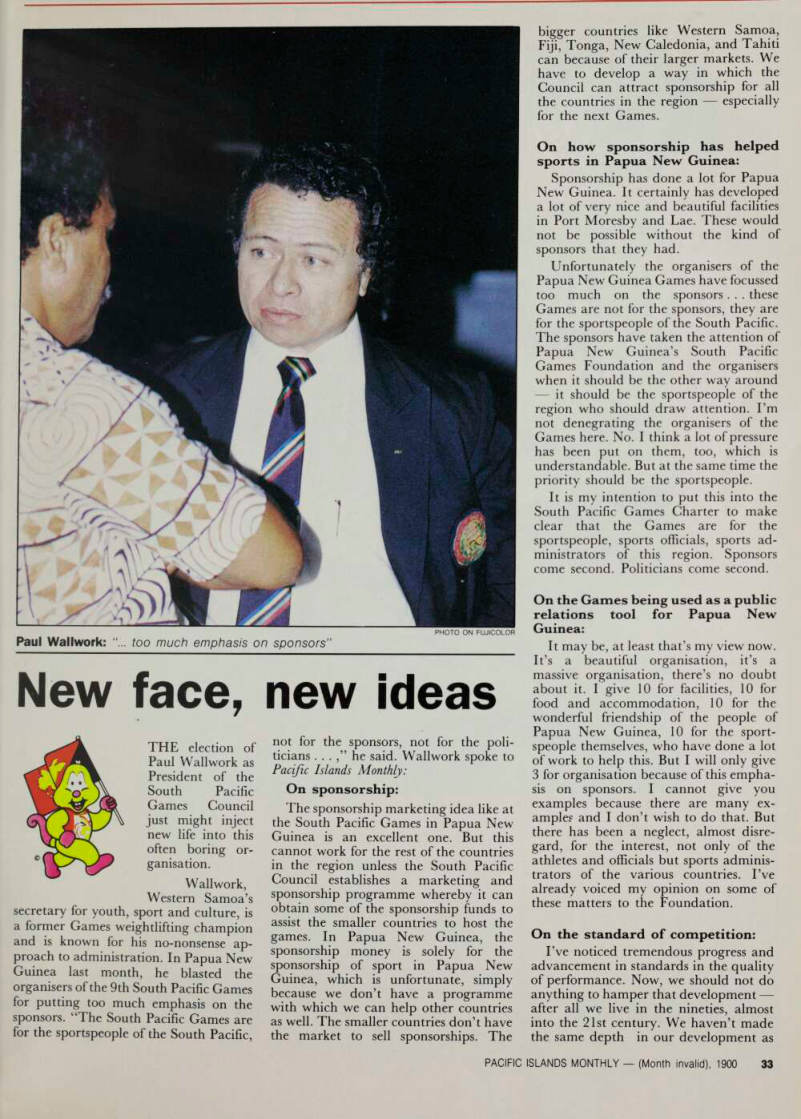
Paul Wallwork: "... too much emphasis on sponsors”
the rest of the world has, but we propose to do that.
In this day and age we see a lot of mobility among our athletes, there’s a lot of movement throughout the Pacific as you see throughout the world. This is happening in the Pacific because of our peculiar situation; there are some Ameri can territories, some French territories and there are some English-oriented countries. Our athletes are moving away to America, to Australia, to New Zea land or to France to develop. We should encourage that.
On which country has improved the most: Papua New Guinea without a doubt, and that’s understandable because they’re hosting the Games and they’ve put a lot of time and money into the development of their athletes. It happens in almost any Games. Once you host the Games the focus of the whole country, the community, the government, is on your athletes and on the development of your athletes. Papua New Guinea has
made some tremendous development in their sportspeople in almost all sports.
I’ve been told that they’ve had athletes tram.ng overseas on a regular basts for P ast 12 mont ’ s - Tl J at s w °" derfu '- If a '> our countries have learned from here the " ou u r standard will improve. There s no about t at.
On the thought of a regional sports institute: j can see a rea i va i ue m it, p apua New Guinea has been fortunate enough to have a sports institute and international exposure as well. A sports institute alone is not going to turn your athletes into champions. You need to expose them to international competition. That’s when they perform. So unless you have funding to take all these P^P 1 ?,,*? "Uernational tournaments you will still have problems, I see real value in developing a regional sports institute. We are looking at real money here and the smaller countries in the region cannot afford to have their own sports institute. The ideal situation will be to develop a regional
Photo On Fujicolour
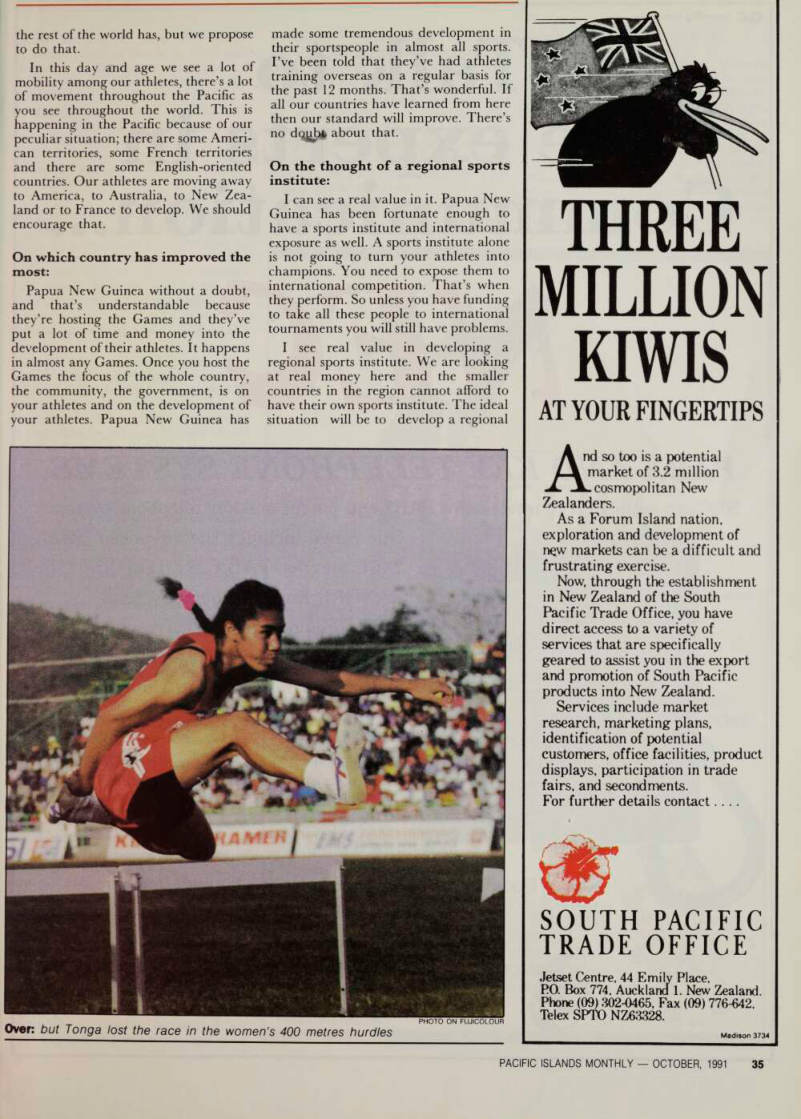
Over: but Tonga lost the race in the women’s 400 metres hurdles
sports institute to help the smaller countries come to par with the bigger countries in the region, particularly if there is a move to include Australia and New Zealand into these Games.
There is a move to bring in Australia and New Zealand and it is good for us to be involved in their level of compe tition. It will automatically raise our standards and we will be recognised internationally.
On government support for sports: I can only speak for Western Samoa where the government has given more for the development of sports this year than in the past 10 years. The government’s view now is that sport plays a big part in development of young people.
On the sport that has developed the most: If we take individual performances then I would say Marcus Steven from Nauru in weightlifting has performed better than any other athlete in the South Pacific Games. In his performance in these Games, Marcus Stevens would be placed sixth or seventh in the world.
There is no other athlete here, no matter in what sport, who went near that. In the other sports the standards are not as good compared to world standard. Marcus Steven is the athlete of these Games because of the very high standard he has obtained. The other sports have done very well in breaking records but on the world level we are still not good enough.
The way in which we can improve is to be exposed internationally and that’s why I am interested in seeing Australia and New Zealand compete in the Games.
They are interested and we are going to keep talking about it. I hope it’s going to be in the next three or four years.
On the big issues during his 12-month term as President: We are going to review the South Pacific Games Charter. In fact we have established a Commission for the review of the Charter, Many aspects of the Charter need to be reviewed and we hope to present a reviewed Charter for adoption at the meeting of the Council in Vanuatu by March next year.
The outdated situation is the eligibility situation for athletes. We are now almost into the 21st century but we are still working on issues from the 1970 s as to how people can be eligible to compete.
It’s an obstacle to mobility. It’s restrict ing athletes in trying to be better by travelling overseas to work there and try to improve their performances. Now, the demands of the Charter on residential status is disruptive to an athlete’s train ing programme overseas and it is one reason why our standard is restricted. We want to promote participation and good
standards. We can only do that if we allow our athletes the full opportunity to train anywhere and come back and represent their countries.
We need to look at the organisation of the Games. As I said these are like sponsors’ Games. The focus from the point of view of the people in Papua New Guinea is to first satisfy the needs of the sponsors, the politicians, and so on. That should not be the case.
There are many other little things we need to look at: residency, protocol,
funding, marketing programmes.
On the 1999 Games:lt is Western Samoa’s intention to bid for that because we’re central. One of the biggest difficult ies we had was paying to bring our team to Papua New Guinea. Of course they find the same problem in coming to Samoa but Western Samoa is in the central part of the Pacific and that makes it easier for the rest of the region to get there. We have to make a presentation at the Council meeting in Vanuatu during the Mini Games there in 1993. □