Glory
pp. 24-25 · Read in the full issue
Days in Moresby
By Jale Moala
THE dust had settled at Sir John Guise Stadium and the athletes were going home.
But at the Prime Minister’s Office in Port Moresby, Rabbie Namaliu was ready to go
for lunch and still in the mood for celebration, “Tahiti tamure,” he sang as he breezed past his secretary in his Tahitian hat and Polynesian shell neck lace. For awhile it seemed like he was going to dance then seeing the visitor, he sat, and smiled, looking very much like a kid who’d asked for a loly and was given a dozen.
It was two days after the 9th South Pacific Games at Port Moresby and Lae.
But up at the Government headquarters in Waigani the celebration had just started. Prime Minister Namaliu was allowing himself to bask in the glory of
hosting and winning the biggest sporting
event in the Pacific Islands: “We’ve been extremely happy ... very proud that the Games have come ofT as successfully as they have. It’s even supprised quite a number of us here, even those who are directly involved. I don’t think they expected it to turn out the way it has.”
That Papua New Guinea won the overall medals tally was only icing on the cake. What pleased Namaliu more was the success of the Games as a public relations exercise for the country at a time when its law and order problems were receiving media attention overseas.
In the end, it was the doomsayer who was disappointed: no rapes, no armed robberies, no rascals. “Just like home,” said Lysis Lavigne, the former Games President from French Polynesia.
These Games, the second in Papua New Guinea since it hosted the first in 1969, were a success story from rhe beginning, brought about as the result of cooperation between the private sector, the government and the people. Fifty eight firms gave K 11.5 million (USsl2.2mil) in cash and in kind in
Photo On Fujicolor
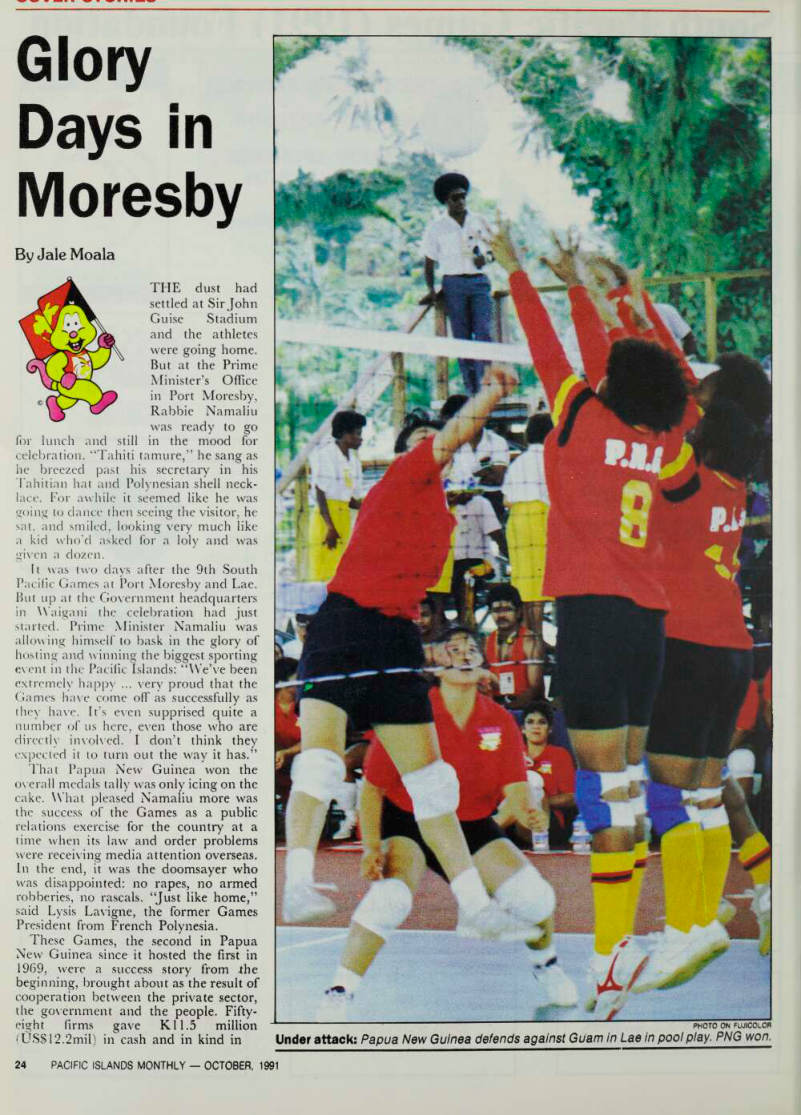
Under attack: Papua New Guinea defends against Guam in Lae in pool play. PNG won.
sponsorship. The Government chipped in with K 2.5 million for the upgrading and maintenance of Lae Technical College, Administrative Col lege (Port Moresby), and the Port Moresby In-Service College which were used for accommodation.
The Sir John Guise complex at Waigani was paid for from an interest free loan of K 9 million from China, a K 1.5 million contribution from National Capital District Interim Commission and K 1.2 million from the South Paicific Games Foundation.
The Government loaned Kl 6 million from the Exim Bank of Tokyo to build
the Sir Ignatius Kilage Sports Complex
at Lac. This was a turn key arrangement over eight years with the Japanese company Kumagai Gumi as the builder.
Other grants covered equipment in all the venues and villages.
No other sporting event in the Pacific Islands has ever attracted so big a sponsorship response. One major reason was the Government decision to intro duce a double taxation system which allowed sponsors to claim rebate on the value of contributions made in cash and in kind.
The major sponsor was the Singapore owned South Pacific Holdings, brewers of SP Lager and bottlers of Pepsi, which gave K 2.5 million. For this, SP Holdings got the rights to be the official sponsor who had the exclusive identification with the Games.
Despite all the sponsorship, the South Pacific Games Foundation announced a projected loss of nearly K 3 million. This was attributed by chairman Bart Philemon to a shortfall in revenue and increased costs, Papua New Guinea had spent the best part of two years preparing its athletes for the South Pacific Games, honing skills at the Sports Institute at Goroka in the Highlands and on many trips abroad.
For this the country scooped 41 gold medals in some of the Games
unforgctable moments.
Take for example the men’s 400 metres final when the first four runners broke the Games record. Little Papua New Guin ean Subul Babo won the gold in a record time of 46.77 seconds. PNG’s Takale Tuna (47.24) and Baobo Duaba (47.43) finished second and third, and Fiji’s Calvin Yce (47.62) finished fourth.
There are many names on the honours list. Unforgetable performances in unforgetablc moments. The 15-year-old French Polynesian sensation, Diane Lacombc, stamped her mark in swim ming with 10 gold medals. Her best was trimming eight seconds off the 200 metres breaststroke record set by Fiji’s Sharon
Pickering in Noumea in 1987. Lacombe was always winning, leaving Pickering, 23, who broke six Games records, always at second place. “She was swifter on the turn,” said Pickering. “That’s the differ ence.”
Marcus Steven, the Commonwealth Games champion from Nauru, set new marks (see report p 27) in weightlifting “that will take 20 years to break”, said one official. “He’s world class.”
The legendary New Caledonia Alain Lazare arrived amidst controversy to prove he’s still the best, won the 10,000 metres and left. 11 is departure left Fiji unchallenged in the long distance races, giving Davendra Singh gold medals in the 3000 metres steeplechase, the 1500 and the 5000.
The men’s 100 metres was another sensation in which Papua New Guinean Ezekiel Wartovo became the fastest man in the Pacific Islands with a record time of 10,80 seconds.
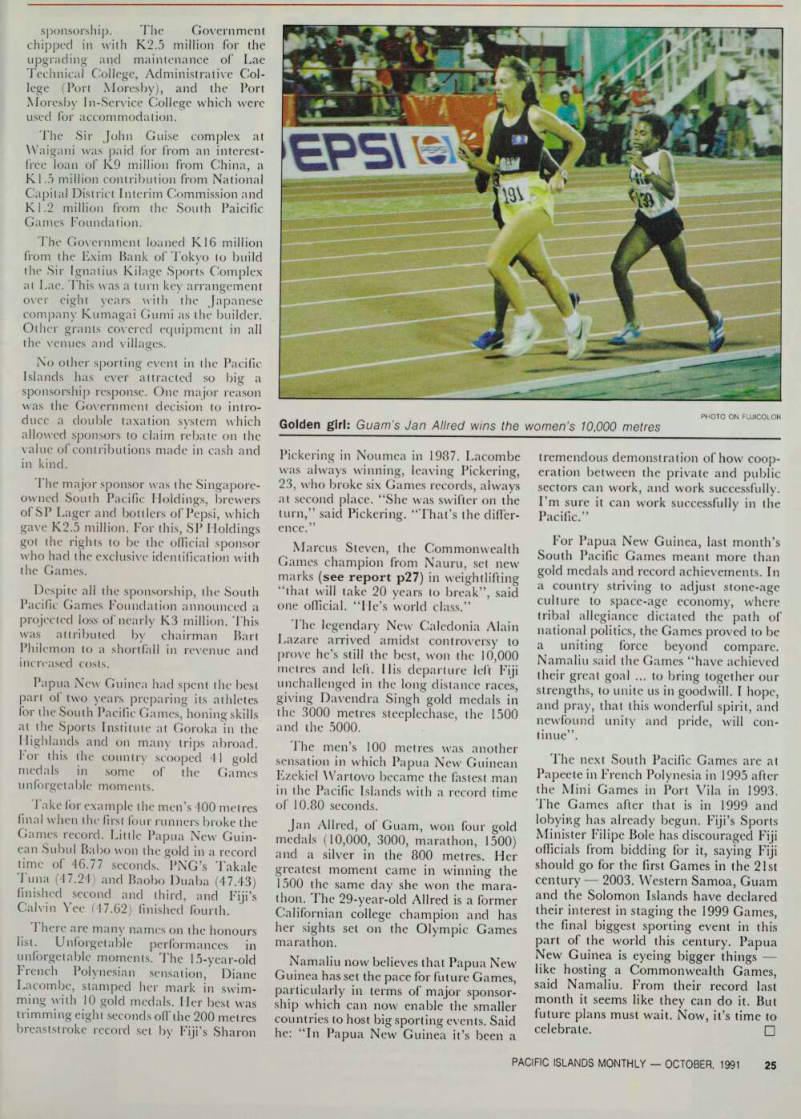
Jan Allred, of Guam, won four gold medals (10,000, 3000, marathon, 1500) and a silver in the 800 metres. Her greatest moment came in winning the 1500 the same day she won the mara thon. The 29-year-old Allred is a former Californian college champion and has her sights set on the Olympic Games marathon.
Namaliu now believes that Papua New Guinea has set the pace for future Games, particularly in terms of major sponsor ship which can now enable the smaller countries to host big sporting events. Said he: “In Papua New Guinea it’s been a
tremendous demonstration of how coop eration between the private and public sectors can work, and work successfully, I’m sure it can work successfully in the Pacific.” s F ° r Papua t l ew Guinea > las ‘ mon ‘ h ’ s S °, u ,' h PaC , ,flC Games meant more than g ° ld medals andrccord achievements. In a , coulUr >’ s,rlvm S lo ad J ust stonc ' a g e Cl l lu , re 0 s P a ce-age economy, where tribal allegiance dictated the path of national politics, the Games proved to be a uniting rorce beyond compare, Namaliu said lhe Games “have achieved lhcir , t 0 brin (oge(her our streng B ths> to B unite us in go ° dw iM. I hope, . ’ , t 4, . j r i • • , T Sp 'u ’ a newfound unity and pride, will con tinue .
The next South Pacific Games are at Papeete in French Polynesia in 1995 after tbe Mini Games in Port Vila in 1993.
The Games after that is in 1999 and '°>! R S has already begun. Fiji’s Sports er F >hpe Bole has discouraged Fiji °/ nclals fr ° m bidding for it, saying Fiji should go for the first Games in the 21st century 2003. Western Samoa, Guam and the Solomon Islands have declared their interest in staging the 1999 Games, the fmal bi §§ est sporting event in this P art of the world this century. Papua is eing bigge , r ‘ hb 'g s llk " h ° S,mg . 3 Commonwealth Games, Sald Namahu. From their record last !^ onth 11 seems like they can do it. But , u . re Pl ans must wait. Now, it’s time to ce * ebrate - □
Photo On Fujicolor
Golden girl: Guam’s Jan Allred wins the women's 10,000 metres