New World Order
at a price
Saudi Arabia crushes hopes for Somare to lead the UN. lan Williams reports.
SIR Michael Somare suffered a shock defeat in the elections for the Presidency of the United Nations General Assembly on September 17. He gained only 47 votes as opposed to Saudi Arabian candidate Samir Shihabi’s 83, and Yemeni candi date A 1 Ashtal’s 20.
Shihabi’s last minute candidacy was backed by Saudi Arabia’s financial pressure, which seems to have success fully eroded the 85 votes promised to PNG in the early stages of the campaign.
Not since the Pacific nations won the battle to have New Caledonia reinscribed as a colony has the region waged such an intensive diplomatic battle at the United Nations.
The man at the centre of both campaigns was Papua New Guinea’s UN ambassador Renagi Renagi Lohia. For a year and a half he and his colleagues at the UN mission have been lobbying and canvassing delegates. For months he and Somare have been courting the non aligned, the Africans, the Common wealth and the big powers.
Usually, the position rotates around the regional groups and this year it was Asia’s turn. Most years the group would have picked a consensus candidate to be elected by acclamation at the General Assembly but this year, despite having
little support in the Asia Group, Cyprus thought it could gain enough non aligned votes at the General Assembly.
It refused to accept the consensus and, as a result, the Yemeni candidate declared that he too would stay in the running. The Saudi Ambassador to the United Nations then entered the field to spoil the chances of the Yemeni candi date, in revenge for the latter’s oppo sition to the Desert Storm operation.
If the Saudi candidacy reflects the New World Order, it is not a prepossess ing prospect, since the principle was cash with order. Saudi oil wealth was a major factor for many countries, although it has to be said that many were unhappy.
At the beginning of September, the Cypriots withdrew. One of their sup porters told PIM that several countries withdrew because of financial induce ments by the oil-rich Saudis.
On the eve of the poll, the Saudi vote was being hyped in the corridors of the UN as the most that money could buy, but the result still came as a shock to many who expected better things from the world’s ambassadors.
The USA was originally believed to support the candidacy of Saudi Arabia, but there were signs of second thoughts at the last minute. With George Bush maintaining a strong stand against the
demands of the Israeli lobby in Washing ton, the presence of a Saudi, even in a symbolic position, at the UN could easily give Israel a propaganda weapon against UN involvement in the Peace talks.
Win some, lose one
SIR Michael Somare was philosophical about the result. He told PIM that for decades he had fought elections he had won some, occasionally lost one.
As “Father of the Nation” he led the move to independence and, after estab lishment of a democratic, multilingual, multi-ethnic state, he stood down as Prime Minister. He moved on to the world stage as Foreign Minister.
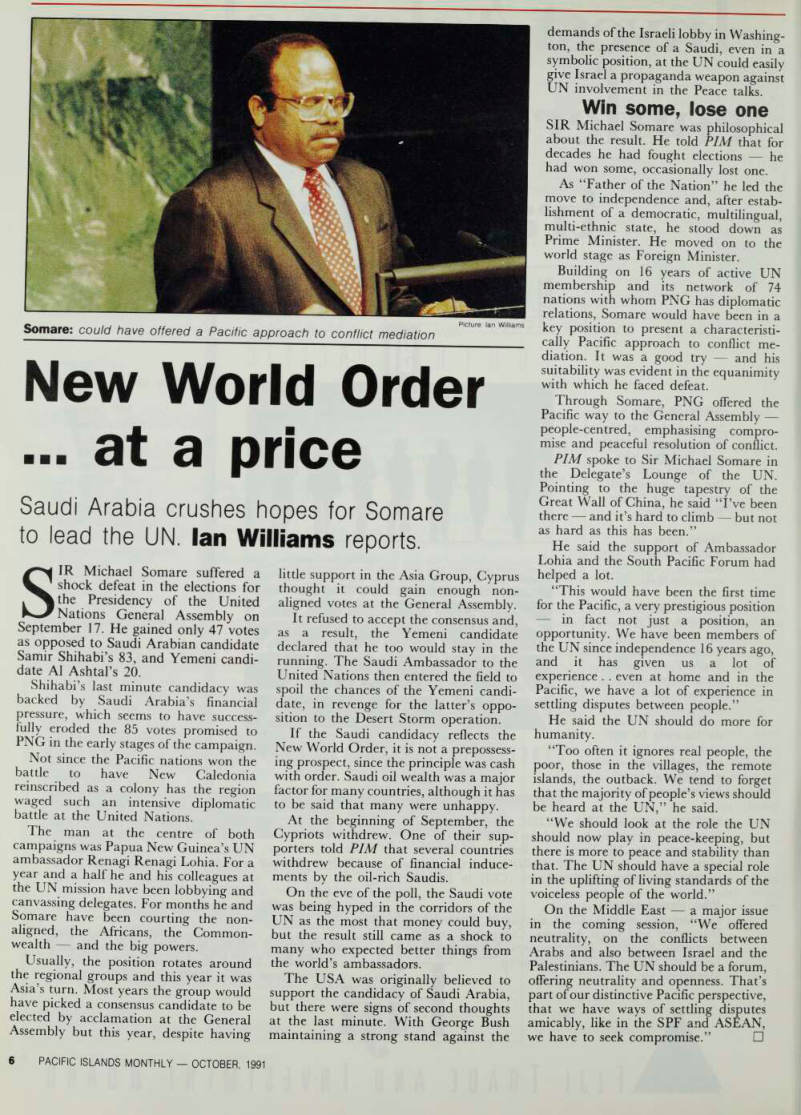
Building on 16 years of active UN membership and its network of 74 nations with whom PNG has diplomatic relations, Somare would have been in a key position to present a characteristi cally Pacific approach to conflict me diation. It was a good try and his suitability was evident in the equanimity with which he faced defeat.
Through Somare, PNG offered the Pacific way to the General Assembly people-centred, emphasising compro mise and peaceful resolution of conflict.
PIM spoke to Sir Michael Somare in the Delegate’s Lounge of the UN.
Pointing to the huge tapestry of the Great Wall of China, he said “I ’ve been there and it’s hard to climb but not as hard as this has been.”
He said the support of Ambassador Lohia and the South Pacific Forum had helped a lot.
“This would have been the first time for the Pacific, a very prestigious position in fact not just a position, an opportunity. We have been members of the UN since independence 16 years ago, and it has given us a lot of experience . . even at home and in the Pacific, we have a lot of experience in
settling disputes between people.”
He said the UN should do more for
humanity.
“Too often it ignores real people, the poor, those in the villages, the remote islands, the outback. We tend to forget that the majority of people’s views should be heard at the UN,” he said.
“We should look at the role the UN should now play in peace-keeping, but there is more to peace and stability than that. The UN should have a special role in the uplifting of living standards of the voiceless people of the world.”
On the Middle East a major issue in the coming session, “We offered neutrality, on the conflicts between Arabs and also between Israel and the Palestinians. The UN should be a forum, offering neutrality and openness. That’s part of our distinctive Pacific perspective, that we have ways of settling disputes amicably, like in the SPF and ASEAN, we have to seek compromise.” □
Picture Ian Williams Somare: could have offered a Pacific approach to conflict mediation