Samoa’s spending more
p. 57 · Read in the full issue
and earning less
By Ulafala Aiavao
WESTERN Samoan authorities sounded an old warning with new urgency in August, calling
for reduced spending on imports and
more investment in the export industry, fhe Central Bank of Samoa has forecast \ decline this year in private remittances rom overseas, another drop in export warnings to a new low, a widening trade deficit, and stagnant aid levels.
Pleas in the past for consumer restraint met with a lukewarm response last fear the level of imports was nine times he value of exports. The high spending s a concern because Western Samoa only generates a third of its public revenue hrough local economic activity. Most of he financing has been underwritten by private remittances and foreign aid.
A decline in remittances this year of 10 )er cent is forecast by the General Manager of the Central Bank, Papalii
fommy Scanlan.
By the end of the year, the Central Sank expects remittances to be about A'SsB4 million (US$35 million), com )ared to last year’s record US$39 nillion. The 1990 figure was boosted by :yclone-related payments, so some de fine was expected. But adding to the fall s the economic downturn and rising inemployment in New Zealand the ource of 40 per cent of total remittances.
In the first quarter of this year, emittances from New Zealand were lown by 28 per cent on the same quarter l year ago.
Aid levels are steadying.
“There is no Hkehood of a substantial imount of foreign aid for the rest of the 'ear,” said Papalii. “If the economies of tid partners are not doing well, there’ll >e a natural reluctance for them to give
(more) aid to us.”
He urged exporters to export more to help counter a gradual decline in foreign exchange reserves. Foreign reserves reached US$74 million in March and have fallen slightly since then. The provisional trade dificit in the first quarter was US$l9 million, an increase
of 13 per cent on the first quarter of 1990.
Good weather has led to plentiful crops for local consumption. But with spending on imports so high, the level of exports to earn money that will pay for the overseas goods is disappointing.
Export earnings this year are expected to hit a record low of US$7.6 million.
That is half of what was earned in 1985, and lower than last year’s poor perform ance when exports were affected by cyclone damage. Most export earnings in the first half of this year came from taro and coconut cream. Taro drew in US$l.9 million, wwhwile coconut cream returned US$l.2 million for the six month period.
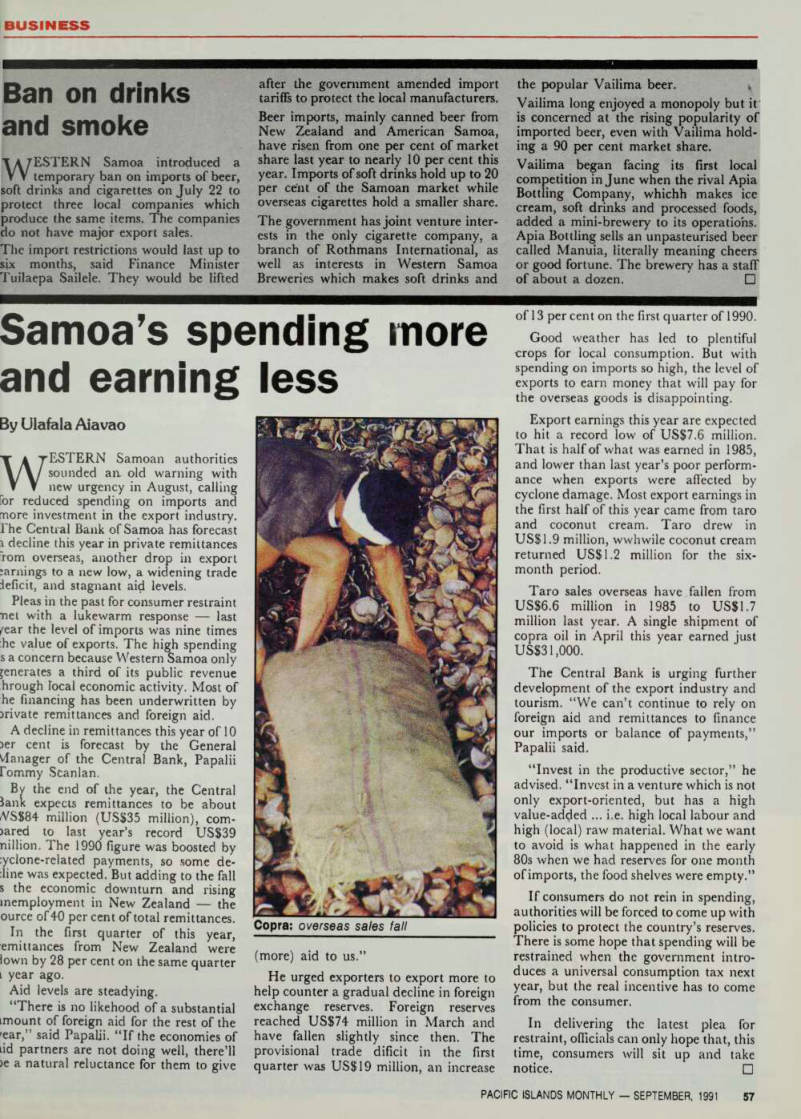
Taro sales overseas have fallen from US$6.6 million in 1985 to US$l.7 million last year. A single shipment of copra oil in April this year earned just
Us$3L,Ooo.
The Central Bank is urging further development of the export industry and tourism. “We can’t continue to rely on foreign aid and remittances to finance our imports or balance of payments,”
Papalii said.
“Invest in the productive sector,” he advised. “Invest in a venture which is not only export-oriented, but has a high value-added ... i.e. high local labour and high (local) raw material. What we want to avoid is what happened in the early 80s when we had reserves for one month of imports, the food shelves were empty.”
If consumers do not rein in spending, authorities will be forced to come up with policies to protect the country’s reserves.
There is some hope that spending will be restrained when the government intro duces a universal consumption tax next year, but the real incentive has to come from the consumer.
In delivering the latest plea for restraint, officials can only hope that, this time, consumers will sit up and take notice. □
Copra: overseas sales fall