When things
pp. 45-47 · Read in the full issue
are hurtin’
Hawaii’s tourism tumbles, hit by war, recession and image fatigue
By Ngaire & Norman Douglas
W ALL ACE Fujiyama, a promin ent Honolulu attorney and ad vocate of Japanese expansion in
investment and tourism, is not a man to mince words even if he doesn’t mind mixing the occasional metaphor. “Ha waii” Fujiyama told a recent seminar organised by the Japan-American So
ciety of Honolulu and the Pacific Rim foundation, “better get its act together,” since its ambiguous signals to Japanese tourists and investors were helping to kill the “golden goose”. Slipping briefly into the role of hypothetical Japanese tourist, Fujiyama addressed the meeting as follows: “You slap my head and kick by butt and you still want me to come here and give you money. You must think I’m stupid.”
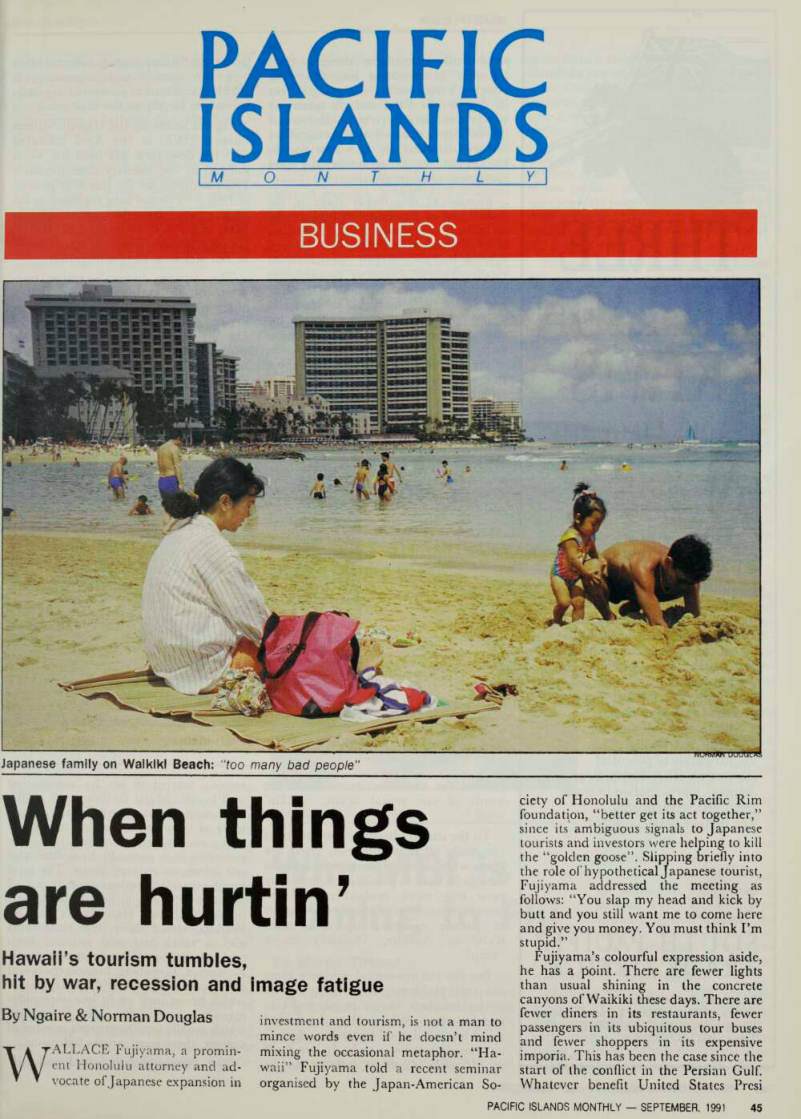
Fujiyama’s colourful expression aside, he has a point. There are fewer lights than usual shining in the concrete canyons of Waikiki these days. There are fewer diners in its restaurants, fewer passengers in its übiquitous tour buses and fewer shoppers in its expensive imporia. This has been the case since the start of the conflict in the Persian Gulf.
Whatever benefit United States Prcsi
dent Bush may have derived from virtually guaranteeing his victory at America’s next elections by going to war in the Middle East, and no matter to what extent the American public has had its confidence restored by the ease of the victory, the effect on the visitor flow to the US state which depends heavily upon tourism is close to disastrous.
Because at this fragile stage in the restoration of American enthusiasm for its military endeavours it would seem less than patriotic to complain that the Gulf exercise had been largely responsible for eroding Hawaii’s number two industry (the military is number one). The other reasons for the remarkable downturn in visitor numbers have also been found: the national economic recession, seasonal shifts in the visitor market, the fickleness of the Japanese traveller and something that one newspaper described as “image
fatigue.”
But whichever way it is explained, one
thing is very certain; the visitor business in Hawaii is, as they say there, “hurtin”. This is so not simply in overdeveloped Waikiki and the main island of Oahu, but in those neigh bour islands - Maui, Kaui and the “big island” Hawaii which have also come to depend in large measure on the transmission of the tourist dollar. As far as industry source are concerned, too many hotel rooms are empty, and the short term apart ment rental business another vital as
pect of the tourist economy is, in the words of one rental agent, “suckin’ wind.”
To the casual observer, a lot of this is not really all that apparent. There are times when Waikiki Beach still looks as though it couldn’t possibly accommodate even one more sunbather, and an impressive number of people still appear to parade endlessly up and down Kalakaua Avenue, Waikiki’s major
“strip”.
But the circumstantial evidence blurs the real problems. The Aloha State’s visitor numbers began to plummet in mid-January. While the downward trend has levelled off somewhat, there is no immediate relief in sight. In late April the Honolulu Advertiser declared on its
front page “Ailing tourism industry takes turn for worse” and announced a US$459 million loss in tourist expendi tures, due largely to the Gulf crisis.
Figures issued by the Hawaii Visitors Bureau (HVB) in late April indicated that the downturn has been the worst suffered by the industry since the early 1960 s and that for the first four months of 1991 a period long regarded as the “high season” there the toursit count was likely to be down by at least 205,000 on the previous year, almost as many visitors as Fiji sees in a 12-month period.
The visitors bureau’s senior vice president of marketing, Gene Cotter, observed: “Anyone who thinks that we are out of the woods is sadly mistaken.”
Coming from the generally optimistic, promotionally aggressive and high pro filed bureau, the observation must be taken seriously.
In late January, when the first effects of the war, hotels and services devoted to
tourism started to act by announcing staff layoffs. Major facilities such as the Sheratons, Hiltons and Hyatts closed some of their rooms and some restaur ants, encouraged employees to take vacations in a normally busy time and put others on reduced hours. The total number of hotel workers actually put off seems to be vague, but the state’s largest hotel, the Hilton Hawaiian Village in Waikiki, closed down two restaurants and a snack bar and reduced both cocktail bar staff and entertainment show times. Elsewhere, housekeepers and restaurant staff were laid off. In a state which prides itself on its low unemploy ment rate and in February, the month which usually sees the greatest number of visitors, these were serious indicators.
The announcement of discounted
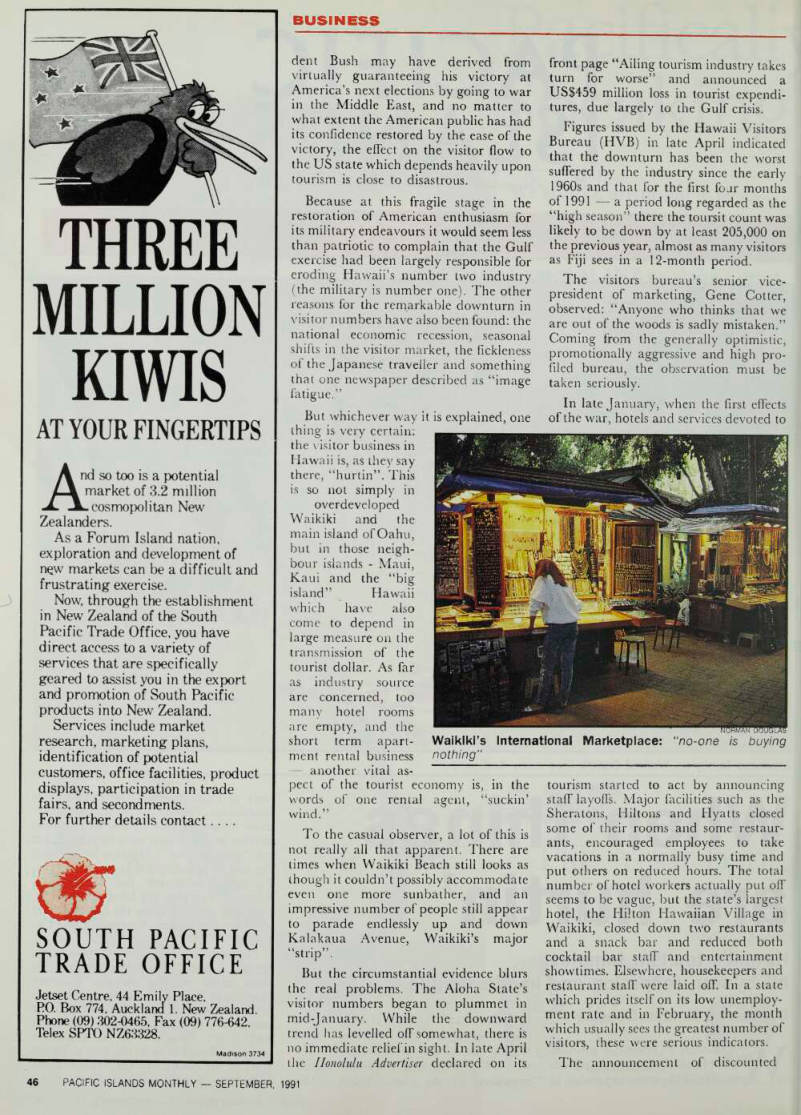
Waikiki’s International Marketplace: " no-one is buying nothing"
airfares between the continental US and Hawaii and the mounting of a 51.4 million advertising campaign on the mainland were intended to close the widening gap between the anticipated and the actual.
The visitors who came didn’t spend enough money to lift retail businesses and restaurants out of the doldrums. The vast Ala Moana Centre, Hawaii’s largest shopping complex where most of Waikiki’s visitors are expected to spend their time when they are not lying on the beach, reported that business was be tween 10 and 12 per cent down.
In the exclusive brand-name shops along the Waikiki strip the Dunhills, the Chanels, the Chaumets and the Louis Vuittons established mainly to present an up market image in what was once a down market area and aimed largely at a Japanese clientele, business is not so much depressed as non existent. The only movement of the extraodinarily expens ive merchandise is as it receives its daily,
dusting.
In the International Market Place, Waikiki’s best known trap for tourism trivia, the crowds are way down and so are the spirits of the stall holders and vendors, many of them of Asian extrac tion who usually function well in the bazaar-like atmosphere, where dozens of stalls all sell exactly the same merchan dise. “I’m not even making enough to pay my rent,” said jewelley-seller Lily from the Philippines, “no-one is buying
nothing.”
The few industry people who re mained optimistic were brought back to reality by the comments of Chuck Gee, Dean of the School of Travel Industry Management at the University of Ha waii. Describing as “cockeyed” those who predicted a recovery by mid-year, Gee pointed out that the downward trend was evident even before the bombs fell on Baghdad, and predicted at least one year of low revenues.
In Japan, there was assurance that for Japanese travellers Llawaii was still a
popular destination, despite diminishing
evidence for the claim. A representative of the Japan Travel Bureau said that Hawaii had been “attractive for a long time”, the implication being that its appeal may be starting to wear thin. This produced the suggestion from the Tokyo correspondent of the Honolulu Advertiser that Hawaii might be suffering from “image fatigue”, since it was being unfavourably compared with “new im age” destinations like Australia.
To test the merit of this claim, we spoke to a random selection of Japanese visitors in Waikiki on the matter of Hawaii appeal. The responses were interesting if perhaps not conclusive. A few approved the destination without qualification, but didn’t seem particu
larly anxious to comment further. Some drew attention to the cost: “very big price”, one said. Probably the most revealing observations were offered by those who weren’t happy about the tawdrier aspects of this corner of Para dise. “Too many bad people”, said one man who was with his wife and young family. Certainly Waikiki has a generous share of hustlers, hookers and hangers on, though it is by no means unique in this respect.
There is evidence that the sometimes dormant opposition of native Hawaiians and long time Haole residents to the demands of tourism is being revived once more. The most recent articulation of it
came from a resident of Aiea, an area of Honolulu not on the beaten tourist path.
“The decline of tourism,” she wrote, “is understandable. Why should tourists who come to experience the warmth of aloha and the breathtaking natural verdure, the power of Pele, the brilliant blue of our once pristine ocean, the rainbow of flora, and the heavenly aroma
of our pikake, plumeria and pakalana,
visit concrete jungles, sluggishly crowded roads, cutesy tourist traps with man made lagoons and waterfalls, all of which
are over-priced.”
It may be some time yet before Hawaii’s tourism industry regains its confidence. □