20 years later
pp. 22-24 · Read in the full issue

The Forum Is acting with the confidence of an organisation that is taken seriously
By Brendon Burns
A PHOTOGRAPH of the first South Pacific Forum shows half a dozen leaders in white shirts and dark ties sitting together on a winter’s morning in 1971 at Parliament buildings
in Wellington. The dilapidated buildings
now lie empty, awaiting refurbishment which the country cannot afford, while New Zealand’s parliament sits in rented accommodation.
Twenty years on, the Forum met last month in the luxurious, US aid dollar built comfort of Palikir, the new capital of the Federated States of Micronesia.
Only one leader has endured from the first, southern-most meeting point of the Forum to its latest, most northern setting.
And Ratu Sir Kamisese Mara did not miss the chance to make the most of his Forum finale.
Strong positions taken on environ mental issues climate change, French testing, Johnston Atoll dominated the communique. But Ratu Sir Kamisese
used his role as Forum spokesman to imprint his views on a number of issues, both on and off the official agenda.
France, the Solomon Islands Prime Minister, the Forum Secretariat, oil companies, Western consultants and some Forum members were targets for criticism.
The list may have been somewhat quixotic but no-one was going to deny Ratu Sir Kamisese the right to tilt his lance this being, he assured leaders, his last Forum. In his opening remarks, FSM’s President Bailey Olter, attending his first Forum, said he would draw upon old hands to assist him as chairman.
He spoke of the Forum reaching maturity and having a voice now listened to around the world with a respect out of proportion to the size of its members.
Increasingly, the Forum is acting with the confidence of an organisation that is taken seriously. Partly this is due to a
generalisation change. The founding
fathers, many with chiefly status, are giving way to a new breed of younger leader, such as Papua New Guinea’s
Rabbie Namaliu. If he can survive his country’s next election, he is assured of becoming a regional mover and shaker.
Another is Nauru’s Bernard Dowiyogo. Hammer Deßoburt may have been there at the birth of the Forum, but health problems saw him sometimes asleep in Nauru’s chair, as hilariously recalled by New Zealand’s David Lange in his recent book.
Dowiyogo seems to have something of the angry young man about him. He led the charge in securing the Forum’s warning to France that it may expand the programme of opposition if nuclear testing continues in the region.
This may emerge as having the South Pacific Regional Environment Pro gramme (SPREP) monitor and evaluate the environmental impact of testing.
Until now SPREP has played a more cautious role on the testing issue, partly due to it being housed in Noumea under the auspices of South Pacific Com mission.
Now off that chain and confirmed as a stand-alone organisation to be based in Apia, SPREP is to gain some teeth for its
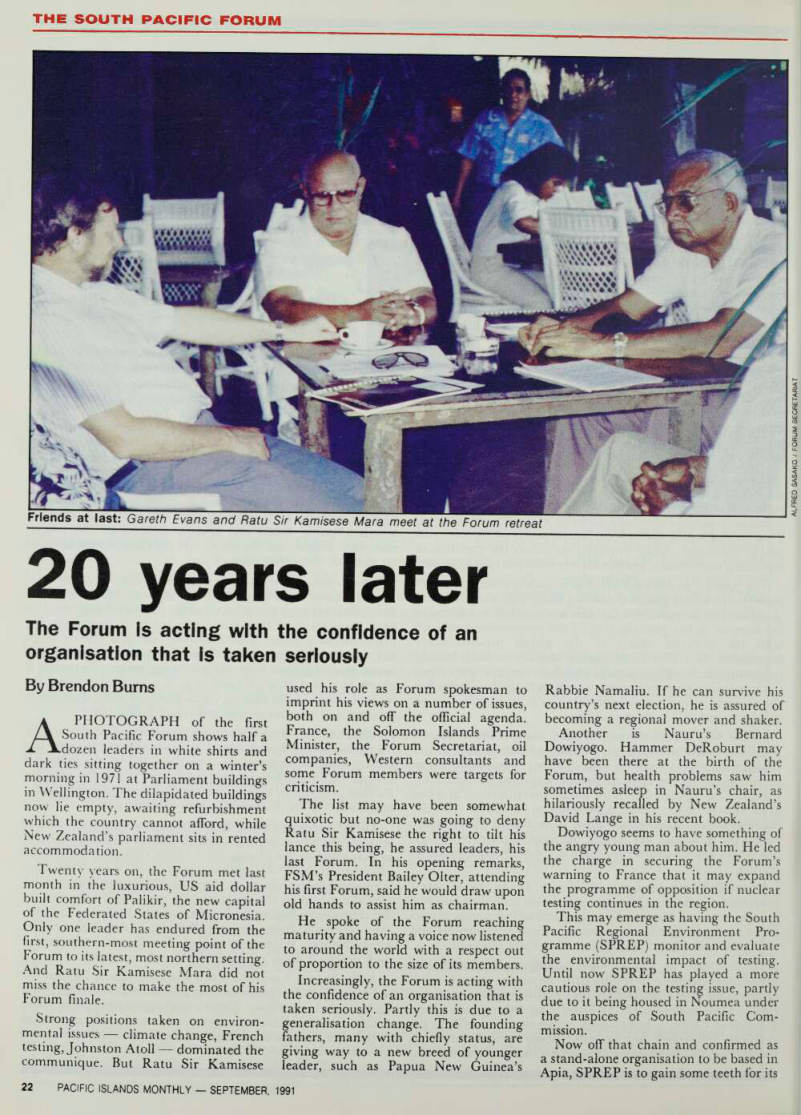
Friends at last: Gareth Evans and Ratu Sir Kamisese Mara meet at the Forum retreat
role as regional environmental watch dog. Again, there is a generational change in leadership. Tongan scientist, Dr Vili Fuavao, still in his thirties is now Director of SPREP, replacing the pre vious title of coordinator. With initial New Zealand support, SPREP has begun to grow from a nebulous SPC adjunct with half a dozen staff into an expanding force in the region. Green politics are a worldwide phenomenon and the South Pacific is no exception. The environment is a glue binding the region together and with a Pacific passion.
French testing had somehow missed the usual communique condemnation at last year’s Forum in Port Vila and at least one French official interpreted the absence as a sign of acceptance. This annoyed everyone and there was no prospect of the Palikir communique failing to register a stiff protest.
The United States chemical weapons disposal programme at Johnston Atoll did not escape the Forum’s wrath in Vila, in spite of the efforts of Australian Prime Minister, Bob Hawke. He fought tooth and nail to gain acceptance of the use of the Johnston Atoll plant to dispose of 100,000 chemical weapons shells, pre viously based in Germany. President Bush’s initiative to meet Pacific Island leaders in Hawaii late last year helped soothe their ears that Johnston Atoll would be used to dispose of further chemical weapon imports. But the Palikir Forum chose to reaffirm oppo sition to the JACADS plant being used for any more than disposal of chemical weapons already held on the atoll, or further stocks discovered in the region, such as World War II shells found in the Solomon Islands, George Bush’s assur ances were deemed to be binding. The United States was urged to bring Johnston Atoll under the SPREP con vention, which deals with hazardous waste.
Such is the strength of feeling within the Forum on environmental issues that it overrides traditional loyalties. Cook Islands Prime Minister, Geoffrey Henry, pro-American enough to question New Zealand’s anti-nuclear policy and the resulting loss of US defence cooperation, said the issue with JACADS is not simply whether it is safe.
“We want respect for our atmosphere, for our ocean,” he said. “So, if you people make these things, make them, but destroy them in your own area, don’t come to our part of the world.”
Forum concern about Greenhouse gas emissions is still couched in less direct
language. But global warming and sea
level rise is still defined as the most serious environmental threat to the Pacific region. Eighty per cent of Greenhouse gases come from 25 per cent of people in the industrialised world.
Greenpeace, as active at Palikir as always, promoted the view that major industrial nations, led by the United States, were undermining efforts to develop an effective international climate convention by adopting a “comprehen sive approach”.
“In essence, the White House wants to give carbon dioxide emissions from gas guzzling US cars and CFG productions from US chemical industries, equal status with methane emissions from rice farmers struggling for survival in the world’s deltas,” said Greenpeace cam paigner Pene Lefale. Climate warming seems to have lost some of the media appeal it enjoyed a year or two ago, meaning future Forum meetings must get
tougher on the issue. While Greenhouse gases may have slipped from the head lines, they still threaten the very existence of some smaller island nations.
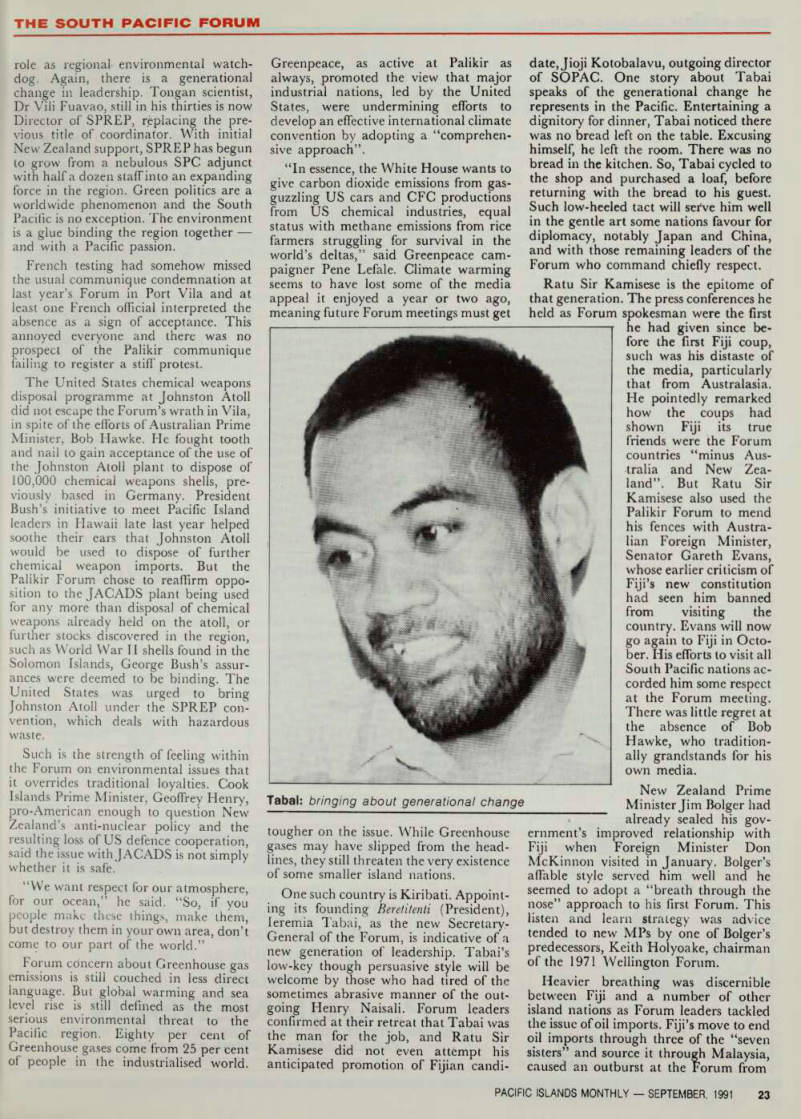
One such country is Kiribati. Appoint ing its founding Beretitenti (President), leremia Tabai, as the new Secretary- General of the Forum, is indicative of a new generation of leadership. Tabai’s low-key though persuasive style will be welcome by those who had tired of the sometimes abrasive manner of the out going Henry Naisali. Forum leaders confirmed at their retreat that Tabai was the man for the job, and Ratu Sir Kamisese did not even attempt his anticipated promotion of Fijian candi
date,Jioji Kotobalavu, outgoing director of SOPAC. One stoi7 about Tabai speaks of the generational change he represents in the Pacific. Entertaining a dignitory for dinner, Tabai noticed there was no bread left on the table. Excusing himself, he left the room. There was no bread in the kitchen. So, Tabai cycled to the shop and purchased a loaf, before returning with the bread to his guest.
Such low-heeled tact will sefve him well in the gentle art some nations favour for diplomacy, notably Japan and China, and with those remaining leaders of the Forum who command chiefly respect.
Ratu Sir Kamisese is the epitome of that generation. The press conferences he held as Forum spokesman were the first
he had given since be fore the first Fiji coup, such was his distaste of the media, particularly that from Australasia.
He pointedly remarked how the coups had shown Fiji its true friends were the Forum countries “minus Aus tralia and New Zea land”. But Ratu Sir Kamisese also used the Palikir Forum to mend his fences with Austra lian Foreign Minister, Senator Gareth Evans, whose earlier criticism of Fiji’s new constitution had seen him banned from visiting the country. Evans will now go again to Fiji in Octo ber. His efforts to visit all South Pacific nations ac corded him some respect at the Forum meeting.
There was little regret at the absence of Bob Hawke, who tradition ally grandstands for his own media.
New Zealand Prime Minister Jim Bolger had already sealed his gov
ernment’s improved relationship with Fiji when Foreign Minister Don McKinnon visited in January. Bolger’s affable style served him well and he seemed to adopt a “breath through the nose” approach to his first Forum. This listen and learn strategy was advice tended to new MPs by one of Bolger’s
predecessors, Keith Holyoake, chairman
of the 1971 Wellington Forum.
Heavier breathing was discernible between Fiji and a number of other island nations as Forum leaders tackled the issue of oil imports. Fiji’s move to end oil imports through three of the “seven sisters” and source it through Malaysia, caused an outburst at the Forum from
Tabal: bringing about generational change
countries fearing oil prices increases from their regional supplier. Ratu Sir Kami sese turned the concern into an attack on the oil companies, accusing them of secretly spreading tales about price rises, while for 20 years they had been systematically robbing Fiji. He further diffused the reaction to his government’s move by promising Fiji would host a meeting of regional energy ministers and the ugly oil companies with the aim of getting to the facts.
With that oil-well fire capped, Ratu Sir Kamisese fanned another with France. The communique expressed a wish to have the Forum assist the FLNKS ensure its objectives are met through the Matignon Accords. How ever, Ratu Sir Kamisese expanded this to include assisting the FLNKS to persuade minority populations in New Caledonia to support independence or self government. This is red rag to a bull stuff lor the Right-Wing rally for Caledonia in the Republic, (RPCR) whose leader, Jacques Lafleur, spurned an offer to be an observer at the Forum. Due to RPCR opposition, France had delayed until July the admission of a Forum delegation to New Caledonia to observe Kanak advancement, in a restrained response to the Forum’s wish for continued involve ment, Louis le Pensec, the French deputy responsible for overseas territories, said it was up to New Caledonians to monitor the Matignon Accords. Access for Forum
delegations is hardly likely to improve
when there appears to be an expressed wish to play a role in New Caledonia’s future.
Jealous guardianship of sovereignty is
not an exclusively French trait, Australia and New Zealand had promoted to the Palikir Forum a wish for much strength ened cooperation in law enforcement.
The bigger members fear drug smugglers and their money launderers, Asian triads and carpetbaggers may target vulnerable small island nations. But there are concerns about how cooperation may
infringe how each country deals with such problems. Officials are to work through these issues and what resources might be necessary to combat such criminal incursions. Action can be ex pected at next year’s Forum in Honiara.
The sovereignty of FSM and the Marshall Islands was affirmed at Palikir, with the bids of these nations to join the United Nations as full members given Forum support. Britain, with Security Council membership, has been reticent to accept the two nations while the free association compacts see the United States responsible for defence, and nominally, foreign affairs.
The bid by Michael Somare for presidency of the United Nations Gen eral Assembly was given Forum endorse ment. If Papua New Guinea’s founding Prime Minister, now Foreign Minister, is successful, the region as a whole will see this as a sign of its acceptance of the international stage.
Any hope Taiwan had of gaining another token of recognition by being accepted at the post-Forum dialogue was dashed. Ratu Sir Kamisese disclosed that Chinese Premier, Li Peng, had lobbied since the Vila Forum against any Taiwanese presence. Ratu Sir Kamisese was scrutably annoyed with Chinese
duplicity trading vigorously with Taiwan but not allowing others political contact. Separate talks with Taiwan, outside the post-Forum setting, are to be considered by the Forum Secretariat, but that proposal comes amid calls for less regional meetings. The construction of the post-Forum meeting came in for some criticism by Ratu Sir Kamisese, who fulminated about the cost of the region of hosting the talks for the convenience of wealthier nations. What seemed to escape him for the moment was that the dialogue is the chance for the South Pacific to set the agenda for a meeting, held in familiar surroundings.
Certainly, the post-Forum dialogue indicated the world is waking up to the South Pacific. The European Commun ity was represented for the first time, if only by officials. Established dialogue partners sent more senior representatives than those at Vila, extending to assistant US Secretary of State, Richard Solomon, Britain’s junior Foreign Minister, Lord Caithness and Japanese Vice-Minister, Muneo Suzuki. While these men are not James Baker, Douglas Hurd or Dr Nakayama, they are beyond the level of diplomats. In 20 years, the Forum has become a voice listened to with attention beyond its size. The challenge for a new generation of leaders is to expand reception without becoming shrill. □