Hilda
pp. 14-15 · Read in the full issue
A Lini in a woman’s world
By David Robie
THE name Hilda Lini has been syn onymous with the “nuclear-free and
independent Pacific” movement and women’s rights. An activist for progress ive political causes since she began working for Vanuatu’s fledgling Vanua’aku Party (then called the New Hebridean Cultural Association) as a teenager in high school two decades ago this year, she has also carved impressive careers as a parliamentarian and jour nalist.
A younger sister of Vanuatu Prime Minister Father Walter Hadye Lini, she comes from a remarkable family on Pentecost Island. A carpenter, Harper Lini and his wife, Jean, had 10 children ... and gave them all except the youngest a name starting with “H”. Several of Hilda’s siblings besides Walter also played a role in the VP’s development.
The eldest sister, Hasel, married to a former police officer, served on the party executive council for two years; the third eldest Hanson, was involved in the inaugural party congress at Luganville and married Kaikot Mataskelekele, an executive council member and a lawyer, Hanson is president of the Pentecost Local Government Council, Heather became the first Vanuatu woman lawyer, and Jeanette is an assistant secretary in the Home Affairs Ministry.
After succeeding Walter Lini as editor of the party’s newspaper, Vanua’aku Viewpoints, Hilda moved to Noumea and established the South Pacific Com mission Women’s Bureau there. Later she returned to Port Vila and was elected Vanuatu’s first woman member of par liament in November 1987, topping the poll ahead of four other male candidites elected in the capital of Port Vila. Often outspoken, last year she became editor of a glossy news magazine in Vanuatu, Pacific Island Profile. Although it had a promising start with backing from pub lisher Philippe Cathonnet, of a local printing company, it was forced to close earlier this year because of a lack of
advertising revenue.
Last November, Hilda led the Vanu atu delegation to the 6th Nuclear-Free and Independent Pacific conference at
Pawarenga, New Zealand, and offered Vanuatu as host country for the NFIP movement’s secreatariat. Sometimes an independent critic of her country’s gov ernment, in spite of her brother’s pos ition, she laments the lack of influence by backbench Members of Parliament on policies. She also believes in an alterna tive media voice in a country where all news media is state-run.
In a Pacific Island Profile editorial she said: “Vanuatu needs to develop an effective media service in line with the important role it plays in the region. (We) hope to provide an opportunity whereby opinions can be expressed ... which seem to be missing.”
Hilda Lini is married to Jean-Marie Vaaganu,a Wallisian, and they have two children; five-year-old Eloi (named after the martyed Kanak leader Eloi Machoro) Ure-Tamata (Peace-in-the
world) and three-year-old Waga-
Tamata (Transporler-of-peace).
Pacific Islands Montly’s David Robie talks to Hilda in Port Vila.
What drove you so young into political activism?
I was going to get involved when I was at the British secondary school in 1970.
When the Vanua’aku Party’s paper came out in 1971 it was called New Hebrides Viewpoints in those days I used to help out Walter at the Longana
Peoples’ Centre on Ambrym dur ing the holidays. Later, we had to help him put the pages together.
The issues controlling the ni- Vanuatu people were discussed in this paper. It was my earliest
political awakening to politics
I was just 17 then.
Throughout my secondary education in Vila we used to have current affairs introduced into the class. We talked about politi cal developments in the New Hebrides and we were able to know what was going on.
My brother was very involved in the Vanua’aku Party and it made me involved as well in what we were fighting, what was going on. Towards the end of 1973-74 some of us students attended political rallies. We stood up and asked questions. By the time the first election was held in 1975, I was working in the bank (now Westpac). Several black Ameri cans working with the
Vanua’aku Party had arranged
training scholarships for ni-
Vanuatu. There were four of us.
We had finished secondary school and I was supposed to do journalism. However, when the scholarships finally came up only
two people went.
Already at that time, the British police were trying to get the names of students involved in the party. Another develop ment while we were students was the people questioning our involvement.
Was it right or not to be involved? My brother was editor of New Hebrides Viewpoints , so it was natural that I became involved.
I went to Vila to help out. In Febuary 1976 the party congress appointed me to become editor of Viewpoints , and Charles Bice as party assistant secretary-general.
Several of our family were working for the party. Hasel got involved even though her husband at the time was a ni- Vanuatu policeman working with the British colonial police and they were checking on the activists.
I became well-known because I was working in the office. The others were also active. 1976 was an important year for our struggle. It was when the Vanua’aku Party won its first election.
The two colonial governments tried to change the system to keep the status quo.
The Vanua’aku Party asked whether chiefs and traditional politicians shouldn’t also be given seats.
In 1971 I also became coordinator of the party’s programme for women. At the same time I was working with the youth programme. We had demonstra tions in Vila in support of the right for
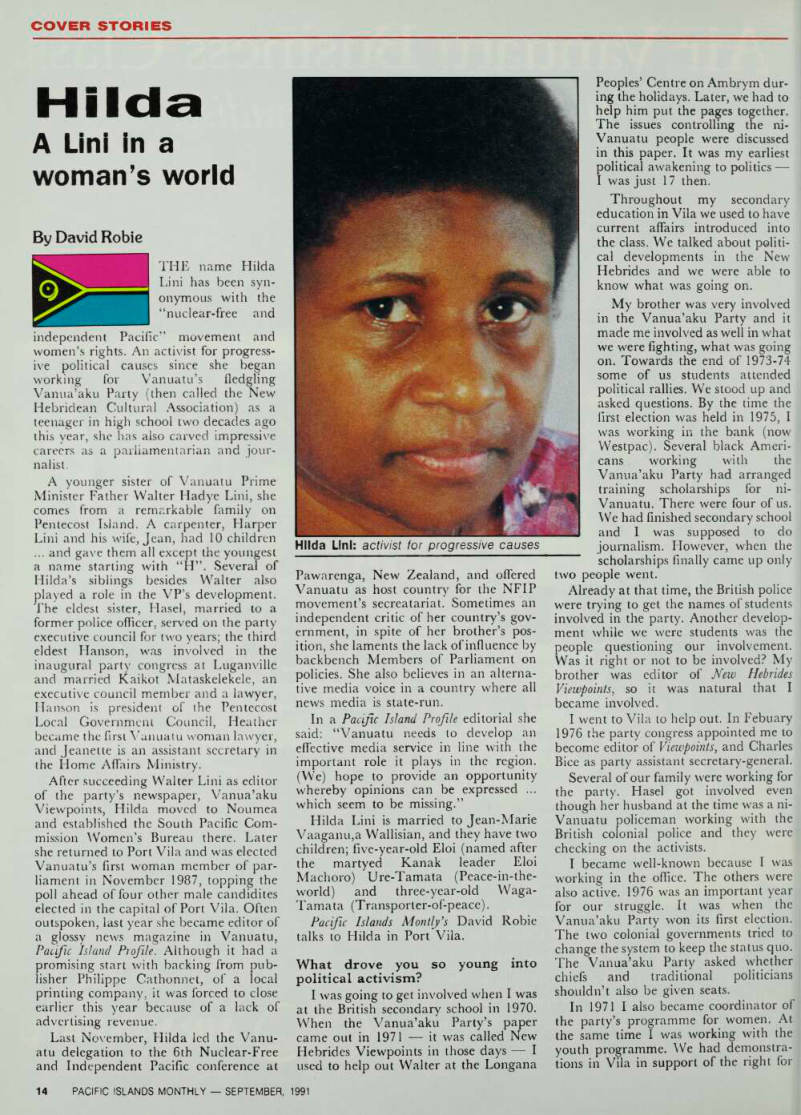
Hilda Linl: activist for progressive causes
18-year-olds to vote. Later that year we formed the provisional people’s govern ment. I believe that a lot of us were working for the mobilisation of women.
Have you been penalised in politics because you are a woman?
In September 1979 I interrupted my studies and came back to contest the elections in Port Vila. I found a lot of discussion involving some leaders that I should not be a candidate they tried to oppose me. These men used the women to go against my candidacy. One of the reasons for the opposition was I was sister of the (then Chief Minister).
What happened then represented a weakeness of women. They didn’t suggest another woman to take my place so the men grabbed the position. So I re enrolled at university although I re turned for the campaign in November.
I have proved a lot of people wrong in their assumptions about my being a sister of the Prime Minister. They find I don’t do what they expect. I critise a lot of things that are not done the right way both within the government and in the party. I speak out on issues such as the enviroment, different policies, women.
What about the new generation of ni-Vanuatu?
People don’t know what we fought for.
We need ni-Vanuatu writers to write about our struggle so our people know their history. At the 19th anniversary of the party, the Prime Minister called for people to write our history. Parents should also be talking about what and who took part in the struggle.
Our leaders need to set down their recollections of the tactics and achieve ments in gaining our independence in 1980. Last year we produced a big birthday book, Vanuatu: 10 Years of Independence, but I was surprised that it didn’t touch much on our indepen dence struggle. There could have been a special section on the struggle.
How do you see the development of Nuclear Free and Independent Pa cific issues?
Ld always taken a strong position on nuclear testing by the time we became independent in 1980. And the Vanua’aku Party had always correctly addressed the nuclear issue as being connected to the colonial issue. You cannot separate the enviromental issues from the political context.
It was in the 1980 conference in Hawaii that what had at first been the nuclear-free Pacific movement became the Nuclear-Free and Independence Pacific (NFIP) movement. But Vanuatu had always stood firm on the issue of colonialism and nuclear-free they go together. That is why we contributed so much to supporting the NFIP ideals. □