Carlot: a better deal
pp. 11-12 · Read in the full issue
for the landowners
By Beryl Cook
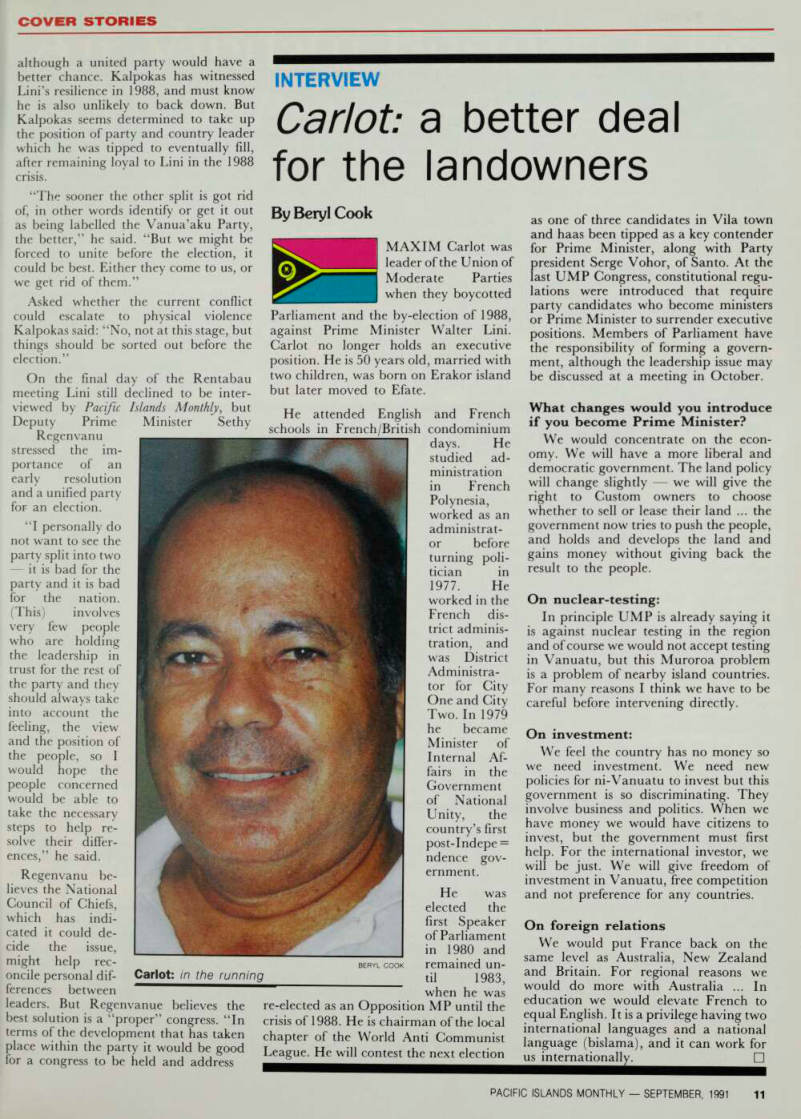
MAXIM Carlot was leader of the Union of Moderate Parties when they boycotted
Parliament and the by-election of 1988, against Prime Minister Walter Lini.
Carlot no longer holds an executive position. He is 50 years old, married with two children, was born on Erakor island but later moved to Efate.
He attended English and French schools in French/British condominium
days. He studied ad ministration in French Polynesia, worked as an administrat or before
turning poli
tician in 1977. He worked in the French dis trict adminis tration, and was District Administra tor for City One and City Two. In 1979 he became Minister of Internal Af fairs in the Government of National
Unity, the
country’s first
post-Indepe =
ndence gov ernment.
He was elected the
first Speaker
of Parliament in 1980 and remained un til 1983, when he was
re-elected as an Opposition MP until the crisis of 1988. He is chairman of the local chapter of the World Anti Communist League. He will contest the next election
as one of three candidates in Vila town and haas been tipped as a key contender for Prime Minister, along with Party president Serge Vohor, of Santo. At the last UMP Congress, constitutional regu lations were introduced that require party candidates who become ministers or Prime Minister to surrender executive positions. Members of Parliament have the responsibility of forming a govern ment, although the leadership issue may be discussed at a meeting in October.
What changes would you introduce if you become Prime Minister?
We would concentrate on the econ omy. We will have a more liberal and democratic government. The land policy will change slightly we will give the right to Custom owners to choose whether to sell or lease their land ... the government now tries to push the people, and holds and develops the land and gains money without giving back the result to the people.
On nuclear-testing:
In principle UMP is already saying it is against nuclear testing in the region and of course we would not accept testing in Vanuatu, but this Muroroa problem is a problem of nearby island countries.
For many reasons I think we have to be
careful before intervening directly.
On investment: We feel the country has no money so we need investment. We need new policies for ni-Vanuatu to invest but this government is so discriminating. They involve business and politics. When we have money we would have citizens to invest, but the government must first help. For the international investor, we will be just. We will give freedom of investment in Vanuatu, free competition and not preference for any countries.
On foreign relations We would put France back on the same level as Australia, New Zealand and Britain. For regional reasons we would do more with Australia ... In education we would elevate French to equal English. It is a privilege having two international languages and a national language (bislama), and it can work for us internationally. □
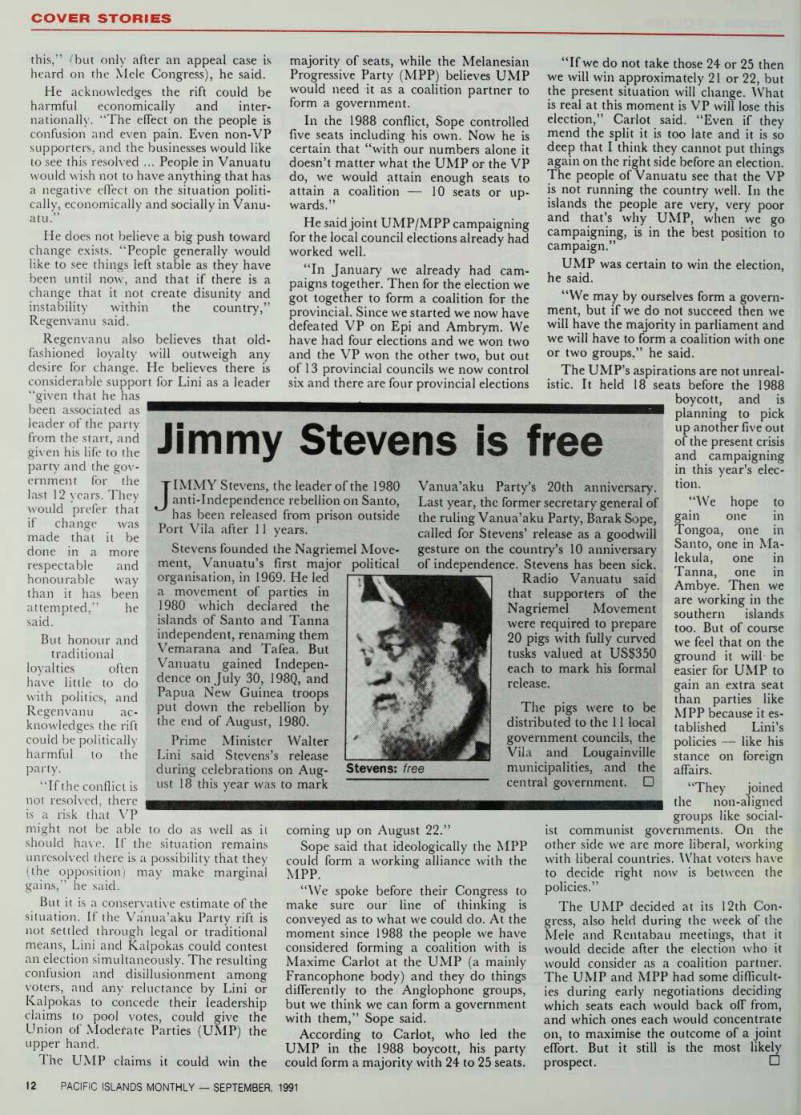
Beryl Cook
Carlot: in the running
this,” (but only after an appeal case is heard on the Mele Congress), he said.
He acknowledges the rift could be harmful economically and inter nationally. “The effect on the people is confusion and even pain. Even non-VP supporters, and the businesses would like to see this resolved ... People in Vanuatu would wish not to have anything that has a negative effect on the situation politi cally, economically and socially in Vanu atu.”
He does not believe a big push toward change exists. “People generally would like to see things left stable as they have been until now, and that if there is a change that it not create disunity and instability within the country,”
Regenvanu said.
Regenvanu also believes that old fashioned loyalty will outweigh any desire for change. He believes there is considerable support for Lini as a leader
“given that he has been associated as leader of the party from the start, and given his life to the party and the gov ernment for the last 12 years. They would prefer that if change was made that it be done in a more respectable and honourable way than it has been
attempted,” he
said.
But honour and traditional
loyalties often
have little to do with politics, and
Regenvanu ac
knowledges the rift could be politically harmful to the party.
“If the conflict is not resolved, there is a risk that VP
might not be able to do as well as it should have. If the situation remains unresolved there is a possibility that they (the opposition) may make marginal gains,” he said.
But it is a conservative estimate of the situation. If the Vanua’aku Party rift is not settled through legal or traditional means, Lini and Kalpokas could contest an election simultaneously. The resulting confusion and disillusionment among voters, and any reluctance by Lini or Kalpokas to concede their leadership claims to pool votes, could give the Union of Moderate Parties (UMP) the upper hand.
The UMP claims it could win the
majority of seats, while the Melanesian Progressive Party (MPP) believes UMP would need it as a coalition partner to form a government.
In the 1988 conflict, Sope controlled five seats including his own. Now he is certain that “with our numbers alone it doesn’t matter what the UMP or the VP do, we would attain enough seals to attain a coalition 10 seats or up wards.”
He said joint UMP/MPP campaigning for the local council elections already had worked well.
“In January we already had cam paigns together. Then for the election we got together to form a coalition for the provincial. Since we started we now have defeated VP on Epi and Ambrym. We have had four elections and we won two and the VP won the other two, but out of 13 provincial councils we now control six and there are four provincial elections
coming up on August 22.”
Sope said that ideologically the MPP could form a working alliance with the
Mpp.
“We spoke before their Congress to make sure our line of thinking is conveyed as to what we could do. At the moment since 1988 the people we have considered forming a coalition with is Maxime Carlot at the UMP (a mainly Francophone body) and they do things differently to the Anglophone groups, but we think we can form a government with them,” Sope said.
According to Carlot, who led the UMP in the 1988 boycott, his party could form a majority with 24 to 25 seats.
“If we do not take those 24 or 25 then we will win approximately 21 or 22, but the present situation will change. What is real at this moment is VP will lose this election,” Carlot said. “Even if they mend the split it is too late and it is so deep that I think they cannot put things again on the right side before an election.
The people of Vanuatu see that the VP is not running the country well. In the islands the people are very, very poor and that’s why UMP, when we go campaigning, is in the best position to
campaign.”
UMP was certain to win the election, he said.
“We may by ourselves form a govern ment, but if we do not succeed then we will have the majority in parliament and we will have to form a coalition with one or two groups,” he said.
The UMP’s aspirations are not unreal istic. It held 18 seats before the 1988
boycott, and is
planning to pick
up another five out of the present crisis
and campaigning
in this year’s elec tion.
“We hope to gain one in Tongoa, one in Santo, one in Ma lekula, one in Tanna, one in Ambye. Then we are working in the southern islands too. But of course we feel that on the ground it will be easier for UMP to gain an extra seat than parties like MPP because it es tablished Lini’s policies like his stance on foreign affairs.
“They joined
the non-aligned
groups like social
ist communist governments. On the other side we are more liberal, working with liberal countries. What voters have to decide right now is between the policies.”
The UMP decided at its 12th Con gress, also held during the week of the Mele and Rcntabau meetings, that it would decide after the election who it would consider as a coalition partner.
The UMP and MPP had some difficult ies during early negotiations deciding which seats each would back off from, and which ones each would concentrate on, to maximise the outcome of a joint effort. But it still is the most likely prospect. □