Divided They Fall
pp. 8-11 · Read in the full issue
Vanuatu Divided They Fall
Vanuatu’s ruling Vanua’aku Party splits again and plunges into another crisis.
Could this division be the beginning of the fall of the House of Uni?
By Beryl Cook
A Divided Van
ua’aku Party could sound its own death knell at an election in
Vanuatu in November, ushering into power a new ruling party, a new Prime Minister, and new foreign and economic
policies.
The Vanua’aku Party (VP) has been keen to portray its leadership wrangle as a temporary, internal party problem. But the dispute has dragged on so long that the local churches are calling for a peaceful resolution, the chiefs are offering to help, and the citizens'of Vanuatu themselves are wondering who, what and even when they will vote.
The rift in the party has been brewing
since at least February when Prime Minister Father Walter Lini, an Angli
can priest, began sacking ministers,
political appointees and civil servants to replace them with friends and relatives he claimed were more competent and loyal. But some of Lini’s old opponents say the rift has grown from the same seeds that led to the 1988 constitutional crisis and that, if it follows the same pattern, Lini will dig his heels hard into the Vanuatu turf to retain leadership of the party and the country.
Lini’s opposition are also proving stubborn, however, and this time could be different. His critics claim that the sackings are nepotistic and dictatorial, and a strong party faction believes a new leader is needed to lead the Vanua’aku Party to an election victory.
They called an extraordinary congress
of the Vanua’aku Party Congress at Mele Village outside the capital Port Vila on August 7 to hold an executive election.
Executive members voted Lini out of the party presidency and voted in party
General Secretary Donald Kalpokas,
who Lini had sacked as Education and Foreign Affairs Minister on June 27. Sela Molisa, who had been sacked as Lini’s Finance Minister in February, was voted in as secretary general. lolu Abil, who had been sacked as Minister of Home Affairs in April, was voted in as party vice president, and Foreign Affairs Min ister Edward Natapei was voted in as Treasurer. (Natapei was later sacked on
August 13).
The Congress intended Lini to be replaced as Prime Minister at the next sitting of Parliament. However, the questions of whether Parliament will sit
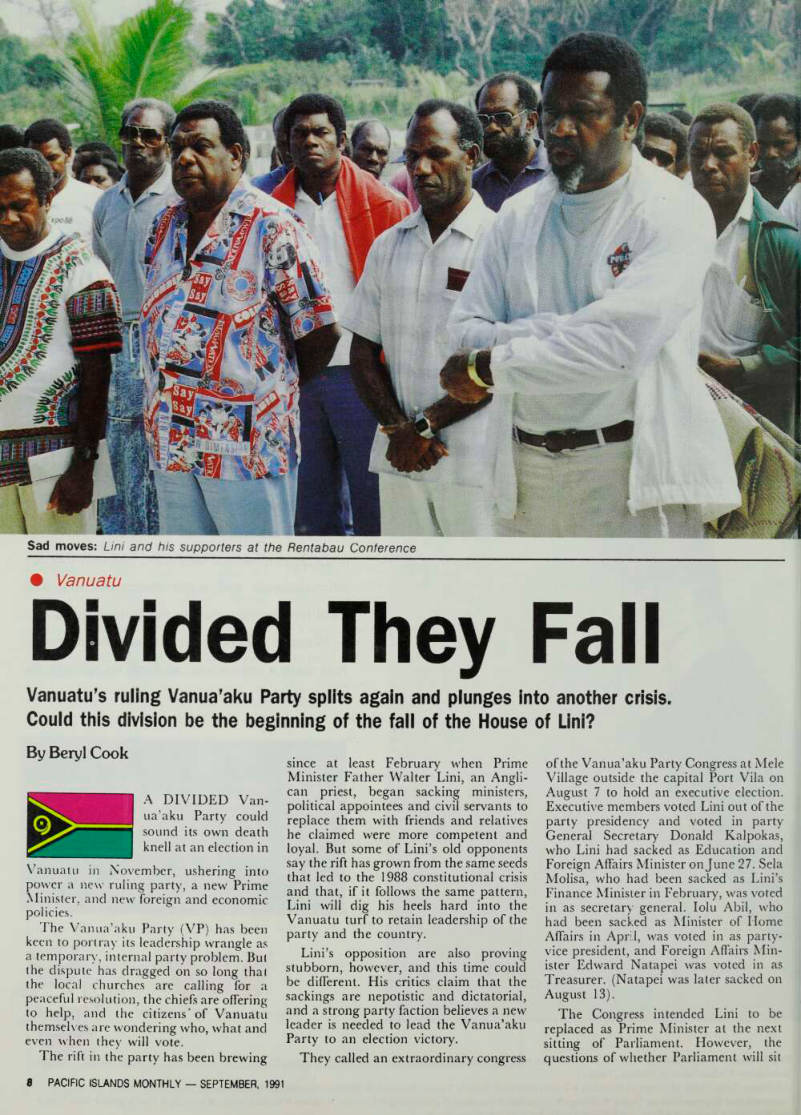
Sad moves: Lini and his supporters at the Rentabau Conference
before the election scheduled for November, and whether an election will even be held then, have become bogged down in political manouvring and technical wrangling. Former Speaker of Parliament Onnyn Tahi, the one who instructs Parliament to sit, resigned recently to become Public Works Minister in Lini’s Government a vacancy created by Lini’s sackings. Whether the Prime Minister can and/or will call Parliament himself, whether the other Members of Parliament can/will call it, and whether the Deputy Speaker or Chiefjustice can/
will instruct Parliament to sit in the Speaker’s absence, also are questions as yet unresolved.
Deputy Speaker Tele Taun instructed Parliament to sit on August 27 to elect a new speaker, who would then be able to instruct Parliament to sit after a seven-day break. But Lini claims Taun has no right to call Parliament, particularly without consulting the Prime Minister. Lini has asked At torney General Silas Hakwa to resign, after Hakwa authorised the notice calling on all MPs to convene the special session.
Lini says Hakwa also should have consulted him, and said he no longer received legal advice from the Attorney Gen eral, Deputy Prime Minister Sethy Regenvanu said earlier in the month that Parliament would sit provided a Speaker could be found. If not, it could be up to the Chief Justice to set a date. (Since then Vanuatu’s Judicial Service Commission, the ac ting secretary of which is Lini’s private secretary Shem Rama, has agreed to appoint a new Chief Justice to replace acting Chief Justice Edwin
Goldsborough before the High
Court hears the appeal case
against the Mele Congress.)
The national Opposition, however, has joined the push for Parliament to sit. Oppo
sition leader Vincent Boulekone said the Deputy Speaker, the Clerk to Parliament and the Attorney General acted accord ing to proper parliamentary procedures calling Parliament to meet. He said Parliament was supreme and he opposed any attempts to boycott the sitting.
Barak Sope, the Melanesian Progress ive Party (MPP) leader who had chal lenged then broken away from Lini and the Vanua’aku Party in 1988, predicted that Lini would try to prevent Parlia ment sitting. But, he says, Kalpokas still has enough support that Parliament may have to sit if half the Members call for it.
The likelihood of this is decreasing, however, because Lini has continued the sackings to install his supporters in Parliament. On August 13 he sacked three more ministers and at least 10 ministerial aides, bringing the oppo sition’s estimate of total sackings since February to eight ministers and more than 50 political appointees and civil servants. The latest sackings have in eluded Edward Natapei, Education Minister Jimmy Meto Chilia, and Agri culture Forestry and Fisheries Minister Jack Hopa all said to be Kalpokas
supporters who attended the Mele congress. (The three are considering taking court action over their dismissal because the dismissal letters said they were sacked for attending the Mele Congress. They claim the Prime Minister can only sack them citing powers vested in him under the constitution.) Willie Jimmy, (who is national treasurer of Vanua’aku Party’s biggest challenger, the Union of Moderate Parties, and an experienced player from 1988), believes Lini may let the election date lapse even though it is normally expected to happen on or before the
expiration of Parliament’s four-year
term.
“Lini would then have to call an election no less than 30 days from that date and no more than 90 days after, That would allow time for the party tc regain its unity for an election by
February,” Jimmy said.
But the MPP’s Sope says there is nc chance Lini can string the election date out because constitutionally the Parlia ment ceases to exist on November 29.
“If he tries to do that we will challenge him in court. We have all the documents
showing Parliament dissolves at the end of its term, so after November 29 it is finished,”
Sope said.
Despite the possibility of an election, the Vanua’aku Party has continued to haggle over the Mele Congress. Unity within the party and a solid campaign effort may not be possible in time for a Novem ber election, judging by the lengthy process of parry and thrust which has dragged on in the legal, political and cultural arenas.
On August 4, Acting Chief Justice Edwin Goldsborough dismissed the bid by Lini supporter and lawyer Kalkot Mataskelekele to have the Mele Congress declared illegal before it was held. Unhappy with the court’s ruling, Lini described it as the “white man’s court”. Mataskelekele is now seeking a Supreme Court injunction to prevent Kalpokas and Abil performing as party president and vice president, convening executive meetings, or enforcing any of the Mele resolutions until the Appeal Court hears a case against the Supreme Court decision.
Lini has also argued against the validity of the Congress on the grounds that it must be opened by the Party president, while his opposition say the
party constitution requires firstly that a Congress have a quorum of half the executive plus one member of each subcommittee, and secondly that either the president or vice-president attend.
As far as Kalpokas is concerned, he was democratically elected the president of the party at Mele. As far as Lini is concerned, he has parliamentary support and the Congress electing Kalpokas was invalid and illegal. Both men claim to have majority party support. The effect on the general public has been confusion and to some extent disillusionment with the Vanua’aku Party as a ruling
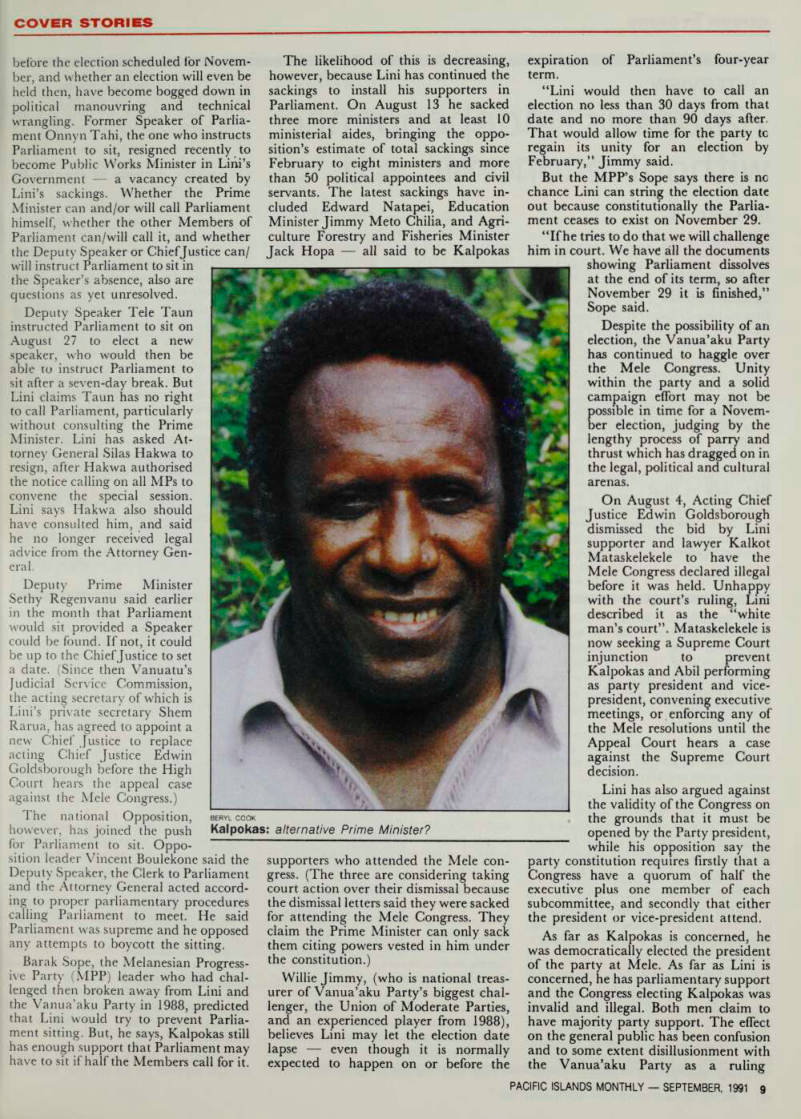
Beryl Cook
Kalpokas: alternative Prime Minister?
body leading the country. While the Mele Congress proceeded on August 7, Lini held his own conference at Rentabau, near Port Vila. Both sides have since claimed their supporters were taken to either the Rentabau or Mele meetings without really knowing where they were headed.
The public confusion and perhaps disillusionment has been made worse by erratic communication lines.
Lini lifted his ban on Radio Vanuatu coverage of the Mele Congress a day before it started. But on August 13 he again ordered publicity on the congress to cease, an instruction which staff interpreted as a ban on the Kalpokas faction.
Within one hour Radio Vanuatu head Bob Makin had defied the ban and broadcast a statement from Kalpokas’s group.
“At this critical time in the period leading up to national elections we feel it is especially expected of us to report all sides and political tendencies,” he said.
Consequently, the voters of Vanuatu have gained a first-hand earful of the “internal and private” dispute of the
ruling party.
Lini’s opposition outside government are also taking steps to keep their information lines flowing. They have been boating to the outer islands and beating the bush tracks on the election campaign trail one way to get around the Government’s traditional monopoly on Radio Vanuatu and the Vanuatu Weekly.
Some churches also have been used to disseminate information such as the book by Grace Molisa, Wea Road, which reportedly listed Lini’s relationship to people he had installed as ministers and
political appointees. (The publication
was later banned.) The split in the party has lasted too long to be viewed as simply an internal party matter, and even the churches have spoken out on the issue. The Presbyterian Church of Vanuatu, the biggest in the country, attacked Lini for the political turmoil resulting from what it called “unchristian and undemocratic nepotism” and Lini’s own church, the Anglican Church, has called on him and Kalpokas to come together and settle their differences.
Lini and Kalpokas have both indi
cated they will stand their ground, even though this could threaten Vanua’aku Party victory at a November election.
Both hope for a resolution before then.
Kalpokas says the Disciplinary Board is bound by an instruction from the Mele Congress to “take any disciplinary action it considers right and proper against an) members who boycotted the Congress”
A party statement said the Disciplinar) Board would work toward uniting the party, and Kalpokas has indicated it is considering Lini’s suspension from the party.
“Clearly the man does not want to step down. He wants to hang on,” he said of Lini. “But at the moment he is not working in the party’s interest. He does not have the majority support.”
Kalpokas believes Lini does not have majority support in his home region either.
“His own island of Pentecost is even split. Central to South Pentecost commit tee members were there with us and voted for the changes. Every decision taken there was unanimous. There was no abstention and no objection,”
Kalpokas said.
He said the party could still retain enough support for an election victory,
although a united party would have a better chance. Kalpokas has witnessed Lini’s resilience in 1988, and must know he is also unlikely to back down. But Kalpokas seems determined to take up the position of party and country leader which he was tipped to eventually fill, after remaining loyal to Lini in the 1988 crisis.
“The sooner the other split is got rid of, in other words identify or get it out as being labelled the Vanua’aku Party, the better,” he said. “But we might be forced to unite before the election, it could be best. Either they come to us, or we get rid of them.”
Asked whether the current conflict could escalate to physical violence Kalpokas said; “No, not at this stage, but things should be sorted out before the election.”
On the final day of the Rentabau meeting Lini still declined to be inter viewed by Pacific Islands Monthly , but Deputy Prime Minister Sethy
Regenvanu stressed the im portance of an early resolution and a unified party for an election, “I personally do not want to see the party split into two it is bad for the party and it is bad for the nation. (This) involves very few people who are holding the leadership in trust for the rest of the party and they should always take into account the feeling, the view and the position of the people, so I would hope the people concerned would be able to take the necessary steps to help re solve their differ ences,” he said.
Regenvanu be
lieves the National Council of Chiefs, which has indi cated it could de cide the issue,
might help rec
oncile personal dif ferences between
leaders. But Regenvanue believes the best solution is a “proper” congress. “In terms of the development that has taken place within the party it would be good for a congress to be held and address