Finding the right sheep
pp. 56-57 · Read in the full issue
in no-wool Fiji Fantastic
By Penny Gibson
THE Fiji Government’s latest at tempt at a sheep meat industry took its first tentative steps towards commercialisation recently when 500 lambs were sold to farmers for fattening for market.
The tropical sheep, specially bred for
Fiji’s rough conditions, will be a welcome source of fresh lamb aand mutton and a potential source of export revenue to many other tropical countries eager to start their own industries.
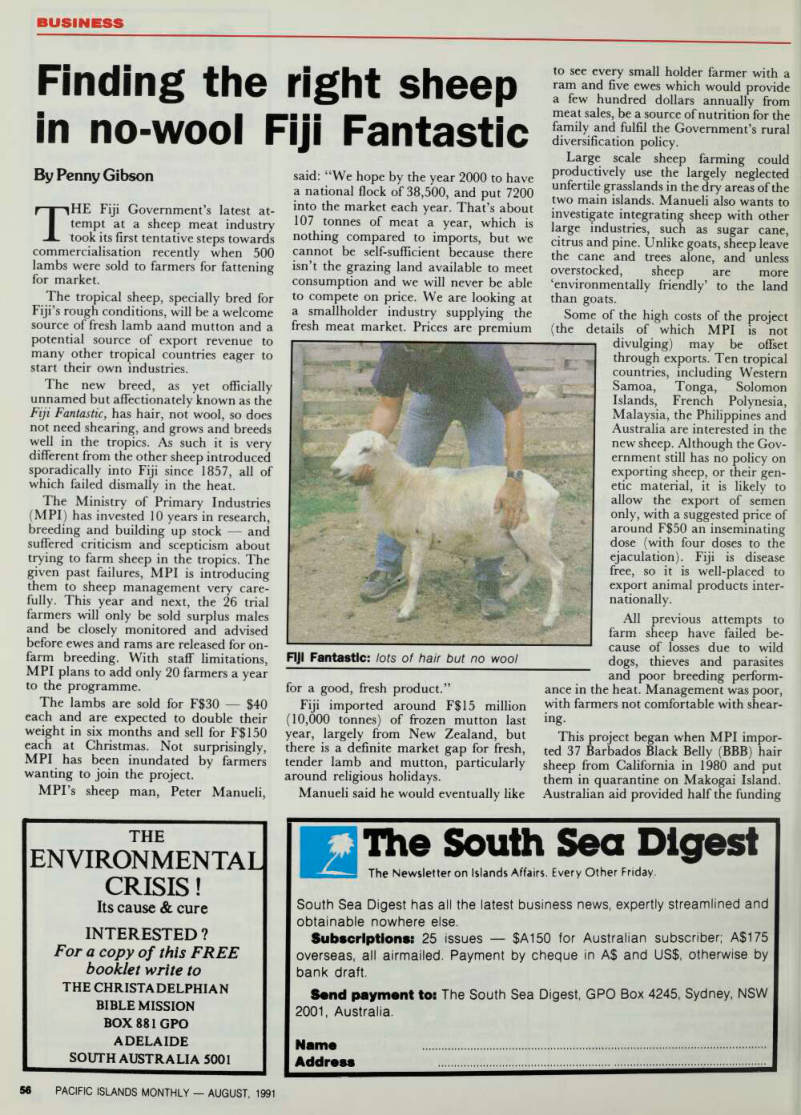
The new breed, as yet officially unnamed but affectionately known as the Fiji Fantastic, has hair, not wool, so does not need shearing, and grows and breeds well in the tropics. As such it is very different from the other sheep introduced sporadically into Fiji since 1857, all of which failed dismally in the heat.
The Ministry of Primary Industries (MPI) has invested 10 years in research, breeding and building up stock and suffered criticism and scepticism about trying to farm sheep in the tropics. The given past failures, MPI is introducing them to sheep management very care fully. This year and next, the 26 trial farmers will only be sold surplus males and be closely monitored and advised before ewes and rams are released for on farm breeding. With staff limitations, MPI plans to add only 20 farmers a year to the programme.
The lambs are sold for Fs3o S4O each and are expected to double their weight in six months and sell for FSISO each at Christmas. Not surprisingly, MPI has been inundated by farmers
wanting to join the project.
MPl’s sheep man, Peter Manueli,
said: “We hope by the year 2000 to have a national flock of 38,500, and put 7200 into the market each year. That’s about 107 tonnes of meat a year, which is
nothing compared to imports, but we
cannot be self-sufficient because there isn’t the grazing land available to meet consumption and we will never be able to compete on price. We are looking at a smallholder industry supplying the fresh meat market. Prices are premium
for a good, fresh product.”
Fiji imported around Fsls million (10,000 tonnes) of frozen mutton last year, largely from New Zealand, but there is a definite market gap for fresh, tender lamb and mutton, particularly around religious holidays.
Manueli said he would eventually like
to see every small holder farmer with a ram and five ewes which would provide a few hundred dollars annually from meat sales, be a source of nutrition for the family and fulfil the Government’s rural
diversification policy.
Large scale sheep farming could
productively use the largely neglected unfertile grasslands in the dry areas of the two main islands. Manueli also wants to
investigate integrating sheep with other
large industries, such as sugar cane, citrus and pine. Unlike goats, sheep leave the cane and trees alone, and unless overstocked, sheep are more ‘environmentally friendly’ to the land than goats.
Some of the high costs of the project (the details of which MPI is not
divulging) may be offset through exports. Ten tropical countries, including Western Samoa, Tonga, Solomon Islands, French Polynesia, Malaysia, the Philippines and Australia are interested in the new sheep. Although the Gov ernment still has no policy on exporting sheep, or their gen etic material, it is likely to allow the export of semen only, with a suggested price of around Fsso an inseminating dose (with four doses to the ejaculation). Fiji is disease free, so it is well-placed to export animal products inter nationally.
All previous attempts to farm sheep have failed be cause of losses due to wild dogs, thieves and parasites and poor breeding perform
ance in the heat. Management was poor, with farmers not comfortable with shear ing.
This project began when MPI impor
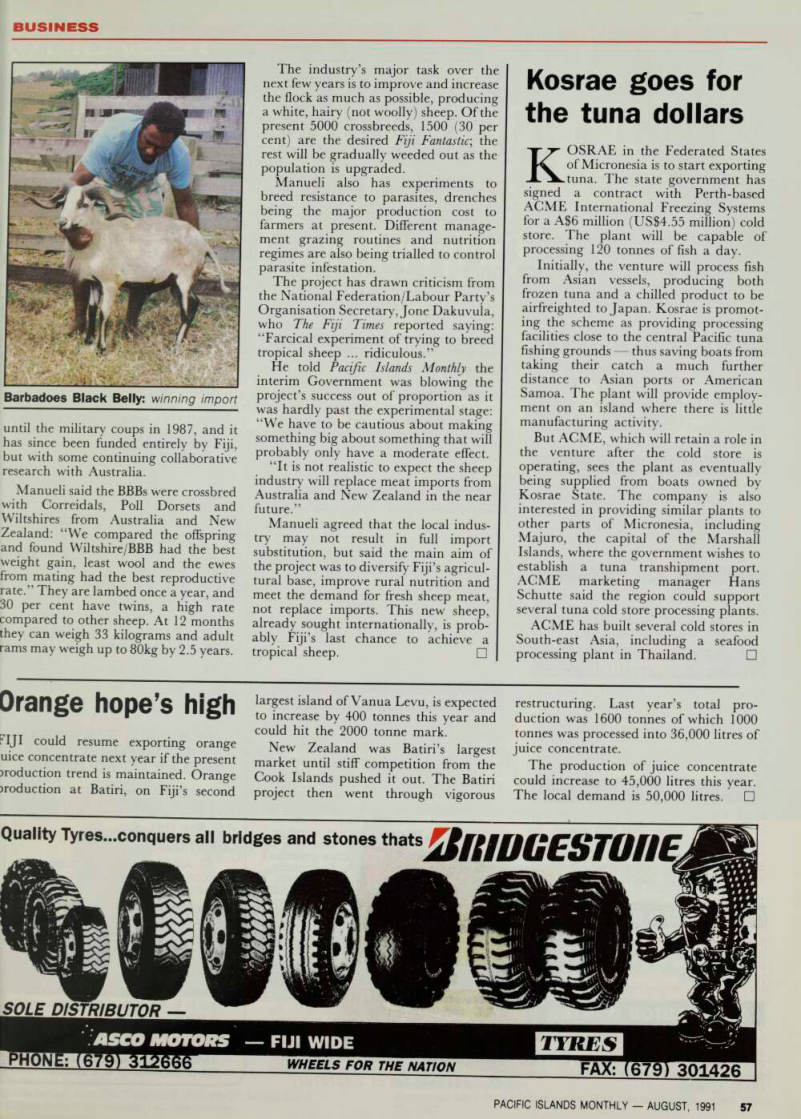
ted 37 Barbados Black Belly (BBB) hair sheep from California in 1980 and put them in quarantine on Makogai Island.
Australian aid provided half the funding
FIJI Fantastic: lots of hair but no wool
until the military coups in 1987, and it has since been funded entirely by Fiji, but with some continuing collaborative research with Australia.
Manueli said the BBBs were crossbred with Correidals, Poll Dorsets and Wiltshires from Australia and New Zealand: “We compared the offspring and found Wiltshire/888 had the best weight gain, least wool and the ewes from mating had the best reproductive rate.” They are lambed once a year, and 30 per cent have twins, a high rate compared to other sheep. At 12 months they can weigh 33 kilograms and adult rams may weigh up to 80kg by 2.5 years.
The industry’s major task over the next few years is to improve and increase the flock as much as possible, producing a white, hairy (not woolly) sheep. Of the present 5000 crossbreeds, 1500 (30 per cent) are the desired Fiji Fantastic, the rest will be gradually weeded out as the population is upgraded.
Manueli also has experiments to breed resistance to parasites, drenches being the major production cost to farmers at present. Different manage ment grazing routines and nutrition regimes are also being trialled to control parasite infestation.
The project has drawn criticism from the National Federation/Labour Party’s
Organisation Secretary, Jone Dakuvula,
who The Fiji Times reported saying; “Farcical experiment of trying to breed tropical sheep ... ridiculous.”
He told Pacific Islands Monthly the interim Government was blowing the project’s success out of proportion as it was hardly past the experimental stage: “We have to be cautious about making
something big about something that will
probably only have a moderate effect.
“It is not realistic to expect the sheep industry will replace meat imports from Australia and New Zealand in the near future.”
Manueli agreed that the local indus try may not result in full import substitution, but said the main aim of the project was to diversify Fiji’s agricul tural base, improve rural nutrition and meet the demand for fresh sheep meat,
not replace imports. This new sheep,
already sought internationally, is prob
ably Fiji’s last chance to achieve a
tropical sheep. □
Barbadoes Black Belly: winning import